



Ecosystem Change and Disturbance
Ecosystem Change and Disturbance
Learn more about FORT research on ecosystem change and disturbance.
Ecosystem change research in support of the Department of the Interior
Ecosystem change research in support of the Department of the Interior
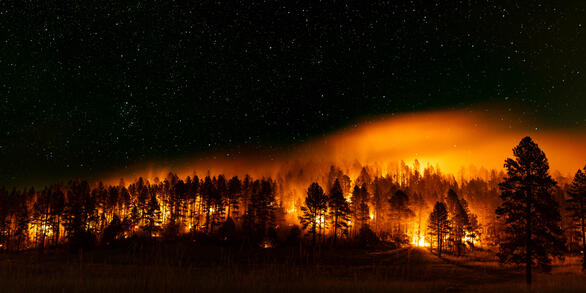
FORT researchers provide sound science to support the Department of the Interior in its efforts to manage wildfires, conserve water, reclaim public lands for multiple uses, and promote food security.
Filter Total Items: 111

Native Pollinators in Agricultural Ecosystems
Beginning in 2012, the USGS collaborated with the USDA to assess the effectiveness of pollinator plantings and how alteration of landscapes has affected native pollinators and potentially contributed to their decline. The 2008 Farm Bill recognized contributions made by pollinators and made conservation of pollinator habitat a priority. The USGS is assessing native bee habitat, diversity, and...

Assessing Threats to Conservation Priority Areas in State Wildlife Action Plans
States across the U.S. have developed Wildlife Action Plans, with the purpose of preventing future listings under the federal Endangered Species Act. Habitat loss and fragmentation are key threats to wildlife in the U.S., and housing development is a major driver of both. USGS is working to quantify the vulnerability of and threat to priority areas in State Wildlife Action Plans from future...

Higher and Farther: Patterns of Development within Protected Areas
There is a well-known bias in the location of protected areas both within the US and globally. Lands protected for conservation tend to be located on less productive soils at high elevations far from cities. USGS is exploring whether this ‘high and far’ paradigm applies within protected areas as well. That is, does human modification within lands that already have some degree of protection, also...

Developing Broad Scale Indicators for Monitoring Ecosystems and Landscapes
Many issues currently facing the Bureau of Land Management (BLM) and other large land managers span large landscapes, including sage-grouse conservation, wildfires, and energy development. Such challenges involve changes at both local and broad scales, but monitoring has typically focused at the scale of individual sites. The USGS is working to develop broad-scale indicators for monitoring...

Science Support for Implementing a Landscape Approach to Resource Management in the Bureau of Land Management
The Bureau of Land Management (BLM) is committed to implementing a landscape approach to resource management to help achieve sustainable social, environmental, and economic outcomes on the public lands it manages. USGS is providing science support for the effort, including identifying core principles of a landscape approach, demonstrating the benefits of multiscale data for evaluating potential...

Riparian Ecology
Riparian ecologists at the Fort Collins Science Center study interactions among flow, channel change, and vegetation along rivers across the western United States and worldwide. Our work focuses on issues relevant to the management of water and public lands, including dam operation, invasive species, and ecological restoration. Investigations take place on a range of scales. For example...

Riparian Vegetation Response to Dam Removal
Dam removal is an approach to river restoration that is becoming increasingly common. In most cases, dam removal is driven by considerations other than river restoration like dam safety, but how dam removal affects aquatic and riparian systems is of great interest in many dam removals. Scientists work in this area has had two areas of focus thus far: 1) studies of vegetation and geomorphic change...

Energy Development and Changing Land Uses
Applied research and integrated regional assessments emphasize spatially explicit analyses of ecosystem components affected by energy development and land-use change in the western United States. Topics include sagebrush-steppe ecology; sagebrush habitat assessments; the effects of human activities (including energy development, transportation, and recreation) on habitats and wildlife behavior...

Wyoming Landscape Conservation Initiative: Inventory and Long-Term Monitoring
The Wyoming Landscape Conservation Initiative (WLCI) addresses effects of land-use and habitat changes on Southwest Wyoming’s natural resources. In partnership with twelve Federal, State, and local natural resource agencies, and non-governmental organizations– FORT and ten other USGS centers are conducting dozens of integrated science projects to assess the status of Southwest Wyoming’s natural...

Wyoming Landscape Conservation Initiative: Mechanistic Studies of Wildlife
The Wyoming Landscape Conservation Initiative (WLCI) addresses effects of land-use and habitat changes on Southwest Wyoming’s natural resources. In partnership with twelve Federal, State, and local natural resource agencies, and non-governmental organizations– FORT and ten other USGS centers are conducting dozens of integrated science projects to assess the status of Southwest Wyoming’s natural...

Wyoming Landscape Conservation Initiative: Baseline Synthesis
The Wyoming Landscape Conservation Initiative (WLCI) addresses effects of land-use and habitat changes on Southwest Wyoming’s natural resources. In partnership with twelve Federal, State, and local natural resource agencies, and non-governmental organizations– FORT and ten other USGS centers are conducting dozens of integrated science projects to assess the status of Southwest Wyoming’s natural...
Wyoming Landscape Conservation Initiative: Effectiveness Monitoring
The Wyoming Landscape Conservation Initiative (WLCI) addresses effects of land-use and habitat changes on Southwest Wyoming’s natural resources. In partnership with twelve Federal, State, and local natural resource agencies, and non-governmental organizations– FORT and ten other USGS centers are conducting dozens of integrated science projects to assess the status of Southwest Wyoming’s natural...