



Ecosystem Change and Disturbance
Ecosystem Change and Disturbance
Learn more about FORT research on ecosystem change and disturbance.
Ecosystem change research in support of the Department of the Interior
Ecosystem change research in support of the Department of the Interior
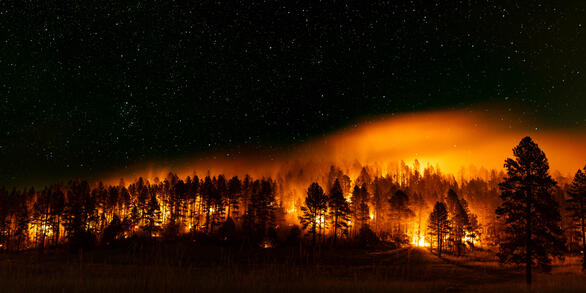
FORT researchers provide sound science to support the Department of the Interior in its efforts to manage wildfires, conserve water, reclaim public lands for multiple uses, and promote food security.
Filter Total Items: 111

Mapping Grassland Bird Community Distribution under a Changing Landscape
Researchers from the U.S. Geological Survey, the U.S. Department of Agriculture-Agricultural Research Service, and University of Arizona are studying the distribution of grassland bird communities across the western Great Plains to anticipate how species distributions may respond to a changing landscape.

Long-term, Place-based, Science and Ecological Monitoring
For over 30 years we have monitored the ecosystem dynamics of the mesas and mountains of northern New Mexico, co-located with mangers. We use a place-based science approach, defined as “science that is founded on long-term, repeated, field data and observations, as well as traditional knowledges, and regularly engages local managers and community members.” This approach enables us to provide land...

Invasive Annual Grass (IAG) Spatial Dataset Compilation and Synthesis
USGS is working closely with partners in the Bureau of Land Management (BLM), U.S. Fish and Wildlife Service (USFWS), and the Intermountain West Joint Venture (IMJV) to collect and summarize spatial datasets that describe measurable aspects of invasive annual grasses (e.g., biomass or presence) across the western United Stated and beyond. The products developed through this project provide...

Optimization of Management Actions for Restoration Success and Wildlife Populations
USGS researchers, in collaboration with the Wyoming Landscape Conservation Initiative and other partners, are developing a statistically based prioritization tool that will aid agencies in their management decisions.

Contributions to the development of the Western Association of Fish and Wildlife Agencies Sagebrush Conservation Strategy
USGS scientists are contributing to the development of the Western Association of Fish and Wildlife Agencies Sagebrush Conservation Strategy, a strategy intended to provide guidance so that efforts to conserve the iconic greater sage-grouse can be expanded to the entire sagebrush biome to benefit the people and wildlife that depend on it.

Forecasting the Spatiotemporal Dynamics of Sagebrush in Wyoming Under a Changing Climate
Prioritizing landscapes for sage-grouse habitat conservation is complicated by long-term changes in climate.

Defining Multi-Scaled Functional Landscape Connectivity for the Sagebrush Biome to Support Management and Conservation Planning of Multiple Species
USGS and Colorado State University scientists are modelling multispecies connectivity through intact and disturbed areas of the sagebrush landscape.

Greater Sage-Grouse and Mule Deer Population Viability Analysis Across Scales
USGS and Colorado State University scientists will use data about sage-grouse and mule deer population data across Wyoming to evaluate the effectiveness of disturbance thresholds and investigate the efficacy of other disturbance metrics.

Using the Past and the Present To Understand Fire Ecology in the Range of the Gunnison Sage-Grouse
Little is known about the role of fire in the sagebrush ecosystem within the range of the Gunnison sage-grouse ( Centrocercus minimus), and fire has been mostly absent from these systems in the 20th century, partially owing to active fire suppression.

Using Long-Term Remote Sensing and an Automated Reference Toolset To Estimate and Predict Post-Development Recovery Potential
USGS scientists are using a time-varying approach to monitor and predict recovery of sagebrush ecosystems following disturbance.

Greater Sage-Grouse Science (2015–17): Synthesis and Potential Management Implications
USGS led an interagency team of Federal and State agency biologists to develop a report that synthesizes greater sage-grouse scientific literature.

Smart Energy Development: Tools for Informed Development & Successful Reclamation
The USGS is developing science and decision support tools to inform policy and management decisions about various aspects of the energy development life cycle.