



Ecosystem Change and Disturbance
Ecosystem Change and Disturbance
Learn more about FORT research on ecosystem change and disturbance.
Ecosystem change research in support of the Department of the Interior
Ecosystem change research in support of the Department of the Interior
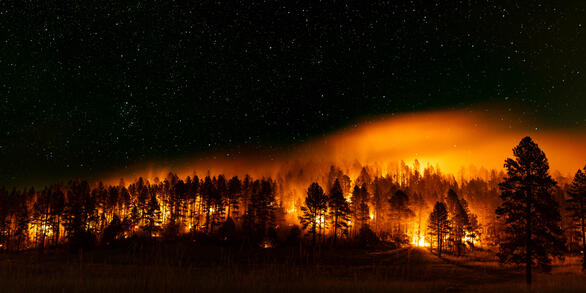
FORT researchers provide sound science to support the Department of the Interior in its efforts to manage wildfires, conserve water, reclaim public lands for multiple uses, and promote food security.
Filter Total Items: 111

Predicting the phenology of invasive grasses under a changing climate to inform mapping and management
Cheatgrass, an invasive annual grass, reduces ecosystem productivity, negatively impacts biodiversity, and is increasingly problematic in higher elevation ecosystems with climate change. Cheatgrass phenology (that is, the timing of yearly growth and lifespan) varies greatly with elevation, climate, and weather from year to year, which can make management planning difficult and reduce the ability...

Understanding How Vehicular Traffic Impacts Sage-Grouse Populations In Wyoming
In 2021, the Fort Collins Science Center initiated a research effort to 1) assess how traffic in Wyoming has impacted sage-grouse population growth rates, 2) identify the spatial scales at which these effects are most evident, and 3) identify what levels of traffic result in sage-grouse population declines.

Road Ecology
Roads and their associated infrastructure can cause substantial and pervasive effects on adjacent ecosystems but are necessary for the movement and redistribution of goods, people, wealth, and natural resources in modern societies. The Fort Collins Science Center has initiated research looking at how roads and traffic may be impacting sagebrush ecosystems and the wildlife inhabiting them. This...

Synthesis and Forecasts of Piñon-Juniper Woodland Die-off
Drought, hotter temperatures, and insect outbreaks are affecting dryland ecosystems across the globe. Pinon-juniper (PJ) woodlands are a widespread vegetation type common to drylands of North America, which have been hit particularly hard by a warming climate. Specifically, mass tree die-off events are transforming PJ woodland structure, composition, and distributions. This project aims to...

Prioritizing conifer removal for multi-species outcomes
Wildlife management is frequently conducted to benefit a single species, despite evidence that suggests such an approach often fails to adequately address the needs of other species within a region. Managing for multiple species’ habitat requirements is even more critical when large scale habitat management efforts change vegetation conditions at the landscape scale, or when management occurs at...

Soil-climate for Managing Sagebrush Ecosystems
Soil-climate describes the temperature and moisture conditions important for plant growth and function. Soil condition patterns determine which vegetation is most abundant, thus controlling which habitats, invasive species, fuels, and economic activities are present in a region. Here, we use a model to simulate the vertical movement of water in a soil profile to provide insights into landscape...

Climate Averages of Soil-climate for Sagebrush Ecosystems
Soil conditions are a key part of functioning ecosystem and affect the distribution and abundance of plants, forage production, and habitat patterns. The distribution of soil conditions, as well as other environmental factors such as precipitation, temperature, geology, topography, and vegetation determine the patterns and dynamics of wildlife habitats and biodiversity across the landscape. We...

Assessing invasive annual grass treatment efficacy across the sagebrush biome
We are using existing datasets that span broad spatial and temporal extents to model the efficacy of invasive annual grass treatments across the sagebrush biome and the influence of environmental factors on their success. The models we develop will be used to generate maps of predicted treatment efficacy across the biome, which will be integrated into the Land Treatment Exploration Tool for land...

Understanding Population Trends for the Gunnison Sage-Grouse to Inform Adaptive Management
In partnership with the Bureau of Land Management and Colorado Parks and Wildlife, scientists from USGS Fort Collins Science Center and Western Ecological Research Center are applying a hierarchical monitoring framework to Gunnison sage-grouse ( Centrocercus minimus) to evaluate population trends and inform adaptive management.

Wild horse and livestock influences on vegetation and wildlife in sagebrush ecosystems: Implications for refining and validating Appropriate Management Level (AML)
USGS researchers are conducting a comprehensive study of wild horse and livestock records across the greater sage-grouse range to investigate impacts on vegetation and wildlife (specifically, sage-grouse and songbirds). Researchers will use these results to evaluate Appropriate Management Levels for wild horse and burros, and projections of vegetation productivity under changing conditions.

Using simulation models to project and evaluate post-fire success in restoring sage-grouse habitat over large landscapes
Wildfires are increasingly destroying wildlife habitat in sagebrush ( Artemisia species) ecosystems, and managers need approaches to scope the pace and degree to which post-fire restoration actions can re-create habitat in dynamic landscapes. Sagebrush recovery takes a long time, and it can be difficult to anticipate restoration outcomes over large, diverse landscapes that have experienced decades...

Simulating the influence of sagebrush restoration on post-fire sage-grouse population recovery
Increased wildfire-induced loss of sagebrush in North American shrublands are outpacing natural recovery and leading to substantial habitat loss for sagebrush-obligate species like sage-grouse. Transplanting sagebrush ( Artemisia species) is a possible strategy for revegetating burned areas, but little is known about sage-grouse or other wildlife responses to restoration strategies.