



Ecosystem Change and Disturbance
Ecosystem Change and Disturbance
Learn more about FORT research on ecosystem change and disturbance.
Ecosystem change research in support of the Department of the Interior
Ecosystem change research in support of the Department of the Interior
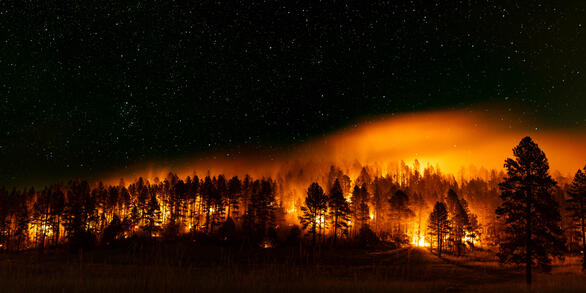
FORT researchers provide sound science to support the Department of the Interior in its efforts to manage wildfires, conserve water, reclaim public lands for multiple uses, and promote food security.
Filter Total Items: 111

Fostering greater use of habitat models for managing rare and invasive plants on public lands
Habitat models can provide critical information on the current and potential distribution of plant species, as well as help target and support conservation efforts. Despite their potential utility in public land management, model use may be constrained by a variety of factors including staff access to and trust in models. In this project, we seek to bring together model users and model developers...

Economic Implications of Sagebrush Treatment and Restoration Practices Across the Great Basin and Wyoming
USGS and Colorado State University researchers are conducting analyses and predictions of sagebrush recovery in the Great Basin and Wyoming and assess the role of weather, soils, and reseeding treatments.

Economic assessment of addressing annual invasive grasses across the sagebrush biome
This interdisciplinary project combines expert judgment on treatment costs with spatially explicit ecological modeling to estimate the financial resources needed to address the threat of invasive annual grass across the entire sagebrush biome. Results of the assessment will provide economic insights that can inform cost-effective resource allocation to efficiently achieve sagebrush conservation...

Creating range-wide predictive maps of Greater Sage-Grouse seasonal habitats
Through a collaborative effort with multiple state and federal agencies, university researchers, and individual stakeholders, we are producing a set of predictive seasonal habitat maps for greater sage-grouse ( Centrocercus urophasianus) spanning the entirety of the species’ U.S. distribution. This is the largest habitat modeling effort of its kind for the species and uses a large, compiled...

Geology, Geophysics, and Geochemistry Stable Isotope Laboratory (GSIL)
The GSIL is a state-of-the-art facility located on the Denver Federal Center that specializes in the measurement of light stable isotope — Hydrogen (H), Carbon (C), Nitrogen (N), Oxygen (O), and Sulfur (S) — compositions and other chemical and biomarker analytes in matrices relevant to the Earth sciences. Chemical and isotopic tracers offer novel insights into ecosystem biogeochemistry, food webs...

Food Webs and Wildlife Nutrition
Wildlife nutrition is an essential element of fitness, and contextualizing resource use within the broader framework of local and regional food webs is paramount to species health, function, and management.

Reconstructing Flow History From Riparian Tree Rings
FORT aquatic scientists analyze rings of riparian trees relating tree growth and establishment to historical flow. They then use the tree rings to reconstruct the flow in past centuries. Flow reconstructions discover the frequency and magnitude of past droughts and floods—information that is essential for management of rivers and water supplies. They have pioneered the use of cottonwood, a...

Integrated River and Riparian Ecosystem Studies
FORT scientists study interactions among river flow, riparian vegetation and channel change at low elevations across the western United States. Cooperators include the National Park Service, Bureau of Land Management, U.S. Fish and Wildlife Service and Bureau of Reclamation. Research areas include reservoir management, control of invasive species, drought response and flood erosion after fires...

FORT Cottonwood Common Garden
FORT scientists established a Common Garden at the Colorado State Forest Service Nursery in Fort Collins, Colorado in 2005 to study the phenology of riparian cottonwood in relation to annual variation in temperature. Phenology is the seasonal timing of life history events including leaf opening, flowering, seed release, bud formation and leaf senescence.

Environmental Stressors
Environmental stressors that impact habitat and wildlife species include: abiotic factors (for example, land use, temperature); soil, air, and water quality (for example, eutrophication, contaminants); and disturbance (for example, fire, drought, hurricanes, species invasions). Understanding how these stressors impact ecosystems is critical to conservation and management.

Agricultural Practices
Agricultural lands account for more than 50% of the lower 48 states and the effects of agricultural land use reach beyond individual fields and farms affecting terrestrial and migratory wildlife. Thus, it is important to know what long-term benefits US Department of Agriculture (USDA) conservation programs and policies have on wildlife habitat and the American public. The USDAs Conservation...

Assessing vegetation and avian community response to juniper reduction treatments in Southwest Montana
The Southwest Montana Sagebrush Partnership (SMSP) team, including land managers, landowners, and scientists, is implementing conifer removal projects encompassing over 55,000 acres of private, state, and federal lands throughout the region. To date, little place-based information exists regarding likely vegetation and bird responses to such treatments in Southwestern Montana. To address this...