



Ecosystem Change and Disturbance
Ecosystem Change and Disturbance
Learn more about FORT research on ecosystem change and disturbance.
Ecosystem change research in support of the Department of the Interior
Ecosystem change research in support of the Department of the Interior
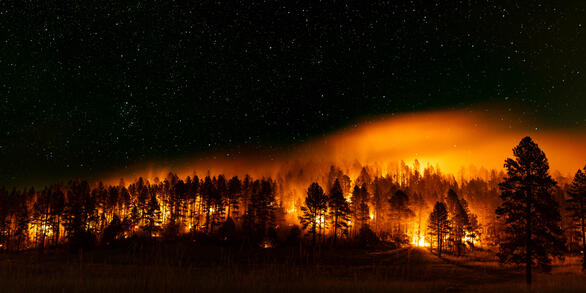
FORT researchers provide sound science to support the Department of the Interior in its efforts to manage wildfires, conserve water, reclaim public lands for multiple uses, and promote food security.
Filter Total Items: 111

Effects of the herbicide, Indaziflam, on invasive annual grasses
Invasive annual grasses are spreading across the sagebrush ecosystem, threatening the survival of native plant species and the wildlife habitats they support. Researchers from the U.S. Geological Survey, Colorado State University, University of Wyoming, the Bureau of Land Management, National Park Service, and the U.S. Fish and Wildlife Service are collaboratively investigating the factors that...

Mapping wild horse densities across broad landscapes of the Western United States
Researchers at USGS are using historical wild horse survey and monitoring records to conduct a study of horse density across sagebrush ecosystems of the western United States. Researchers will develop generalized density maps for the species that will enhance concurrent evaluations into the ecological effects of wild horse populations.

Evaluating potential vectors of annual grass invasion
Invasive annual grasses, facilitated by a range of disturbances, are invading many areas within the sagebrush biome. Researchers from the U.S. Geological Survey, Colorado State University, U.S. Fish and Wildlife Service and the Bureau of Land Management are investigating which non-fire disturbances are most associated with the spread of invasive grasses. The findings from this study could guide...

Assessing the Proliferation, Connectivity, and Consequences of Invasive Fine Fuels on the Sagebrush Biome
Invasive annual grasses can replace native vegetation and alter fire behavior, impacting a range of habitats and species. A team of researchers from the U.S. Geological Survey, Colorado State University, the Bureau of Land Management, and the U.S. Fish and Wildlife Service are working to identify factors that influence changes in the distribution and abundance of invasive annual grasses (IAGs)...

Impacts of changing climate and disturbance regimes on forest ecosystem resilience in the Southern Rocky Mountains
Climate-driven forest disturbances, particularly drought-induced tree mortality and large high-severity fires from increasingly warm and dry conditions, are altering forest ecosystems and the ecosystem services society depends on (e.g., water supplies) in the Southern Rockies and across the Western U.S. We will combine unique, long-term place-based ecological data, diverse methods (e.g., paleo...

Effects of global change on alpine and subalpine ecosystems
Atmospheric nitrogen deposition, changing environmental patterns, and recreation are rapidly altering high elevation ecosystems. This project will evaluate long-term biogeochemical, hydrological, and ecological trends in Rocky Mountain National Park to understand the causes and rates of change in alpine and subalpine waters, soils, and vegetation. Resource managers of high-elevation, protected...

Developing fire science syntheses for wildland fire managers
Federal agencies manage wildland fire in many ways, including broad-scale fire management planning and site-specific fire and fuels management actions. Federal policy requires agencies to use science in fire management planning and environmental effects analyses. However, fire managers have limited time to compile and synthesize science. The USGS is collaborating with fire management staff across...

Predicting Recovery of Sagebrush Ecosystems Across the Sage-grouse Range from Remotely Sensed Vegetation Data
USGS researchers are using remote-sensing and other broadscale datasets to study and predict recovery of sagebrush across the sage-grouse range, assessing influence of disturbance, restoration treatments, soil moisture, and other ecological conditions on trends in sagebrush cover. The results will be used to inform conservation prioritization models, economic analyses, projections of future...

Gunnison Sage-grouse Prioritizing Restoration of Sagebrush Ecosystems Tool (PReSET)
In partnership with the United States Fish and Wildlife Service, and other partners, scientists from USGS Fort Collins Science Center are working to create a suite of prioritization scenarios that will inform adaptive management for Gunnison sage-grouse.

Modeling Songbird Density-Habitat Relationships to Predict Population Responses to Environmental Change Within Pinyon-juniper and Sagebrush Ecosystems
Within areas of overlapping sagebrush and pinyon-juniper ecosystems, wildlife populations are declining due to habitat fragmentation and degradation, changing environments, and human development. However, management to bolster species associated with one ecosystem may result in negative consequences for species associated with the other. Thus, land managers are challenged with balancing which...

Estimating road age and traffic volume for disturbance assessments in Wyoming
In 2021, the Fort Collins Science Center initiated a research effort to estimate road age and annual traffic volumes across the majority of roads in Wyoming for assessing impacts to wildlife. Data on roads often focus on the ‘where’ (for example, spatial features) but neglect the ‘when’ (for example, road age) or ‘how much’ (for example, traffic volume). Knowing these characteristics is critical...

Characterizing greater sage-grouse climate-driven maladaptation
Climate change will expose many species to novel extreme environmental conditions, that may test organisms’ ability to respond to environmental change. Local adaptation, when a species evolves to be more suited for its local environment, can be an indicator of whether a species is likely to persist in the rapidly changing environment. Habitat specialists, like the greater sage-grouse, have evolved...