U.S. flag

An official website of the United States government

Images

Images from the National Wildlife Health Center.

Filter Total Items: 225
Photomicrographs from a mountainous star coral (Montastraea cavernosa) in Florida, USA.

Photomicrographs from a mountainous star coral (Montastraea cavernosa) in Florida, USA. (A) A large cluster of filamentous bacteria are within the gastrovascular space and gastrodermis (asterisk) and extending through mesoglea (arrow) with necrosis and loss of the surface gastrodermis (arrowheads). H&E stain.  Scale bar 200 μm.

Photomicrographs from a mountainous star coral (Montastraea cavernosa) in Florida, USA. (A) A large cluster of filamentous bacteria are within the gastrovascular space and gastrodermis (asterisk) and extending through mesoglea (arrow) with necrosis and loss of the surface gastrodermis (arrowheads). H&E stain.  Scale bar 200 μm.

Photomicrographs from little brown bats, one with square-eared anomaly.
Photomicrographs from little brown bats, one with square-eared anomaly, found dead in Montana, USA.

Photomicrographs from an unaffected Little Brown Bat (M. lucifugus; A-B) and Little Brown Bat found dead in Montana, USA with the square-eared anomaly (C-E). Periodic Acid Schiff-Hematoxylin. (A) Pinna of an unaffected Little Brown Bat showing the epidermis (e and arrow), dermis (d) and central elastic cartilage plate (c).

Photomicrographs from an unaffected Little Brown Bat (M. lucifugus; A-B) and Little Brown Bat found dead in Montana, USA with the square-eared anomaly (C-E). Periodic Acid Schiff-Hematoxylin. (A) Pinna of an unaffected Little Brown Bat showing the epidermis (e and arrow), dermis (d) and central elastic cartilage plate (c).

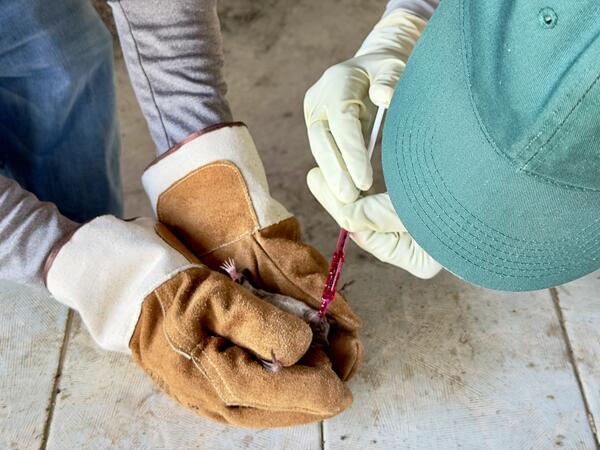
Photographs from a Little Brown Bat (Myotis lucifugus) found dead in Montana, USA.

Photographs from a Little Brown Bat (Myotis lucifugus) found dead in Montana, USA (A, B, D). (A) Multiple foci of depigmentation (arrowheads) measuring up to 3 mm in diameter are present on the patagia. (B) Under ultraviolet light, there is a single pinpoint focus of orange fluorescence (arrowhead) and multiple pinpoint foci of blue fluorescence (arrow).

Photographs from a Little Brown Bat (Myotis lucifugus) found dead in Montana, USA (A, B, D). (A) Multiple foci of depigmentation (arrowheads) measuring up to 3 mm in diameter are present on the patagia. (B) Under ultraviolet light, there is a single pinpoint focus of orange fluorescence (arrowhead) and multiple pinpoint foci of blue fluorescence (arrow).

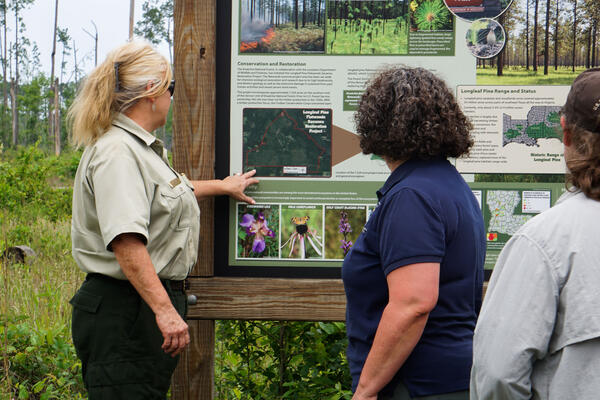
Forest Supervisor talks with USFWS about flatwoods

Kisatchie National Forest Supervisor talks with U.S. Fish and Willdlife Service employees about a flatwoods project site in the forest May 7, 2024.

Kisatchie National Forest Supervisor talks with U.S. Fish and Willdlife Service employees about a flatwoods project site in the forest May 7, 2024.

Photomicrographs of the small intestine from a Western gull showing parasites in intestinal wall.
Photomicrographs of the small intestine from a Western gull (Larus occidentalis) from California, USA

Photomicrographs of the small intestine from a Western gull (Larus occidentalis) from California, USA. H & E stain. (A) Expanding the small intestinal lumen and distorting intestinal villi are multiple adult metazoan parasites (arrow); similar parasites are within cavitations in the intestinal wall or serosa (arrowhead).

Photomicrographs of the small intestine from a Western gull (Larus occidentalis) from California, USA. H & E stain. (A) Expanding the small intestinal lumen and distorting intestinal villi are multiple adult metazoan parasites (arrow); similar parasites are within cavitations in the intestinal wall or serosa (arrowhead).

Intestinal serosa from a Western gull showing Acanthocephaliasis.
Photographs from a Western gull (Larus occidentalis) in California, USA

Photographs from a Western gull (Larus occidentalis) in California, USA. (A) On the intestinal serosa are multifocal 1-mm diameter firm white nodules (arrows). A white fungal plaque (white arrow) also overlies the serosa.

Photographs from a Western gull (Larus occidentalis) in California, USA. (A) On the intestinal serosa are multifocal 1-mm diameter firm white nodules (arrows). A white fungal plaque (white arrow) also overlies the serosa.

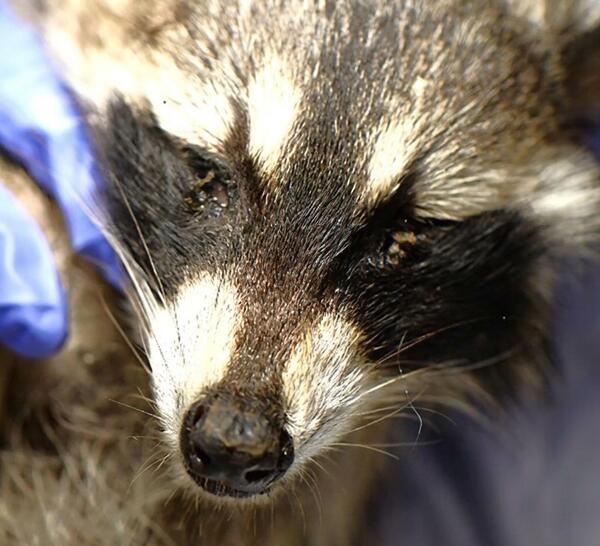
Photos showing discard on raccoon eye, crusty nasal planum, and lesions in airway.
Photographs and photomicrographs from a Common Raccoon (Procyon lotor) found dead in Wisconsin

Photographs and photomicrographs from a Common Raccoon (Procyon lotor) found dead in Wisconsin, USA. (A) There is green-gray mucoid discharge around the eyes and the nasal planum is crusty (arrows).

Images of tissues from a gull showing lesions and bacteria.
Tissue from a gull (Larus sp) from Wisconsin

Tissue from a gull (Larus sp) from Wisconsin. (A) Diffusely the pericardium (star) is greatly expanded by fibrin, edema and necrotic debris (H&E). (B) Lymphoplasmacytic myositis (arrows) creating linear lesions along fascial planes of the pectoral skeletal muscle (H&E).

Tissue from a gull (Larus sp) from Wisconsin. (A) Diffusely the pericardium (star) is greatly expanded by fibrin, edema and necrotic debris (H&E). (B) Lymphoplasmacytic myositis (arrows) creating linear lesions along fascial planes of the pectoral skeletal muscle (H&E).

Photomicrographs of the plagiopatagium from a Little Brown Bat showing nematodes.
Photomicrographs of the plagiopatagium from a Little Brown Bat

Photomicrographs of the plagiopatagium from a Little Brown Bat (Myotis lucifugus) captured live in Wyoming, U.S.A. (A) Adult nematodes (asterisks) are present in the dermis. They are filled with larval nematodes (arrowhead). The overlying epidermis is hyperplastic (arrow). H&E stain.

Photomicrographs of the plagiopatagium from a Little Brown Bat (Myotis lucifugus) captured live in Wyoming, U.S.A. (A) Adult nematodes (asterisks) are present in the dermis. They are filled with larval nematodes (arrowhead). The overlying epidermis is hyperplastic (arrow). H&E stain.

Gross photographs from a Cooper’s hawk showing Air sac overlying the lung and liver with yellow to green, irregular nodules.
Gross photographs from a Cooper’s hawk (Accipiter cooperii)

Gross photographs from a Cooper’s hawk (Accipiter cooperii). (A) Air sac overlying the lung and liver have multiple yellow to green, irregular nodules (arrows). (B) Liver (asterisk) has multiple 1 mm, round to irregular, tan nodules in addition to innumerable miliary foci.

Gross photographs from a Cooper’s hawk (Accipiter cooperii). (A) Air sac overlying the lung and liver have multiple yellow to green, irregular nodules (arrows). (B) Liver (asterisk) has multiple 1 mm, round to irregular, tan nodules in addition to innumerable miliary foci.

Photomicrographs showing lesions in Cooper’s hawk soft palate and lung.
Photomicrographs of Cooper’s hawk soft palate and lung

(A) Soft palate of a Cooper’s hawk (Accipiter cooperii). The submucosa is expanded by a myriad of epithelioid macrophages (arrow) surrounding multinucleated giant cells centered on a necrotic center (asterisk). H&E stain. Insert: Intrahistiocytic and extracellular acid-fast bacilli.

(A) Soft palate of a Cooper’s hawk (Accipiter cooperii). The submucosa is expanded by a myriad of epithelioid macrophages (arrow) surrounding multinucleated giant cells centered on a necrotic center (asterisk). H&E stain. Insert: Intrahistiocytic and extracellular acid-fast bacilli.

Photomicrograph at low magnification from elkhorn coral showing flatworm along body wall.
Photomicrograph at low magnification from elkhorn coral (Acropora palmata) found with multifocal tissue loss in the Dominican Republic

Photomicrograph at low magnification from elkhorn coral (Acropora palmata) found with multifocal tissue loss in the Dominican Republic. A flatworm (fw) is present along a multifocally ulcerated coral surface body wall (c) along one polyp. A small amount of cellular debris can be seen within the pharynx (p) of the flatworm.

Photomicrographs of from unknown species of flatworm

Photomicrographs of from unknown species of flatworm. (A) Dorsal detail showing epidermis with rhabdites (black arrowheads) and endosymbionts visible within the flatworm parenchyma (fw).

Photomicrographs of from unknown species of flatworm. (A) Dorsal detail showing epidermis with rhabdites (black arrowheads) and endosymbionts visible within the flatworm parenchyma (fw).

Healthy elkhorn coral tissue next to elkhorn coral with tissue loss shown by atrophic and thin body wall.
Photomicrograph from a healthy example of elkhorn coral side-by-side with elkhorn coral found with multifocal tissue loss

(A) Photomicrograph from a healthy example of elkhorn coral (Acropora palmata). Tall columnar epidermis (E), gastrodermis (g), skeletal space (s), gastrovascular cavity (gvc), and calicodermis (white arrowhead). H&E stain.

Photographs of elkhorn coral show white portions where tissue loss has occurred.
Photographs from an elkhorn coral colony (Acropora palmata) losing tissue on a reef in the Dominican Republic

Photographs from an elkhorn coral colony (Acropora palmata) losing tissue on a reef in the Dominican Republic. (A) Colony in situ with bright white skeleton exposed by multifocal tissue loss (arrowheads) and areas of older tissue loss with algae overgrowth (*).  (B) Submitted samples. Gross lesions are obscured by with loss of pigment with fixation.

Photographs from an elkhorn coral colony (Acropora palmata) losing tissue on a reef in the Dominican Republic. (A) Colony in situ with bright white skeleton exposed by multifocal tissue loss (arrowheads) and areas of older tissue loss with algae overgrowth (*).  (B) Submitted samples. Gross lesions are obscured by with loss of pigment with fixation.

Photographs of Mexican wolf brain showing lesions.
Photographs from a Mexican Wolf (Canis lupus baileyi) euthanized due to neurologic illness in New York

Photographs from a Mexican Wolf (Canis lupus baileyi) euthanized due to neurologic illness in New York, USA. (A) An area of light gray discoloration is present on the surface of the left cranio-dorsal cerebrum (arrow).

Photomicrographs from a Mexican Wolf euthanized due to neurologic illness.

Photomicrographs from a Mexican Wolf (Canis lupus baileyi) euthanized due to neurologic illness in New York, USA. (A) Most of the neoplasm consists of loosely arranged, highly vacuolated stellate cells within a variably fine fibrovascular stroma. (B) An area of necrosis (asterisk) surrounded by pseudopalisading neoplastic cells (arrows).

Photomicrographs from a Mexican Wolf (Canis lupus baileyi) euthanized due to neurologic illness in New York, USA. (A) Most of the neoplasm consists of loosely arranged, highly vacuolated stellate cells within a variably fine fibrovascular stroma. (B) An area of necrosis (asterisk) surrounded by pseudopalisading neoplastic cells (arrows).

Photomicrographs from a Mallard Duck with amyloidosis
Photomicrographs of Amyloidosis in a Mallard Duck

Photomicrographs from a Mallard Duck (Anas platyrhynchos) found dead in Missouri, U.S.A. (A) The glomerular mesangium (asterisk) is expanded by amorphous, eosinophilic, acellular material. H&E stain. (B) Tubules in medullary cones are often surrounded by amorphous, eosinophilic, acellular material. H&E stain.

Photomicrographs from a Mallard Duck (Anas platyrhynchos) found dead in Missouri, U.S.A. (A) The glomerular mesangium (asterisk) is expanded by amorphous, eosinophilic, acellular material. H&E stain. (B) Tubules in medullary cones are often surrounded by amorphous, eosinophilic, acellular material. H&E stain.

Photos of eastern massasauga rattlesnake showing discolored scales and nodule on lung.
Photographs from an eastern massasauga rattlesnake with snake fungal disease

Photographs from an eastern massasauga rattlesnake (Sistrurus catenatus) found lethargic in Wisconsin, U.S.A. (A) There is a 15 x 12 mm area with firm, misshapen, and discolored scales (arrows) on the ventral neck. (B) There is a 10 x 6 focal area of depression with tan to dark red scale discoloration (arrow) on the ventral body.

Photographs from an eastern massasauga rattlesnake (Sistrurus catenatus) found lethargic in Wisconsin, U.S.A. (A) There is a 15 x 12 mm area with firm, misshapen, and discolored scales (arrows) on the ventral neck. (B) There is a 10 x 6 focal area of depression with tan to dark red scale discoloration (arrow) on the ventral body.

Photomicrographs from an eastern massasauga rattlesnake showing necrosis and fungal hyphae.
Photomicrographs from an eastern massasauga rattlesnake (Sistrurus catenatus) from Wisconsin

Photomicrographs from an eastern massasauga rattlesnake (Sistrurus catenatus) from Wisconsin, U.S.A. Periodic acid-Shiff. (A) On the ventral neck are multifocal areas of superficial to mid-epidermal necrosis (arrows). (B) Areas of necrosis often contain ~5-µm diameter branching, septate, PAS-positive fungal hyphae (arrowheads).

Photomicrographs from an eastern massasauga rattlesnake (Sistrurus catenatus) from Wisconsin, U.S.A. Periodic acid-Shiff. (A) On the ventral neck are multifocal areas of superficial to mid-epidermal necrosis (arrows). (B) Areas of necrosis often contain ~5-µm diameter branching, septate, PAS-positive fungal hyphae (arrowheads).

Was this page helpful?