



Wildlife Disease Biologist Ariel Mixon organizes samples and completes datasheets on the tailgate of a truck after conducting avian influenza surveillance work through the National Wildlife Disease Program.
Images
Images from the National Wildlife Health Center.
Filter Total Items: 235
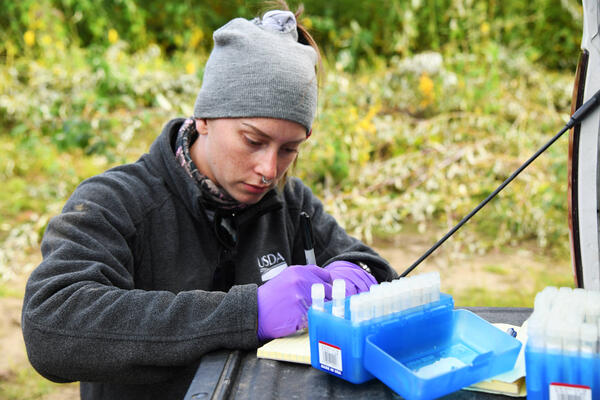
Biologist organizes samples in the field.
Wildlife Disease Biologist Ariel Mixon organizes samples and completes datasheets on the tailgate of a truck after conducting avian influenza surveillance work through the National Wildlife Disease Program.

Biological Sciences Laboratory Technician donning protective gear for SARS-CoV-2 testing
Biological Sciences Laboratory Technician donning protective gear for SARS-CoV-2 testingBiological Sciences Laboratory Technician donning protective gear for SARS-CoV-2 testing in the NWHC Diagnostic Virology Laboratory.
Biological Sciences Laboratory Technician donning protective gear for SARS-CoV-2 testing
Biological Sciences Laboratory Technician donning protective gear for SARS-CoV-2 testingBiological Sciences Laboratory Technician donning protective gear for SARS-CoV-2 testing in the NWHC Diagnostic Virology Laboratory.
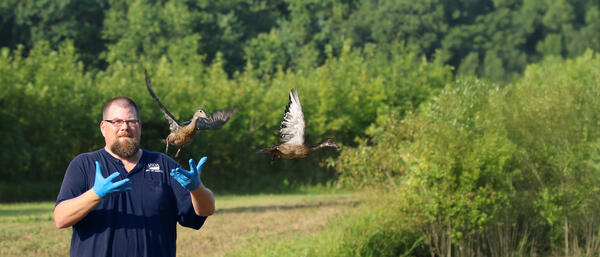
Clint Turnge (USDA) releases wood ducks
Clint Turnge (USDA) releases wood ducks. NWRC Accomplishment Report Photos. In 2016, NWRC's National Wildlife Disease Program sampled more than 21,800 wild birds for highly pathogenic avian influenza (HPAI).
Clint Turnge (USDA) releases wood ducks. NWRC Accomplishment Report Photos. In 2016, NWRC's National Wildlife Disease Program sampled more than 21,800 wild birds for highly pathogenic avian influenza (HPAI).

Photomicrographs from an eastern gray squirrel (Sciurus carolinensis) found dead in Wisconsin
Photomicrographs from an eastern gray squirrel (Sciurus carolinensis) found dead in WisconsinPhotomicrographs from an eastern gray squirrel (Sciurus carolinensis) found dead in Wisconsin, U.S. (A) On low magnification, the cerebrum exhibits areas of hypercellularity (arrows). H&E stain. (B) Detail of A: There is mild lymphoplasmacytic perivascular cuffing (arrowhead) and areas of gliosis (arrow) within the cerebrum.
Photomicrographs from an eastern gray squirrel (Sciurus carolinensis) found dead in Wisconsin
Photomicrographs from an eastern gray squirrel (Sciurus carolinensis) found dead in WisconsinPhotomicrographs from an eastern gray squirrel (Sciurus carolinensis) found dead in Wisconsin, U.S. (A) On low magnification, the cerebrum exhibits areas of hypercellularity (arrows). H&E stain. (B) Detail of A: There is mild lymphoplasmacytic perivascular cuffing (arrowhead) and areas of gliosis (arrow) within the cerebrum.

Photographs and a radiograph from a deceased Northern sea otter
Photographs and a radiograph from a deceased Northern sea otterPhotographs and a radiograph from a Northern sea otter (Enhydra lutris kenyoni) from Oregon, U.S.A. (A) The deceased sea otter on a beach in Oregon, U.S.A.
Photographs and a radiograph from a deceased Northern sea otter
Photographs and a radiograph from a deceased Northern sea otterPhotographs and a radiograph from a Northern sea otter (Enhydra lutris kenyoni) from Oregon, U.S.A. (A) The deceased sea otter on a beach in Oregon, U.S.A.

Photographs from Wild Turkeys (Meleagris gallopavo) found dead in WI
Photographs from Wild Turkeys (Meleagris gallopavo) found dead in WIPhotographs from Wild Turkeys (Meleagris gallopavo) found dead in Wisconsin, USA. (A) The liver contains many multifocal to coalescing bullseye-shaped foci of necrosis (arrows). The ventriculus (*) is labeled for orientation. (B) The paired ceca (*) are ectatic with thickened walls.
Photographs from Wild Turkeys (Meleagris gallopavo) found dead in WI
Photographs from Wild Turkeys (Meleagris gallopavo) found dead in WIPhotographs from Wild Turkeys (Meleagris gallopavo) found dead in Wisconsin, USA. (A) The liver contains many multifocal to coalescing bullseye-shaped foci of necrosis (arrows). The ventriculus (*) is labeled for orientation. (B) The paired ceca (*) are ectatic with thickened walls.

Photomicrographs from Wild Turkeys (Meleagris gallopavo) found dead
Photomicrographs from Wild Turkeys (Meleagris gallopavo) found deadPhotomicrographs from Wild Turkeys (Meleagris gallopavo) found dead in Wisconsin, USA. (A) In the liver, hepatocytes were replaced by macrophages, lymphocytes, and plasma cells (lower left) with occasional multinucleated giant cells (arrows). H&E stain. (B) The cecum contains a fibrinonecrotic membrane effacing the mucosa (arrow).
Photomicrographs from Wild Turkeys (Meleagris gallopavo) found dead
Photomicrographs from Wild Turkeys (Meleagris gallopavo) found deadPhotomicrographs from Wild Turkeys (Meleagris gallopavo) found dead in Wisconsin, USA. (A) In the liver, hepatocytes were replaced by macrophages, lymphocytes, and plasma cells (lower left) with occasional multinucleated giant cells (arrows). H&E stain. (B) The cecum contains a fibrinonecrotic membrane effacing the mucosa (arrow).

Applying hot water to control invasive corallimorphs at Palmyra Atoll National Wildlife Refuge
Applying hot water to control invasive corallimorphs at Palmyra Atoll National Wildlife RefugeUSGS scientists and partners applied hot water as a control method for invasive corallimorphs at Palmyra Atoll National Wildlife Refuge.
Applying hot water to control invasive corallimorphs at Palmyra Atoll National Wildlife Refuge
Applying hot water to control invasive corallimorphs at Palmyra Atoll National Wildlife RefugeUSGS scientists and partners applied hot water as a control method for invasive corallimorphs at Palmyra Atoll National Wildlife Refuge.

Applying toxic paste to control invasive corallimorphs at Palmyra Atoll National Wildlife Refuge
Applying toxic paste to control invasive corallimorphs at Palmyra Atoll National Wildlife RefugeUSGS scientists and partners applied a toothpaste-like compound mixed with sodium hydroxide as a control method for invasive corallimorphs at Palmyra Atoll National Wildlife Refuge.
Applying toxic paste to control invasive corallimorphs at Palmyra Atoll National Wildlife Refuge
Applying toxic paste to control invasive corallimorphs at Palmyra Atoll National Wildlife RefugeUSGS scientists and partners applied a toothpaste-like compound mixed with sodium hydroxide as a control method for invasive corallimorphs at Palmyra Atoll National Wildlife Refuge.

Photographs from red crossbills and American goldfinches from Montana
Photographs from red crossbills and American goldfinches from MontanaPhotographs from red crossbills (Loxia curvirostra; A, C) and American goldfinches (Spinus tristis; B, D) from Montana, U.S.A. (A) A large yellow/tan plaque (asterisk) is present on the mucosal surface of the crop. (B) White seed-like plaques (arrow) are present on the mucosal surface of the crop.
Photographs from red crossbills and American goldfinches from Montana
Photographs from red crossbills and American goldfinches from MontanaPhotographs from red crossbills (Loxia curvirostra; A, C) and American goldfinches (Spinus tristis; B, D) from Montana, U.S.A. (A) A large yellow/tan plaque (asterisk) is present on the mucosal surface of the crop. (B) White seed-like plaques (arrow) are present on the mucosal surface of the crop.

Photomicrographs from a California newt found moribund in California
Photomicrographs from a California newt found moribund in CaliforniaPhotomicrographs from a California newt (Taricha torosa) found moribund in California, USA. (A) Necrosis of the tail tip with exposed vertebral bone (B), hyperplastic epithelial regrowth at the edges (arrowhead), moderate mixed leukocytes and dilated lymphatics (*), and a few osteoclasts remodeling the exposed bone (arrows). H&E stain 4X.
Photomicrographs from a California newt found moribund in California
Photomicrographs from a California newt found moribund in CaliforniaPhotomicrographs from a California newt (Taricha torosa) found moribund in California, USA. (A) Necrosis of the tail tip with exposed vertebral bone (B), hyperplastic epithelial regrowth at the edges (arrowhead), moderate mixed leukocytes and dilated lymphatics (*), and a few osteoclasts remodeling the exposed bone (arrows). H&E stain 4X.

Giant Garter Snake
A giant garter snake (Thamnophis gigas) slithering through grass, photographed during field work in western Oregon.
A giant garter snake (Thamnophis gigas) slithering through grass, photographed during field work in western Oregon.

Chondroma mass on the hock of a sandhill crane
Photographs from a sandhill crane (Antigone canadensis) found dead in Indiana, U.S.A. (A) There is a firm mass on the right cranial hock with a roughened black and tan surface. (B) On cut section, the mass is gelatinous, mottled light pink to gray, and extends to the joint space (arrow).
Photographs from a sandhill crane (Antigone canadensis) found dead in Indiana, U.S.A. (A) There is a firm mass on the right cranial hock with a roughened black and tan surface. (B) On cut section, the mass is gelatinous, mottled light pink to gray, and extends to the joint space (arrow).

Photomicrographs from a sandhill crane found dead in Indiana U.S.A.
Photomicrographs from a sandhill crane found dead in Indiana U.S.A.Photomicrographs from a sandhill crane (Antigone canadensis) found dead in Indiana, U.S.A. (A) The mass is composed of islands of well-differentiated chondrocytes separated by fibrovascular connective tissue. There is minimal cellular pleomorphism and no mitotic figures are seen (inset).
Photomicrographs from a sandhill crane found dead in Indiana U.S.A.
Photomicrographs from a sandhill crane found dead in Indiana U.S.A.Photomicrographs from a sandhill crane (Antigone canadensis) found dead in Indiana, U.S.A. (A) The mass is composed of islands of well-differentiated chondrocytes separated by fibrovascular connective tissue. There is minimal cellular pleomorphism and no mitotic figures are seen (inset).
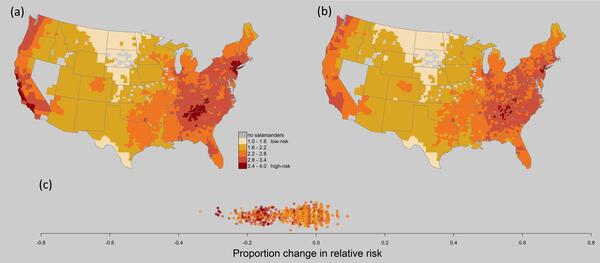
Maps of Bsal risk in the U.S. comparing pre- and post- action risk
Maps of Bsal risk in the U.S. comparing pre- and post- action riskRelative risk maps of combined Bsal risk, comparing (a) pre-action risk (2010–2015), to (b) risk after implementation of surveillance and of importation restrictions on over 200 salamander species. Relative risk scores were scaled to 2010–2015. (c) Change in relative risk score per county as proportion of pre-action risk.
Maps of Bsal risk in the U.S. comparing pre- and post- action risk
Maps of Bsal risk in the U.S. comparing pre- and post- action riskRelative risk maps of combined Bsal risk, comparing (a) pre-action risk (2010–2015), to (b) risk after implementation of surveillance and of importation restrictions on over 200 salamander species. Relative risk scores were scaled to 2010–2015. (c) Change in relative risk score per county as proportion of pre-action risk.

Photomicrograph from a raccoon found sick and euthanized in Texas
Photomicrograph from a raccoon found sick and euthanized in TexasPhotomicrograph from a raccoon (Procyon lotor) found sick and euthanized in Texas, US. (A) A cluster of schistosome ova are present in the pancreas. Ova are thin-shelled and are not operculated. Each viable egg contains a miracidium (arrows). The ova are surrounded by infiltrates of eosinophils, macrophages, and lymphocytes. H&E stain.
Photomicrograph from a raccoon found sick and euthanized in Texas
Photomicrograph from a raccoon found sick and euthanized in TexasPhotomicrograph from a raccoon (Procyon lotor) found sick and euthanized in Texas, US. (A) A cluster of schistosome ova are present in the pancreas. Ova are thin-shelled and are not operculated. Each viable egg contains a miracidium (arrows). The ova are surrounded by infiltrates of eosinophils, macrophages, and lymphocytes. H&E stain.

Rat snake museum specimen
This rat snake is a preserved museum specimen with snake fungal disease that was collected in Tennessee in 1973. The photo was taken at the USGS National Wildlife Health Center in 2017 as part of a study.
This rat snake is a preserved museum specimen with snake fungal disease that was collected in Tennessee in 1973. The photo was taken at the USGS National Wildlife Health Center in 2017 as part of a study.

Nematodes in raccoon tissue
Photographs from a raccoon (Procyon lotor) from Arizona, US. (A) Large tan nematodes (arrowheads) are present within the subcutaneous tissue and muscle fascia in the distal right forelimb. (B) Closer view of the distal right forelimb showing the large tan nematodes (arrowheads).
Photographs from a raccoon (Procyon lotor) from Arizona, US. (A) Large tan nematodes (arrowheads) are present within the subcutaneous tissue and muscle fascia in the distal right forelimb. (B) Closer view of the distal right forelimb showing the large tan nematodes (arrowheads).

Photographs from a wild turkey found dead in Minnesota
Photographs from a wild turkey found dead in MinnesotaPhotographs from a wild turkey (Meleagris gallopavo) found dead in Minnesota, USA. (A) There are numerous multifocal to coalescing yellow proliferative lesions covering the eyelids, head, and neck with a region of ulceration and necrosis (*). (B) Yellow irregular plaques (arrow heads) multifocally cover the oral cavity.
Photographs from a wild turkey found dead in Minnesota
Photographs from a wild turkey found dead in MinnesotaPhotographs from a wild turkey (Meleagris gallopavo) found dead in Minnesota, USA. (A) There are numerous multifocal to coalescing yellow proliferative lesions covering the eyelids, head, and neck with a region of ulceration and necrosis (*). (B) Yellow irregular plaques (arrow heads) multifocally cover the oral cavity.

Photomicrographs from a wild turkey found dead in Minnesota
Photomicrographs from a wild turkey found dead in MinnesotaPhotomicrographs from a wild turkey (Meleagris gallopavo) found dead in Minnesota, USA. (A) The normal epithelium becomes markedly thickened due to hyperplasia of the stratum spinosum (left to right) with regions of ulceration and crusting (arrow). H&E stain.
Photomicrographs from a wild turkey found dead in Minnesota
Photomicrographs from a wild turkey found dead in MinnesotaPhotomicrographs from a wild turkey (Meleagris gallopavo) found dead in Minnesota, USA. (A) The normal epithelium becomes markedly thickened due to hyperplasia of the stratum spinosum (left to right) with regions of ulceration and crusting (arrow). H&E stain.

Photograph & photomicrographs from exotic duck with avian tuberculosis
Photograph & photomicrographs from exotic duck with avian tuberculosisPhotographs and photomicrographs from an exotic duck. (A) Grossly, the spleen is enlarged, firm, and yellow (arrow). Throughout the liver are multifocal to coalescing firm tan nodules (arrowheads). (B) The liver contains multifocal granulomas (asterisk). H&E stain.
Photograph & photomicrographs from exotic duck with avian tuberculosis
Photograph & photomicrographs from exotic duck with avian tuberculosisPhotographs and photomicrographs from an exotic duck. (A) Grossly, the spleen is enlarged, firm, and yellow (arrow). Throughout the liver are multifocal to coalescing firm tan nodules (arrowheads). (B) The liver contains multifocal granulomas (asterisk). H&E stain.