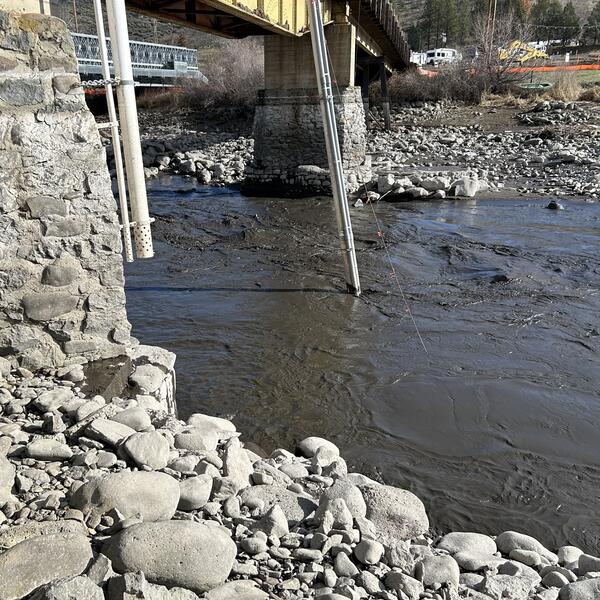
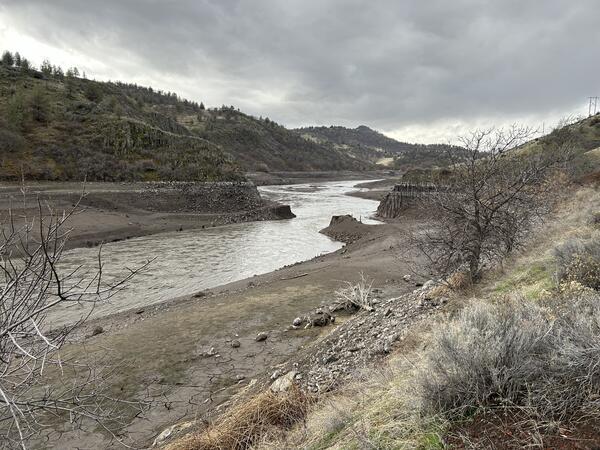
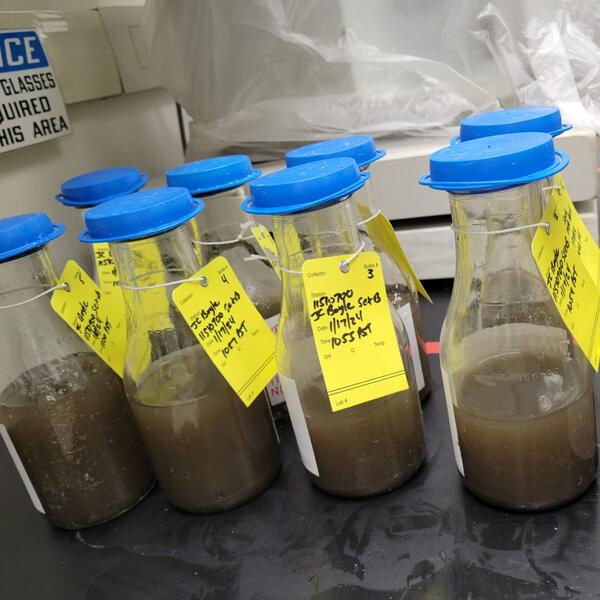
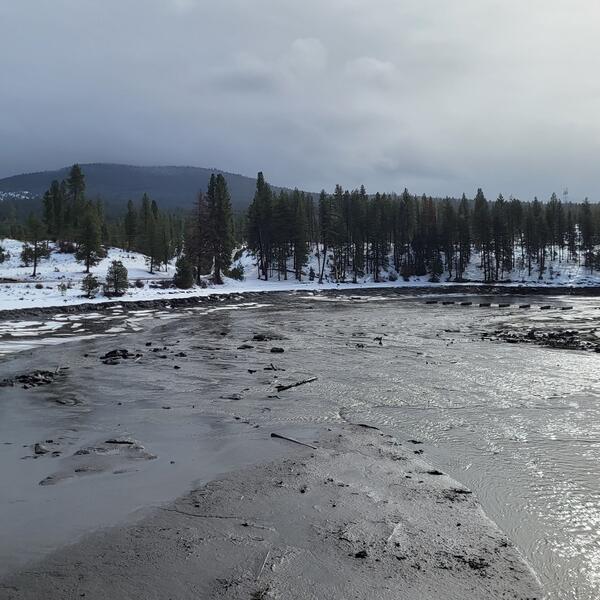
Photo taken during the Green Peter Reservoir drawdown The water is brown due to suspended sediment loads.
Images
Check out photos of some of the awesome work USGS scientists and field technicians have done over the years.
Photo taken during the Green Peter Reservoir drawdown The water is brown due to suspended sediment loads.
River bed-sediment size and distribution is critical for fish spawning habitat. The kayaking scientist in this photo is towing an advanced acoustic instrument that measures river velocity and depth. In addition, a camera captures photos that can be used to create digital elevation models and eventually maps of river bed-sediment size.
Researcher collecting depth, velocity, water surface elevation, and 360 degree imagery on the North Santiam River.
Researchers prep equipment before a river mapping survey on the Niagara section of the North Santiam River.
Following a wet winter, bulrush is shown growing in Malheur Lake. Emergent vegetation like bulrush provides nesting habitat and food resources for birds.
Black angular basalt fragments in the foreground against a backdrop of rolling yellow hills.
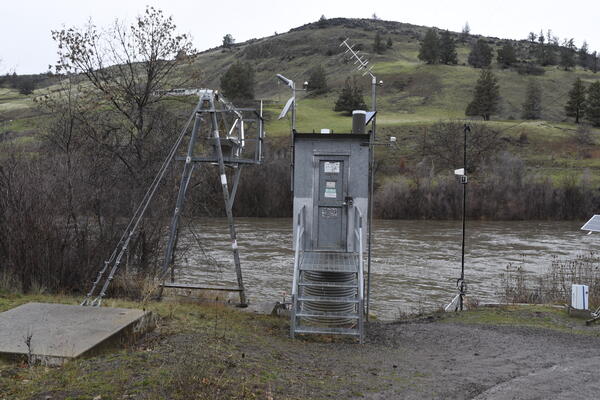
The small house is the monitoring station for Columbia River at The Dalles. The house protects sensitive electronics from the elements.
Substrate Mapping on the Little North Santiam River
Substrate Mapping on the Little North Santiam RiverA substrate mapping survey in action. Scientists aim to map the size and distribution of river sediments.
Substrate Mapping on the Little North Santiam River
Substrate Mapping on the Little North Santiam RiverA substrate mapping survey in action. Scientists aim to map the size and distribution of river sediments.
Native fish populations, like the Chinook salmon during spawning season, rely on the Santiam River.
Water quality sensor inspection - Willamette River
Water quality sensor inspection - Willamette RiverHydrologic technician, Ann McGowan, shows OMSI representative a water quality sensor deployed in the Willamette River near OMSI. This sensor monitors water temperature, dissolved oxygen, chlorophyll, blue green algea, specific conductance and pH. The sensors need cleaned every 4-6 weeks.
Water quality sensor inspection - Willamette River
Water quality sensor inspection - Willamette RiverHydrologic technician, Ann McGowan, shows OMSI representative a water quality sensor deployed in the Willamette River near OMSI. This sensor monitors water temperature, dissolved oxygen, chlorophyll, blue green algea, specific conductance and pH. The sensors need cleaned every 4-6 weeks.
Hydrologist Kurt Carpenter demonstrated gathering a water sample from the Willamette on the docks at OMSI. The netting gets pulled through the water and is then funneled into a sample bottle.
Oregon Water Science Center staff accept centennial monitoring station award
Oregon Water Science Center staff accept centennial monitoring station awardOregon Water Science Center received the award plaques during the 2023 USGS National Data Training Conference in Phoenix Arizona. Pictured right to left: Marc Stewart, Deputy Director for Data, followed by expert hydrologic technicians; Carrie Boudreau, Amarys Acosta, Scott Deweese, and Tasha Albertson-Herberholz.
Oregon Water Science Center staff accept centennial monitoring station award
Oregon Water Science Center staff accept centennial monitoring station awardOregon Water Science Center received the award plaques during the 2023 USGS National Data Training Conference in Phoenix Arizona. Pictured right to left: Marc Stewart, Deputy Director for Data, followed by expert hydrologic technicians; Carrie Boudreau, Amarys Acosta, Scott Deweese, and Tasha Albertson-Herberholz.
Harmful Algae Bloom seen near USGS gage on OMSI docks
Harmful Algae Bloom seen near USGS gage on OMSI docksGreen cyanobacteria in the Willamette River at the new USGS water quality monitor at OMSI.
Harmful Algae Bloom seen near USGS gage on OMSI docks
Harmful Algae Bloom seen near USGS gage on OMSI docksGreen cyanobacteria in the Willamette River at the new USGS water quality monitor at OMSI.
Cyanobacteria in the Willamette River near new USGS water quality monitor at OMSI. Photo courtesy of Kale Clausen (ODEQ).
Streaks of blue-green cyanobacteria in the Willamette River
Streaks of blue-green cyanobacteria in the Willamette RiverStreaks of blue-green cyanobacteria in the Willamette River at the new USGS water-quality monitor at OMSI.
Streaks of blue-green cyanobacteria in the Willamette River
Streaks of blue-green cyanobacteria in the Willamette RiverStreaks of blue-green cyanobacteria in the Willamette River at the new USGS water-quality monitor at OMSI.
Microcyctis aeruginosa is a freshwater cyanobacteria that produce cyanotoxins such as Microcystin. Cyanotoxins are harmful to humans and pets.
Water level and temperature sensor in the Middle Santiam River
Water level and temperature sensor in the Middle Santiam RiverNew USGS water temperature and water level gage installed in Middle Santiam River in the Middle Santiam Wildness Area upstream of Green Peter Dam. This gage will help characterize habitat conditions for multiple life stages of spring Chinook salmon in this river reach.
Water level and temperature sensor in the Middle Santiam River
Water level and temperature sensor in the Middle Santiam RiverNew USGS water temperature and water level gage installed in Middle Santiam River in the Middle Santiam Wildness Area upstream of Green Peter Dam. This gage will help characterize habitat conditions for multiple life stages of spring Chinook salmon in this river reach.
Brandon Overstreet paddles North Santiam River near Narrows Rapid collecting survey data and underwater photographs to characterize channel bed topography and substrates
Preliminary topobathymetric digital elevation model of the Santiam River, OR.
Preliminary topobathymetric digital elevation model of the Santiam River, OR.Image of a preliminary topobathymetric digital elevation model captured of the of the Santiam River, OR.
Preliminary topobathymetric digital elevation model of the Santiam River, OR.
Preliminary topobathymetric digital elevation model of the Santiam River, OR.Image of a preliminary topobathymetric digital elevation model captured of the of the Santiam River, OR.