U.S. flag

An official website of the United States government

Images

Check out photos of some of the awesome work USGS scientists and field technicians have done over the years.

Filter Total Items: 365
a hovercraft sits atop a mudflat with mountains in the background
A hovercraft glides over the surface of Summer Lake, Oregon
yellow field, barn with red roof, an old windmill, and sparse trees against a stormy sunset.
Umatilla River Basin

The Umatilla River basin in northeastern Oregon is characterized by warm, dry summers and cold, wet winters. Photo taken during groundwater recharge research field work.

The Umatilla River basin in northeastern Oregon is characterized by warm, dry summers and cold, wet winters. Photo taken during groundwater recharge research field work.

see caption
Well water samples in the Umatilla River Basin

Scientist collects well water sample to test for isotopic age tracers. Well locations represent different flow paths in the aquifer system. 

Scientist collects well water sample to test for isotopic age tracers. Well locations represent different flow paths in the aquifer system. 

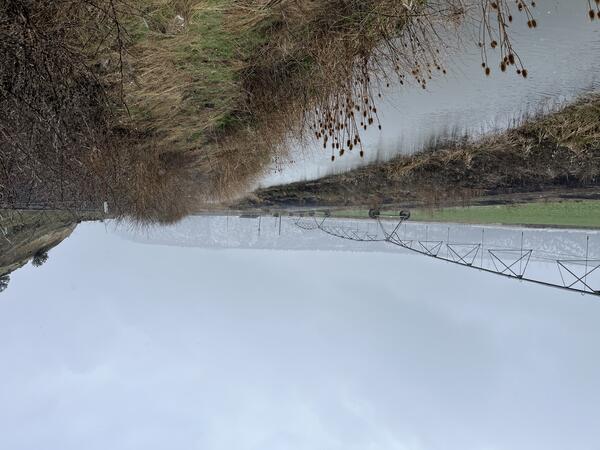
a small narrow waterway with grassy banks flows between an agriculture field and a roadway. Rainy cloudy day
McKay Creek
McKay Creek
McKay Creek

Looking downstream at McKay Creek above its confluence with the Crooked River, Oregon. McKay Creek originates in the Ochoco National Forest and flows for 37 miles, passing through private agricultural lands before merging with the Crooked River northwest of Prineville in Crook County.

Looking downstream at McKay Creek above its confluence with the Crooked River, Oregon. McKay Creek originates in the Ochoco National Forest and flows for 37 miles, passing through private agricultural lands before merging with the Crooked River northwest of Prineville in Crook County.

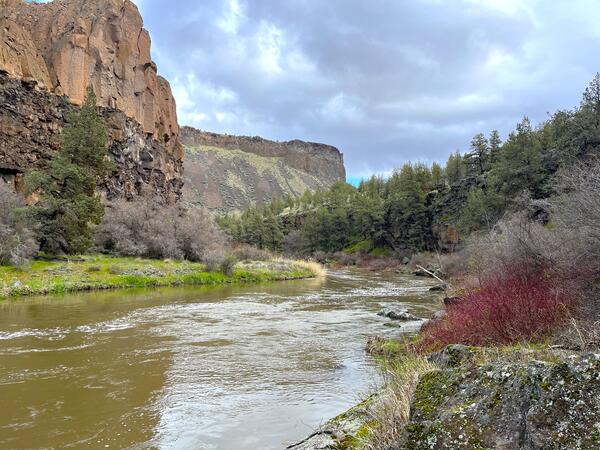
grey-brown river winds around a bend against the shear canyon of brown-black basalt rock. Cloudy winter day
Crooked River
Crooked River
Crooked River

Looking upstream of the Crooked River below Osborne Canyon near Opal City, OR. Photo taken during field work.

Looking upstream of the Crooked River below Osborne Canyon near Opal City, OR. Photo taken during field work.

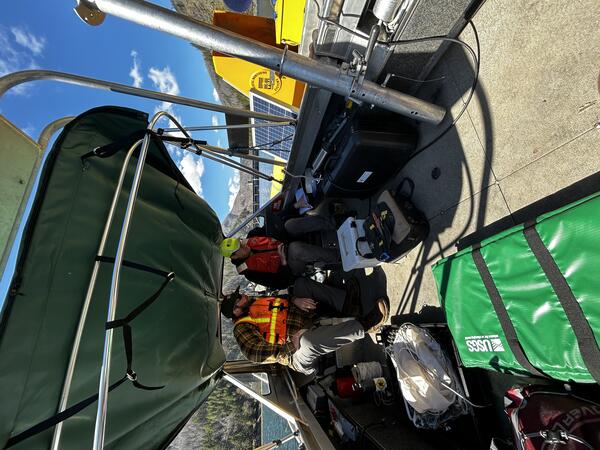
two male scientists look at computer on a boat next to yellow pontoon platform housing lake water profiler sensors
Maintenance at Detroit Lake's water-quality profiler

Scientists take reference check readings from freshly calibrated sensors to ensure accuracy of deployed instruments.

see caption
ADCP Measurement training at Malheur National Wildlife Refuge.

USGS Oregon Water Science Center instructors prep Malheur National Wildlife Refuge & High Desert Partnership staff to collect streamflow measurements with an acoustic instrument (ADCP). This training will empower them to collect important data for decision-making for years to come. Photo by Brandon McMullen.

USGS Oregon Water Science Center instructors prep Malheur National Wildlife Refuge & High Desert Partnership staff to collect streamflow measurements with an acoustic instrument (ADCP). This training will empower them to collect important data for decision-making for years to come. Photo by Brandon McMullen.

see caption
Setting up the ADCP
Setting up the ADCP
Setting up the ADCP

Hydro tech Josh Price guides training participants as they set up the software that interfaces with the acoustic measurement equipment. Photo by Brandon McMullen.

Hydro tech Josh Price guides training participants as they set up the software that interfaces with the acoustic measurement equipment. Photo by Brandon McMullen.

An acoustic measurement instrument on an orange trimaran is being hand guided by rope across the water surface.
Measuring the Donner und Blitzen River at Malheur National Wildlife Refuge

The Donner und Blitzen River flows north through the Malheur National Wildlife Refuge into Malheur Lake. Photo by Brandon McMullen.

3 students on a foot bridge look at a field tablet showing water flow data. Its a cloudy, cold day and everyone is bundled up
USGS streamflow measurement training at Malheur National Wildlife Refuge

Participants from the Malheur National Wildlife Refuge and High Desert Partnership gathered for a USGS lead streamflow measurement training using acoustic technology. Photo by Jeremiah Drewel. 

See caption
USGS streamflow measurement training at Malheur National Wildlife Refuge

Training participant holds the rope that is tethered to an acoustic doppler current profiler (ADCP). The ADCP is ferried back and forth the channel while it collects streamflow data. 

A lady hydro tech in a red coat smiles from on top a mossy gage house.
Gage house maintenance

Sometimes climbing up on top of a gage house is necessary to check on the condition of the solar panel and satellite antenna.

Sometimes climbing up on top of a gage house is necessary to check on the condition of the solar panel and satellite antenna.

Katie sits on the edge of the bridge monitoring her incoming data from the equipment in the turbid water
Measuring Middle Fork Coquille river

Esteemed Hydrologic Technician, Katie Baker, measures streamflow with an acoustic doppler current profiler (ADCP). The ADCP tracks the velocity of particles in the water and maps the channel bottom, combine that data with channel width and you can calculate stream flow!

Esteemed Hydrologic Technician, Katie Baker, measures streamflow with an acoustic doppler current profiler (ADCP). The ADCP tracks the velocity of particles in the water and maps the channel bottom, combine that data with channel width and you can calculate stream flow!

view from inside the cable car. Hydro tech reels equipment through the water column
Operating a cable car

Measuring streamflow from a human powered cable car takes a lot of skill and quick thinking. A flow meter is lowered into the water using a reel.

Measuring streamflow from a human powered cable car takes a lot of skill and quick thinking. A flow meter is lowered into the water using a reel.

Two sets of pipes hang from
Monitoring equipment in the Klamath River

The pipes suspended from the bridge house monitoring equipment that records real-time water-quality data in the Klamath River (11511990) during the Klamath dam removal.

The pipes suspended from the bridge house monitoring equipment that records real-time water-quality data in the Klamath River (11511990) during the Klamath dam removal.

Two scientists in bright colored safety gear and hard hats stand on a bridge above the river.
Field work at the Klamath River above Fall Creek near Copco California

USGS field crew pauses for a photo while performing emergency repairs on water-quality pipes suspended from Daggett Bridge. Once hanging in the calm reservoir, the pipes were exposed to swift currents after dam removal and had to be stabilized to ensure the instruments continued collecting reliable data.

USGS field crew pauses for a photo while performing emergency repairs on water-quality pipes suspended from Daggett Bridge. Once hanging in the calm reservoir, the pipes were exposed to swift currents after dam removal and had to be stabilized to ensure the instruments continued collecting reliable data.

narrow rectangular metal gage house next to the river on a cloudy day.
USGS Klamath River streamgage below Iron Gate

USGS streamgage 11516530 on the Klamath River below Iron Gate Dam in Siskiyou County, California, monitors real-time streamflow and water temperature for a 4,630-square-mile basin.

USGS streamgage 11516530 on the Klamath River below Iron Gate Dam in Siskiyou County, California, monitors real-time streamflow and water temperature for a 4,630-square-mile basin.

Brown river water flows by muddy banks with course grained sediment. Columns of basalt in right. Cloudy skies.
Iron Gate Dam Klamath River

The drained Iron Gate Reservoir is a free flowing section of the Klamath River after reservoir drawdowns and damn removal.

The drained Iron Gate Reservoir is a free flowing section of the Klamath River after reservoir drawdowns and damn removal.

brown water in clear glass bottles with blue lids and yellow ID tags
Sediment samples from the Klamath River near Keno

Sediment samples collected during reservoir drawdown on the Klamath River below where John C. Boyle Powerplant used to be near Keno, Oregon. 

Sediment samples collected during reservoir drawdown on the Klamath River below where John C. Boyle Powerplant used to be near Keno, Oregon. 

Klamath River flows through snow covered hills with sparse pine trees. Cloudy cold day
Klamath River during early dam removal

Starting January 2024, water levels behind the dams were gradually lowered over several weeks to prevent flooding and minimize downstream sediment impacts.

Starting January 2024, water levels behind the dams were gradually lowered over several weeks to prevent flooding and minimize downstream sediment impacts.

A person is yellow safety gear is dwarfted by the large logs jammed up against the outflow gate of Fall Creek Dam
Elevation levels at Fall Creek Reservoir

One of our incredible hydrologic technicians is in full safety gear, including fall protection and life vest, as she surveys elevation levels. In this photo the white level marker rod has fallen onto the pile of floating logs. It was safely retrieved! 

One of our incredible hydrologic technicians is in full safety gear, including fall protection and life vest, as she surveys elevation levels. In this photo the white level marker rod has fallen onto the pile of floating logs. It was safely retrieved! 

Was this page helpful?