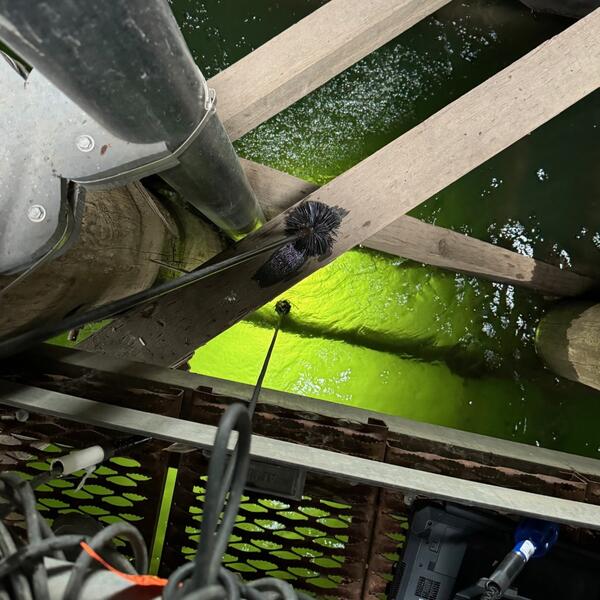
The brown PVC bank mounted pipe houses water-quality instruments. The grey cylinder houses an automatic sampler, that draws water samples from the river at programed times.
Images
Check out photos of some of the awesome work USGS scientists and field technicians have done over the years.
The brown PVC bank mounted pipe houses water-quality instruments. The grey cylinder houses an automatic sampler, that draws water samples from the river at programed times.
Lisa Hoaks and Carrie Boudreau ran an exhibit booth at the 2024 Children's Clean Water Festival. They presented an introduction to the Water Cycle with an interactive matching game along with a look at the USGS Streamer app to see where nearby rivers flow.
Retrieving a Solid Phase Adsorption Toxin Tracking (SPATT) sampler from the Columbia River. Passive samplers like this one are left in the river to accumulate toxins over time for later analysis.
The USGS monitors for toxins near the industrial complexes of the Columbia River in Portland. Learn more about Portland's industrial areas.
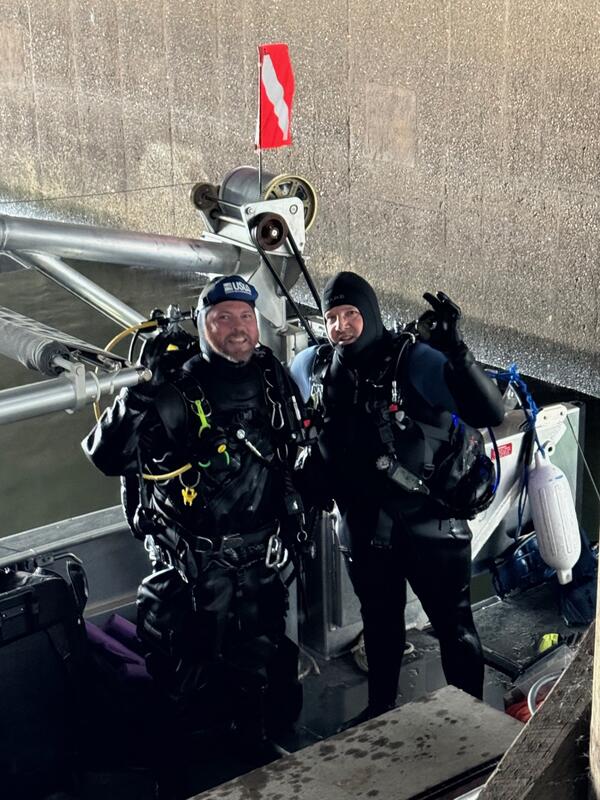
Scientist's boat on the Columbia River collecting samples to help track toxins throughout the year.
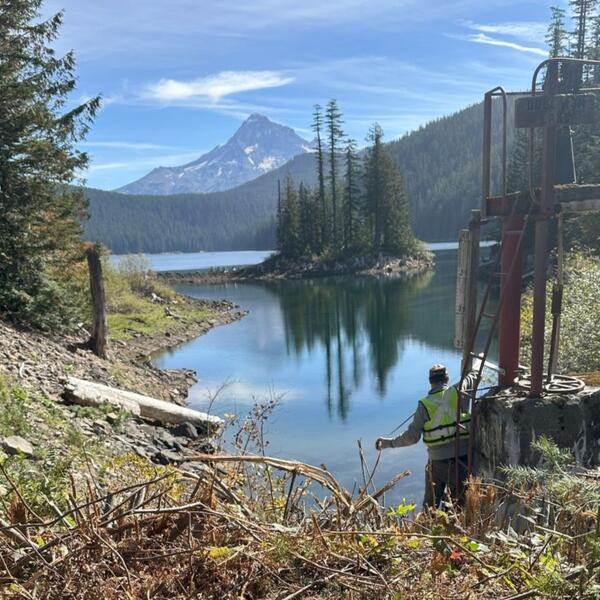
Detroit Lake water-quality pontoon platform monitoring station
Detroit Lake water-quality pontoon platform monitoring stationTechnicians deployed Detroit Lake's new water-quality monitoring station in April, 2024.
Detroit Lake water-quality pontoon platform monitoring station
Detroit Lake water-quality pontoon platform monitoring stationTechnicians deployed Detroit Lake's new water-quality monitoring station in April, 2024.
A hovercraft glides over the surface of Summer Lake, Oregon
A hovercraft glides over the surface of Summer Lake, OregonSummer Lake, Oregon is one of the 20 terminal lakes identified by USGS partners as priority ecosystems for study by the Saline Lakes Ecosystems IWAA.
A hovercraft glides over the surface of Summer Lake, Oregon
A hovercraft glides over the surface of Summer Lake, OregonSummer Lake, Oregon is one of the 20 terminal lakes identified by USGS partners as priority ecosystems for study by the Saline Lakes Ecosystems IWAA.
The Umatilla River basin in northeastern Oregon is characterized by warm, dry summers and cold, wet winters. Photo taken during groundwater recharge research field work.
Scientist collects well water sample to test for isotopic age tracers. Well locations represent different flow paths in the aquifer system.
Looking upstream of the Crooked River below Osborne Canyon near Opal City, OR. Photo taken during field work.
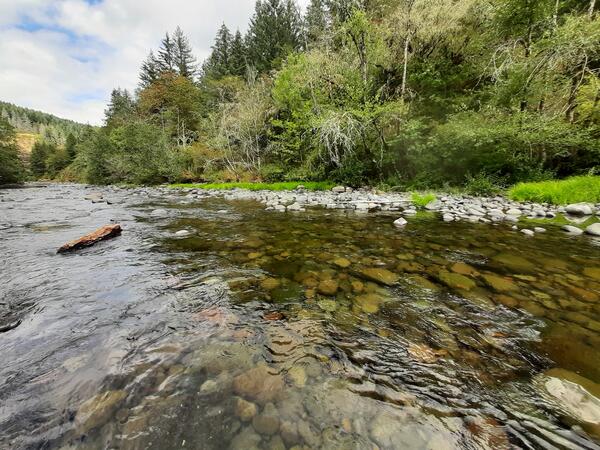
Looking downstream at McKay Creek above its confluence with the Crooked River, Oregon. McKay Creek originates in the Ochoco National Forest and flows for 37 miles, passing through private agricultural lands before merging with the Crooked River northwest of Prineville in Crook County.
Maintenance at Detroit Lake's water-quality profiler
Maintenance at Detroit Lake's water-quality profilerScientists take reference check readings from freshly calibrated sensors to ensure accuracy of deployed instruments.
Maintenance at Detroit Lake's water-quality profiler
Maintenance at Detroit Lake's water-quality profilerScientists take reference check readings from freshly calibrated sensors to ensure accuracy of deployed instruments.
ADCP Measurement training at Malheur National Wildlife Refuge.
ADCP Measurement training at Malheur National Wildlife Refuge.USGS Oregon Water Science Center instructors prep Malheur National Wildlife Refuge & High Desert Partnership staff to collect streamflow measurements with an acoustic instrument (ADCP). This training will empower them to collect important data for decision-making for years to come. Photo by Brandon McMullen.
ADCP Measurement training at Malheur National Wildlife Refuge.
ADCP Measurement training at Malheur National Wildlife Refuge.USGS Oregon Water Science Center instructors prep Malheur National Wildlife Refuge & High Desert Partnership staff to collect streamflow measurements with an acoustic instrument (ADCP). This training will empower them to collect important data for decision-making for years to come. Photo by Brandon McMullen.
Hydro tech Josh Price guides training participants as they set up the software that interfaces with the acoustic measurement equipment. Photo by Brandon McMullen.
Measuring the Donner und Blitzen River at Malheur National Wildlife Refuge
Measuring the Donner und Blitzen River at Malheur National Wildlife RefugeThe Donner und Blitzen River flows north through the Malheur National Wildlife Refuge into Malheur Lake. Photo by Brandon McMullen.
Measuring the Donner und Blitzen River at Malheur National Wildlife Refuge
Measuring the Donner und Blitzen River at Malheur National Wildlife RefugeThe Donner und Blitzen River flows north through the Malheur National Wildlife Refuge into Malheur Lake. Photo by Brandon McMullen.
USGS streamflow measurement training at Malheur National Wildlife Refuge
USGS streamflow measurement training at Malheur National Wildlife RefugeParticipants from the Malheur National Wildlife Refuge and High Desert Partnership gathered for a USGS lead streamflow measurement training using acoustic technology. Photo by Jeremiah Drewel.
USGS streamflow measurement training at Malheur National Wildlife Refuge
USGS streamflow measurement training at Malheur National Wildlife RefugeParticipants from the Malheur National Wildlife Refuge and High Desert Partnership gathered for a USGS lead streamflow measurement training using acoustic technology. Photo by Jeremiah Drewel.
USGS streamflow measurement training at Malheur National Wildlife Refuge
USGS streamflow measurement training at Malheur National Wildlife RefugeTraining participant holds the rope that is tethered to an acoustic doppler current profiler (ADCP). The ADCP is ferried back and forth the channel while it collects streamflow data.
USGS streamflow measurement training at Malheur National Wildlife Refuge
USGS streamflow measurement training at Malheur National Wildlife RefugeTraining participant holds the rope that is tethered to an acoustic doppler current profiler (ADCP). The ADCP is ferried back and forth the channel while it collects streamflow data.
Measuring streamflow from a human powered cable car takes a lot of skill and quick thinking. A flow meter is lowered into the water using a reel.
Sometimes climbing up on top of a gage house is necessary to check on the condition of the solar panel and satellite antenna.
Esteemed Hydrologic Technician, Katie Baker, measures streamflow with an acoustic doppler current profiler (ADCP). The ADCP tracks the velocity of particles in the water and maps the channel bottom, combine that data with channel width and you can calculate stream flow!