Episode 43 of the ongoing Kīlauea summit eruption occurred on March 10. Lava fountains from the north and south vents on the western side of Halema‘uma‘u crater floor produced a large eruption plume of volcanic gases and rock fragments (tephra).
Images
Volcano Science Center images.
Episode 43 of the ongoing Kīlauea summit eruption occurred on March 10. Lava fountains from the north and south vents on the western side of Halema‘uma‘u crater floor produced a large eruption plume of volcanic gases and rock fragments (tephra).
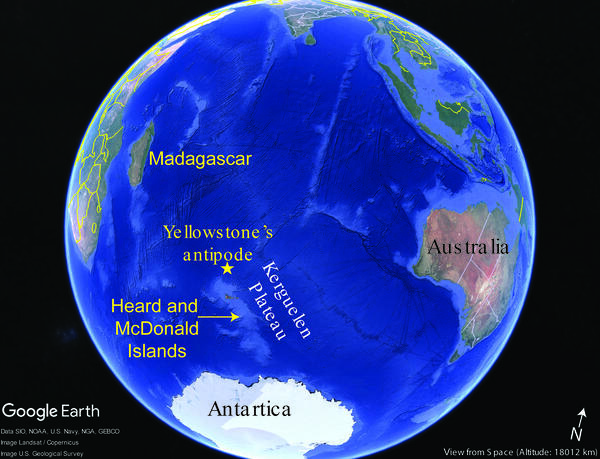
Google Earth map showing the location of Yellowstone Caldera’s antipode
Google Earth map showing the location of Yellowstone Caldera’s antipodeGoogle Earth map showing the location of Yellowstone Caldera’s antipode, the Kerguelen Plateau in the southern Indian Ocean, and Heard and McDonald Islands, which host active volcanoes.
Google Earth map showing the location of Yellowstone Caldera’s antipode
Google Earth map showing the location of Yellowstone Caldera’s antipodeGoogle Earth map showing the location of Yellowstone Caldera’s antipode, the Kerguelen Plateau in the southern Indian Ocean, and Heard and McDonald Islands, which host active volcanoes.
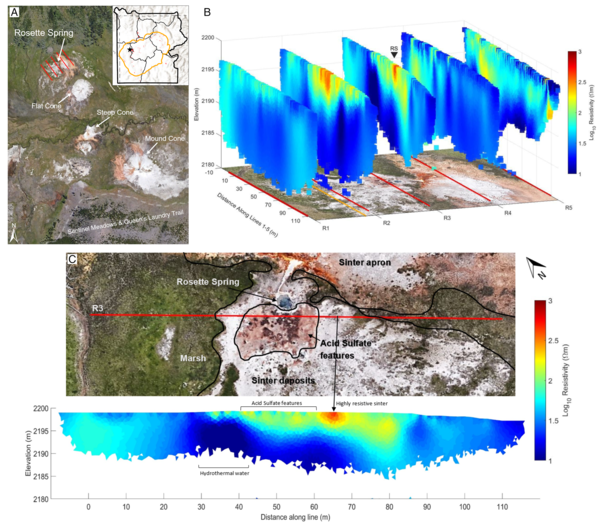
Surface imagery and subsurface electrical resistivity tomography results from Rosette Spring in Yellowstone’s Lower Geyser Basin
Surface imagery and subsurface electrical resistivity tomography results from Rosette Spring in Yellowstone’s Lower Geyser BasinSurface imagery and subsurface electrical resistivity tomography results from Rosette Spring in Yellowstone’s Lower Geyser Basin. A) Site Overview: Google Earth imagery of Sentinel Meadows identifying Rosette Spring, Flat Cone, Steep Cone, and Mound Cone. Red lines denote the five parallel NW-SE electrical resistivity tomography (ERT) survey profiles.
Surface imagery and subsurface electrical resistivity tomography results from Rosette Spring in Yellowstone’s Lower Geyser Basin
Surface imagery and subsurface electrical resistivity tomography results from Rosette Spring in Yellowstone’s Lower Geyser BasinSurface imagery and subsurface electrical resistivity tomography results from Rosette Spring in Yellowstone’s Lower Geyser Basin. A) Site Overview: Google Earth imagery of Sentinel Meadows identifying Rosette Spring, Flat Cone, Steep Cone, and Mound Cone. Red lines denote the five parallel NW-SE electrical resistivity tomography (ERT) survey profiles.
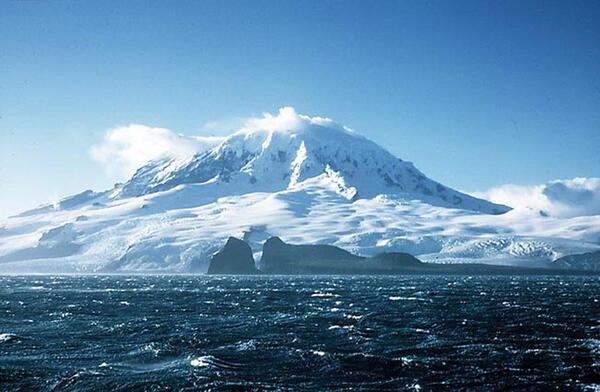
Big Ben Volcano on Heard Island. Credit: Australian Antarctic Division (A.J. Graff).
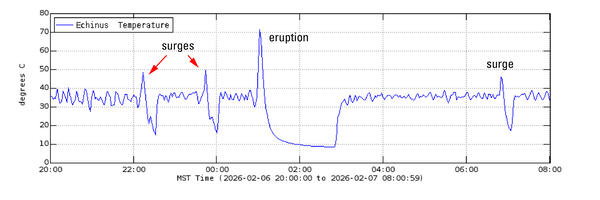
Echinus temperature record during February 6-7, 2026
Echinus temperature record during February 6-7, 2026Temperature record from Echinus Geyser outflow channel for February 6, 2026, at 8 p.m. MST to February 7, 2026, at 8 a.m. MST. The plot shows initial baseline temperatures, then two spikes to 50 °C representing water surges, then an eruption marked by a spike to 70 °C followed by a lull to 10 °C, and finally a return to baseline.
Echinus temperature record during February 6-7, 2026
Echinus temperature record during February 6-7, 2026Temperature record from Echinus Geyser outflow channel for February 6, 2026, at 8 p.m. MST to February 7, 2026, at 8 a.m. MST. The plot shows initial baseline temperatures, then two spikes to 50 °C representing water surges, then an eruption marked by a spike to 70 °C followed by a lull to 10 °C, and finally a return to baseline.
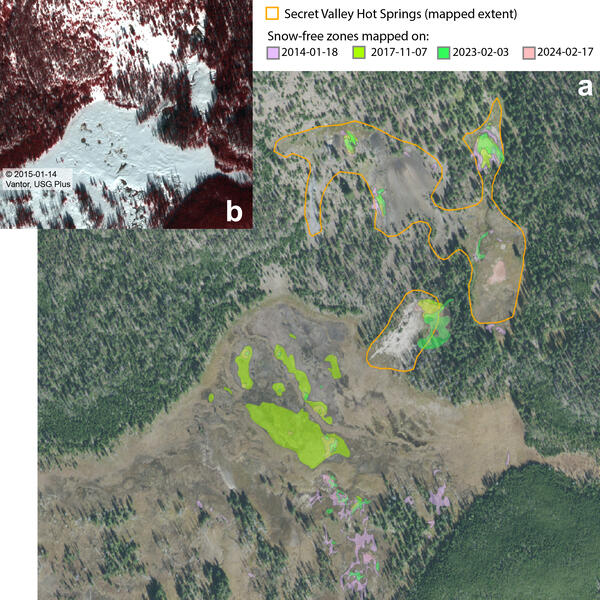
Satellite mapping of thermal ground at Secret Valley Hot Springs, Yellowstone National Park
Satellite mapping of thermal ground at Secret Valley Hot Springs, Yellowstone National Park(a) NAIP (National Agriculture Imagery Program) natural-color aerial photograph of Secret Valley Hot Springs, in the backcountry between Norris Geyser Basin and Madison Junction, from September 25, 2015, showing snow-free zone mapping based on snowy wintertime imagery from multiple years. The mapped boundaries of the thermal area are indicated by the orange out
Satellite mapping of thermal ground at Secret Valley Hot Springs, Yellowstone National Park
Satellite mapping of thermal ground at Secret Valley Hot Springs, Yellowstone National Park(a) NAIP (National Agriculture Imagery Program) natural-color aerial photograph of Secret Valley Hot Springs, in the backcountry between Norris Geyser Basin and Madison Junction, from September 25, 2015, showing snow-free zone mapping based on snowy wintertime imagery from multiple years. The mapped boundaries of the thermal area are indicated by the orange out
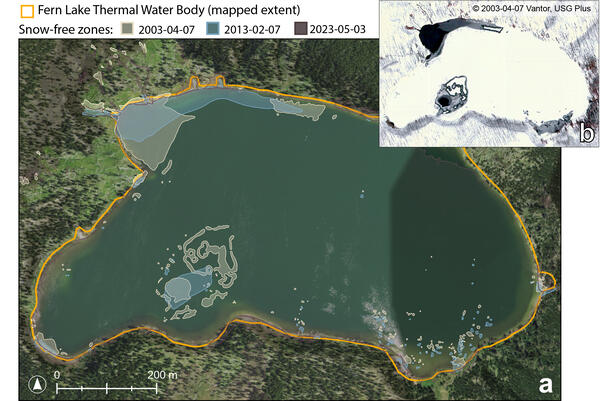
Mapping thermal input to Fern Lake, Yellowstone National Park, using satellite imagery
Mapping thermal input to Fern Lake, Yellowstone National Park, using satellite imagery(a) NAIP (National Agriculture Imagery Program) natural-color aerial photograph of Fern Lake, in the east part of Yellowstone National Park, from July 17, 2022, showing mapped locations of liquid water during the winter when the rest of the water body was iced over. The mapped boundary of the lake is indicated by the orange outline, with shaded areas noting re
Mapping thermal input to Fern Lake, Yellowstone National Park, using satellite imagery
Mapping thermal input to Fern Lake, Yellowstone National Park, using satellite imagery(a) NAIP (National Agriculture Imagery Program) natural-color aerial photograph of Fern Lake, in the east part of Yellowstone National Park, from July 17, 2022, showing mapped locations of liquid water during the winter when the rest of the water body was iced over. The mapped boundary of the lake is indicated by the orange outline, with shaded areas noting re
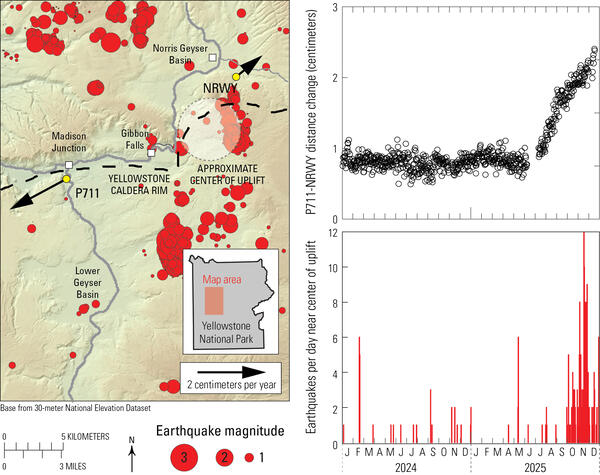
Deformation and seismicity during 2024-2025 associated with Norris Uplift Anomaly, Yellowstone National Park
Deformation and seismicity during 2024-2025 associated with Norris Uplift Anomaly, Yellowstone National ParkMap of horizontal velocities between July and December 2025 at Global Positioning System (GPS) stations P711 and NRWY (arrows and yellow circles; arrow length gives displacement rate) in the area between Norris Geyser Basin and Madison Junction. Dashed black line indicates boundary of Yellowstone Caldera and gray lines are roads.
Deformation and seismicity during 2024-2025 associated with Norris Uplift Anomaly, Yellowstone National Park
Deformation and seismicity during 2024-2025 associated with Norris Uplift Anomaly, Yellowstone National ParkMap of horizontal velocities between July and December 2025 at Global Positioning System (GPS) stations P711 and NRWY (arrows and yellow circles; arrow length gives displacement rate) in the area between Norris Geyser Basin and Madison Junction. Dashed black line indicates boundary of Yellowstone Caldera and gray lines are roads.
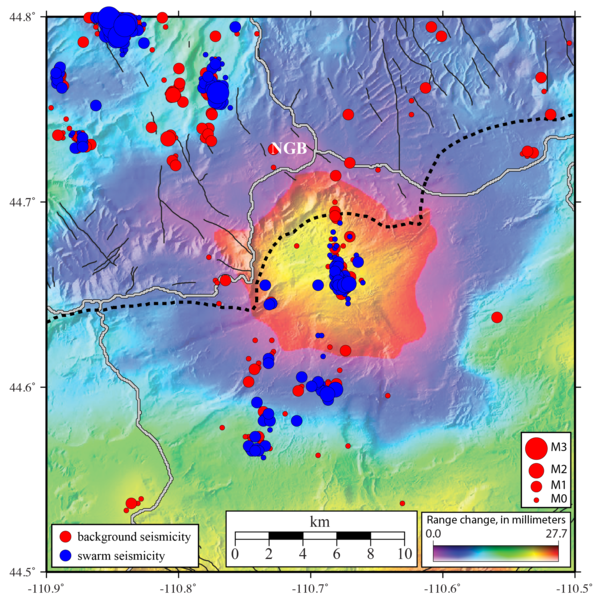
Map of uplift and earthquakes near Norris Geyser Basin, Yellowstone National Park, during 2024-2025
Map of uplift and earthquakes near Norris Geyser Basin, Yellowstone National Park, during 2024-2025Map of uplift as seen by interferometric synthetic aperture radar (InSAR) covering the time between October 7, 2024, and October 2, 2025 (the uplift began in July 2025) along the north rim of Yellowstone Caldera to the south of Norris Geyser Basin (NGB).
Map of uplift and earthquakes near Norris Geyser Basin, Yellowstone National Park, during 2024-2025
Map of uplift and earthquakes near Norris Geyser Basin, Yellowstone National Park, during 2024-2025Map of uplift as seen by interferometric synthetic aperture radar (InSAR) covering the time between October 7, 2024, and October 2, 2025 (the uplift began in July 2025) along the north rim of Yellowstone Caldera to the south of Norris Geyser Basin (NGB).
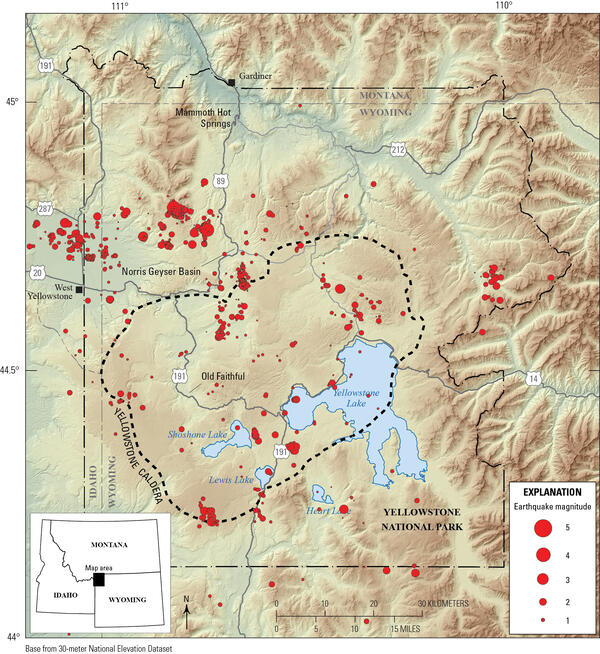
Map of seismicity (red circles) in the Yellowstone region during 2025. Gray lines are roads, black dashed line shows the caldera boundary, Yellowstone National Park is outlined by black dot-dashed line, and gray dashed lines denote state boundaries.
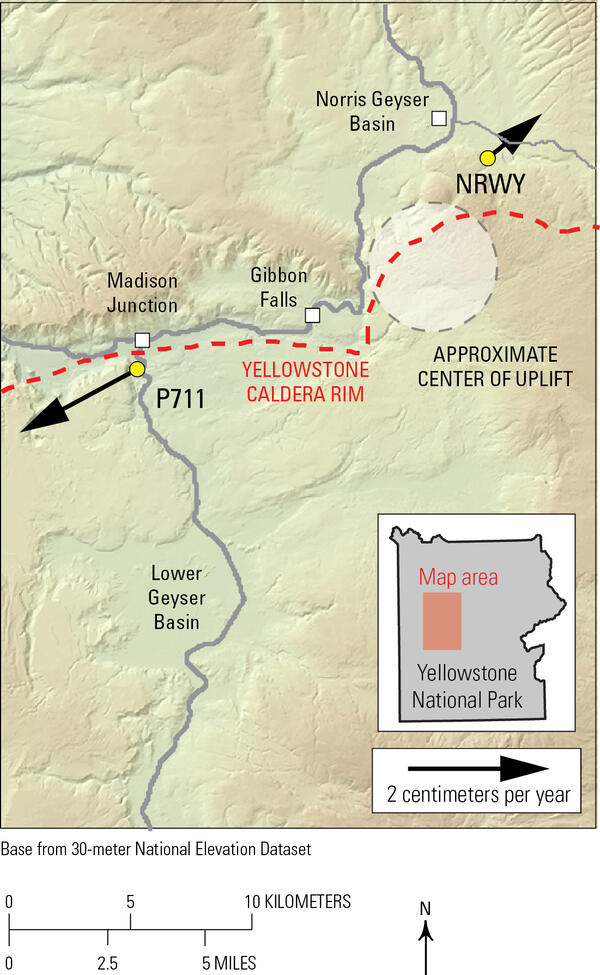
Horizontal GPS velocities during July-December 2025 in the Madison and Norris areas of Yellowstone National Park
Horizontal GPS velocities during July-December 2025 in the Madison and Norris areas of Yellowstone National ParkMap of horizontal velocities between July and December 2025 at Global Positioning System (GPS) stations P711 and NRWY (arrows and yellow circles) in the area between Norris Geyser Basin and Madison Junction. Dashed red line indicates boundary of Yellowstone Caldera and gray lines are roads.
Horizontal GPS velocities during July-December 2025 in the Madison and Norris areas of Yellowstone National Park
Horizontal GPS velocities during July-December 2025 in the Madison and Norris areas of Yellowstone National ParkMap of horizontal velocities between July and December 2025 at Global Positioning System (GPS) stations P711 and NRWY (arrows and yellow circles) in the area between Norris Geyser Basin and Madison Junction. Dashed red line indicates boundary of Yellowstone Caldera and gray lines are roads.
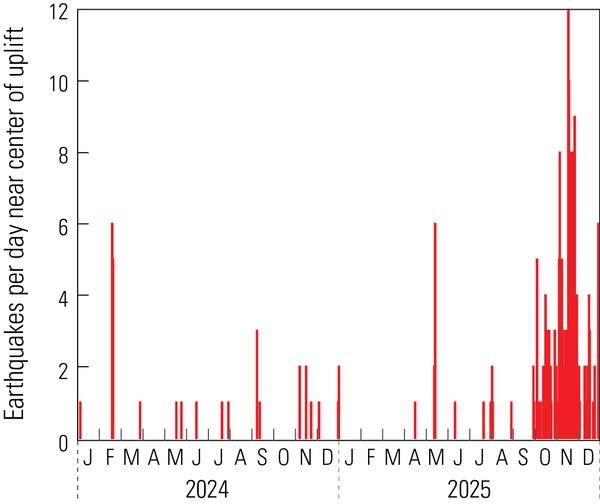
Plot of daily earthquakes located in the area of the Norris Uplift Anomaly during 2024-2025
Plot of daily earthquakes located in the area of the Norris Uplift Anomaly during 2024-2025Plot of numbers of earthquakes per day in the immediate vicinity of the Norris Uplift Anomaly during 2024-2025. An increase in the rate of seismicity occurred in September-December 2025, especially in November. The largest earthquake during that time was M2.7.
Plot of daily earthquakes located in the area of the Norris Uplift Anomaly during 2024-2025
Plot of daily earthquakes located in the area of the Norris Uplift Anomaly during 2024-2025Plot of numbers of earthquakes per day in the immediate vicinity of the Norris Uplift Anomaly during 2024-2025. An increase in the rate of seismicity occurred in September-December 2025, especially in November. The largest earthquake during that time was M2.7.
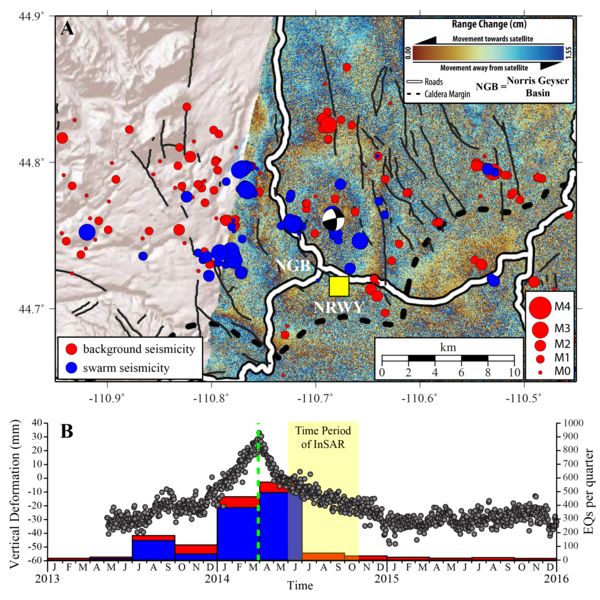
The 2013–2014 Norris uplift and associated earthquakes
The 2013–2014 Norris uplift and associated earthquakesThe 2013–2014 Norris Geyser Basin (NGB) uplift and associated earthquakes.
The 2013–2014 Norris uplift and associated earthquakes
The 2013–2014 Norris uplift and associated earthquakesThe 2013–2014 Norris Geyser Basin (NGB) uplift and associated earthquakes.
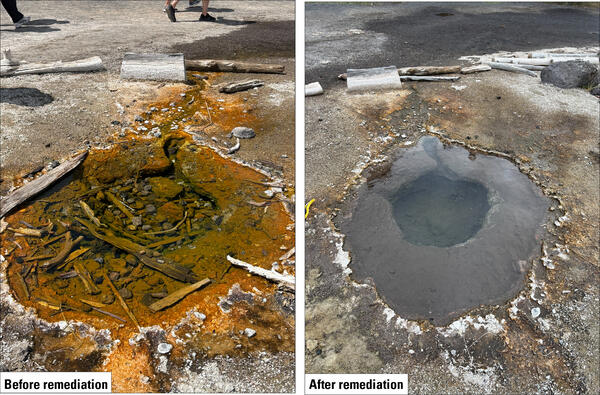
Hot spring along trail to Grand Prismatic Spring overlook before and after remediation
Hot spring along trail to Grand Prismatic Spring overlook before and after remediationHot spring located along the trail to the Grand Prismatic Spring overlook shown before and after the Yellowstone National Park Geology Program team cleaned the feature of sticks and rocks that were thrown in by visitors. National Park Service photos by Margery Price, July and September 2025,
Hot spring along trail to Grand Prismatic Spring overlook before and after remediation
Hot spring along trail to Grand Prismatic Spring overlook before and after remediationHot spring located along the trail to the Grand Prismatic Spring overlook shown before and after the Yellowstone National Park Geology Program team cleaned the feature of sticks and rocks that were thrown in by visitors. National Park Service photos by Margery Price, July and September 2025,
Infographic with statistics about hats that were recovered from thermal areas in Yellowstone National Park during 2025
Infographic with statistics about hats that were recovered from thermal areas in Yellowstone National Park during 2025Infographic showing the numbers, styles, colors, and other data regarding hats recovered from thermal areas by the Yellowstone National Park Geology Program in 2025. Designed by Margery Price, Yellowstone National Park.
Infographic with statistics about hats that were recovered from thermal areas in Yellowstone National Park during 2025
Infographic with statistics about hats that were recovered from thermal areas in Yellowstone National Park during 2025Infographic showing the numbers, styles, colors, and other data regarding hats recovered from thermal areas by the Yellowstone National Park Geology Program in 2025. Designed by Margery Price, Yellowstone National Park.
Relocated Yellowstone seismicity recorded during 2008-2022
Relocated Yellowstone seismicity recorded during 2008-2022Map view of relocated Yellowstone seismicity recorded during 2008-2022, colored by time, on the left. White line gives the outline of Yellowstone caldera. The A-A’ cross section through Yellowstone Lake is shown at the right and illustrates how seismic swarms that are distinct in time relate to one another. Adapted from Florez and others, 2025 (
Relocated Yellowstone seismicity recorded during 2008-2022
Relocated Yellowstone seismicity recorded during 2008-2022Map view of relocated Yellowstone seismicity recorded during 2008-2022, colored by time, on the left. White line gives the outline of Yellowstone caldera. The A-A’ cross section through Yellowstone Lake is shown at the right and illustrates how seismic swarms that are distinct in time relate to one another. Adapted from Florez and others, 2025 (
InSAR data from the Yellowstone region spanning October 7, 2024 to October 2, 2025
InSAR data from the Yellowstone region spanning October 7, 2024 to October 2, 2025Interferogram created from satellite radar data collected on October 7, 2024, and October 2, 2025, over the Yellowstone region by the Sentinel-1 satellite system. Colored fringes indicate a change in distance (called range change) between the satellite and ground surface that is caused by surface deformation during the time spanned.
InSAR data from the Yellowstone region spanning October 7, 2024 to October 2, 2025
InSAR data from the Yellowstone region spanning October 7, 2024 to October 2, 2025Interferogram created from satellite radar data collected on October 7, 2024, and October 2, 2025, over the Yellowstone region by the Sentinel-1 satellite system. Colored fringes indicate a change in distance (called range change) between the satellite and ground surface that is caused by surface deformation during the time spanned.
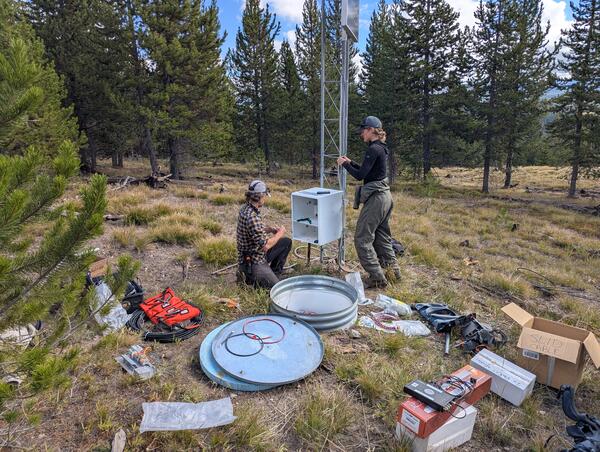
Upgrading the WLWY continuous GPS site in Yellowstone National Park
Upgrading the WLWY continuous GPS site in Yellowstone National ParkEarthScope engineers Brendan Hodge (left) and Lia Lajoie (right) perform upgrades at the WLWY (White Lake) continuous GPS station in Yellowstone National Park. The white box contains the receiver, while the barrel on the ground contains batteries. The tower holds the solar panels, as well as a cellular modem and meteorological sensors that were recently
Upgrading the WLWY continuous GPS site in Yellowstone National Park
Upgrading the WLWY continuous GPS site in Yellowstone National ParkEarthScope engineers Brendan Hodge (left) and Lia Lajoie (right) perform upgrades at the WLWY (White Lake) continuous GPS station in Yellowstone National Park. The white box contains the receiver, while the barrel on the ground contains batteries. The tower holds the solar panels, as well as a cellular modem and meteorological sensors that were recently
Hats collected by the Yellowstone National Park Geology Program from sensitive thermal areas in 2025
Hats collected by the Yellowstone National Park Geology Program from sensitive thermal areas in 2025Just some of the hats collected by the Yellowstone National Park Geology Program from sensitive thermal areas throughout the park in 2025. National Park Service photo by Margery Price, September 3, 2025.
Hats collected by the Yellowstone National Park Geology Program from sensitive thermal areas in 2025
Hats collected by the Yellowstone National Park Geology Program from sensitive thermal areas in 2025Just some of the hats collected by the Yellowstone National Park Geology Program from sensitive thermal areas throughout the park in 2025. National Park Service photo by Margery Price, September 3, 2025.
USGS geologist collects a sample from a potential newly recognized lava flow along the Gibbon River, Yellowstone National Park
USGS geologist collects a sample from a potential newly recognized lava flow along the Gibbon River, Yellowstone National ParkUSGS geologist Mark Stelten collects a sample of what is potentially a newly recognized lava flow exposed along the Gibbon River. USGS photo by Nicole Thomas, September 2025.
USGS geologist collects a sample from a potential newly recognized lava flow along the Gibbon River, Yellowstone National Park
USGS geologist collects a sample from a potential newly recognized lava flow along the Gibbon River, Yellowstone National ParkUSGS geologist Mark Stelten collects a sample of what is potentially a newly recognized lava flow exposed along the Gibbon River. USGS photo by Nicole Thomas, September 2025.
Kīlauea summit caldera from B1 camera on August 29, 2025
Kīlauea summit caldera from B1 camera on August 29, 2025View of Kaluapele (Kīlauea's summit caldera) from the B1 webcam on August 29, 2025, acquired between lava fountaining episodes 31 and 32.
Kīlauea summit caldera from B1 camera on August 29, 2025
Kīlauea summit caldera from B1 camera on August 29, 2025View of Kaluapele (Kīlauea's summit caldera) from the B1 webcam on August 29, 2025, acquired between lava fountaining episodes 31 and 32.