Marie Bartlett at the microscope station where visitors could look at foraminifera, tiny microfossils that live in marine environments. Scientists at the USGS use foraminifera to determine the age of sediment found many meters below the seafloor and to learn more about past climate conditions.
Images
Woods Hole Coastal and Marine Science Center images
Marie Bartlett at the microscope station where visitors could look at foraminifera, tiny microfossils that live in marine environments. Scientists at the USGS use foraminifera to determine the age of sediment found many meters below the seafloor and to learn more about past climate conditions.
Zafer Defne discussing COAWST, a modeling system that allows many sophisticated models to feedback to one another to accurately simulate physical storm processes.
USGS at the 2025 Woods Hole Science Stroll on August 9, 2025! This year's participants included Meagan Eagle, Eric Moore, Zafer Defne, Marie Bartlett, Sara Ernst, Amit Millo, Seth Ackerman, Brita Jessen, and Alfredo Aretxabaleta.
Jin-Si Over at the 2025 Woods Hole Science Stroll on August 9, 2025. During this free event, a variety of booths line the streets, docks, and Waterfront Park to deliver hands-on science activities, games, demonstrations, and more to visitors of all ages.
Seth Ackerman showing drones to Science Stroll attendees. The Aerial Imaging and Mapping Group showcased uncrewed aircraft system technology (drones) of all sizes and talked about how they’re used to map short- and long-term changes in coastal landscapes. The group also flew one of the drones to demonstrate how they’re piloted.
Jin-Si Over talking to an attendee about foraminifera, tiny microfossils that live in marine environments. Scientists at the USGS use foraminifera to determine the age of sediment found many meters below the seafloor and to learn more about past climate conditions.
Eric Moore setup a shake table that moves in different directions, at varying frequencies to demonstrate the power of earthquakes. People built structures out of Legos to put on the shake table to test how buildings, bridges, and other infrastructure would behave during a real seismic event.
Marie Bartlett at the 2025 Woods Hole Science Stroll on August 9, 2025. During this free event, a variety of booths line the streets, docks, and Waterfront Park to deliver hands-on science activities, games, demonstrations, and more to visitors of all ages.
Brita Jessen and Eric Moore at the earthquake station at the 2025 Woods Hole Science Stroll on August 9, 2025. We setup a shake table that moves in different directions, at varying frequencies to demonstrate the power of earthquakes.
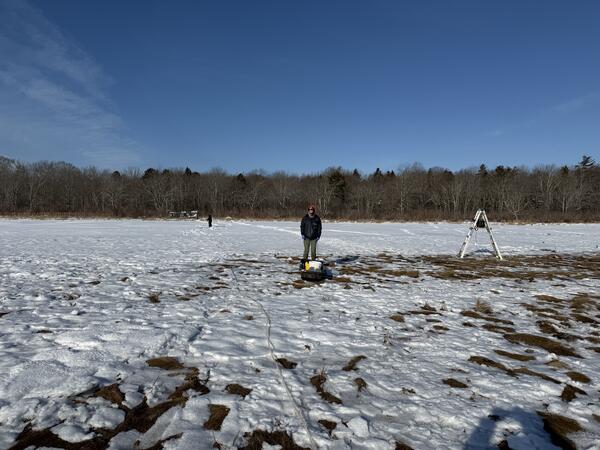
The USGS office in Woods Hole, MA recently conducted a survey of Long Pond—a local waterbody in the town of Falmouth. Long Pond has been Falmouth’s primary drinking water source since 1898.
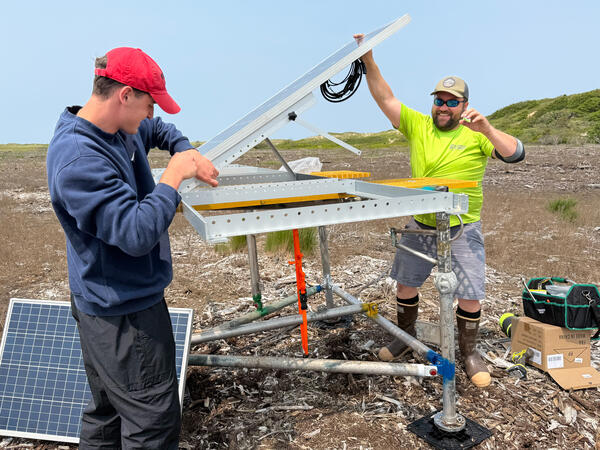
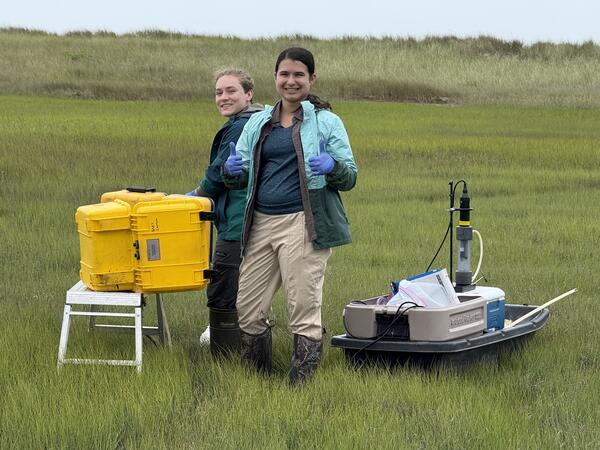
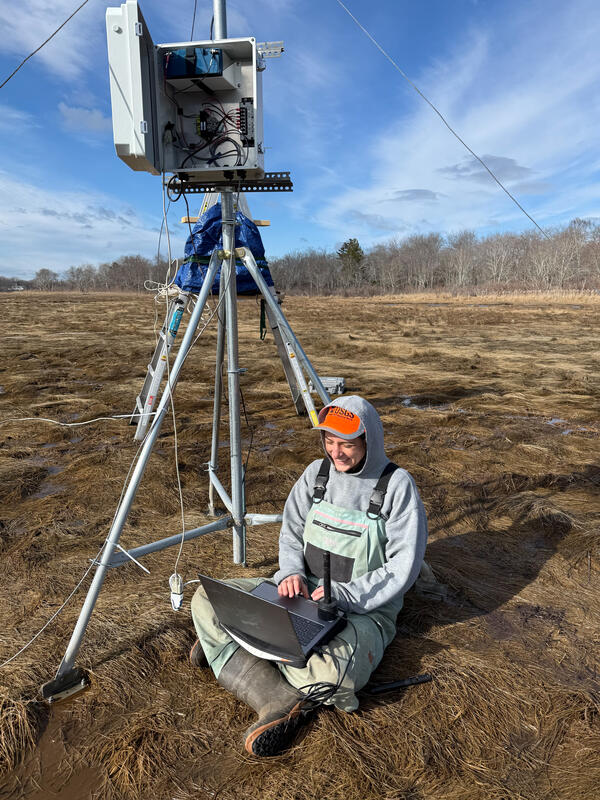
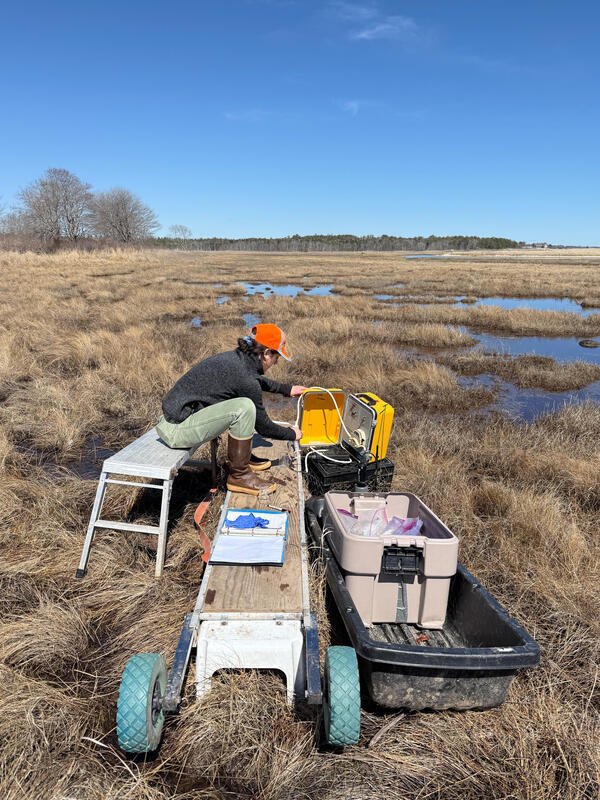
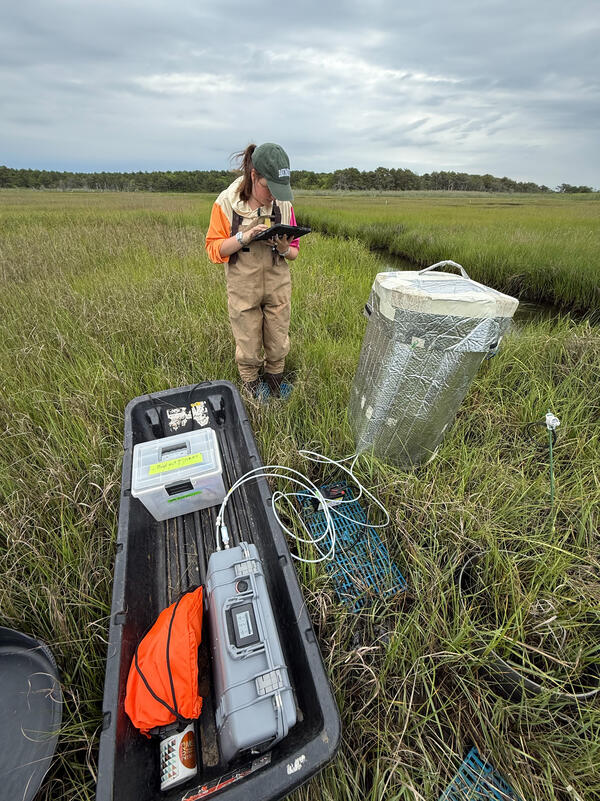
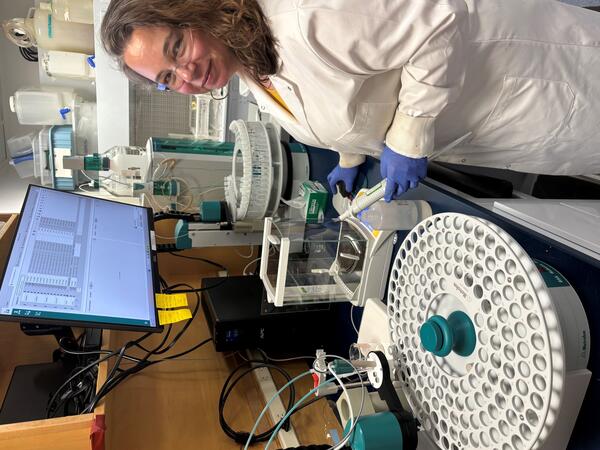
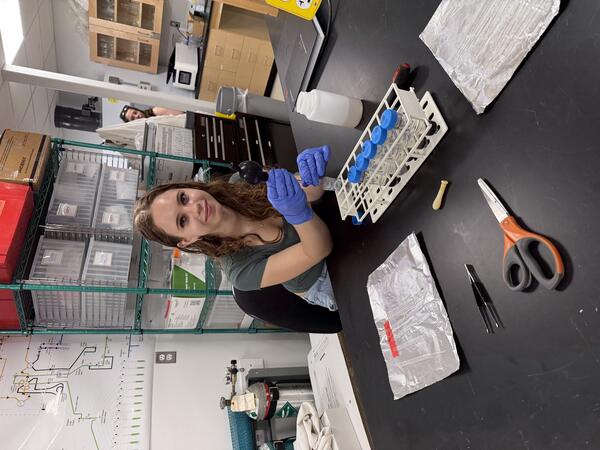
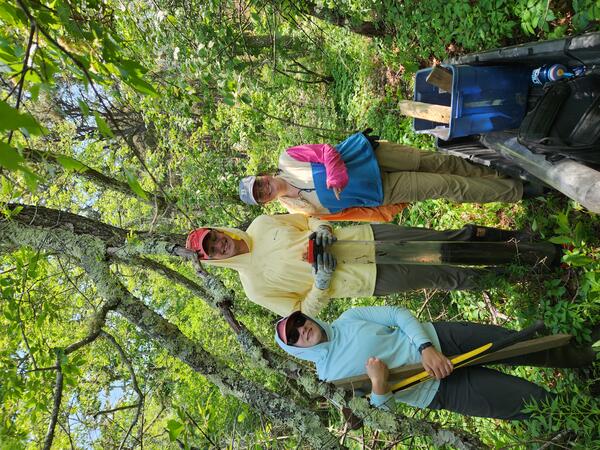
In August, the Woods Hole Coastal and Marine Science Center had four great presentations from summer interns discussing various aspects of salt marsh science!
EPA/USGS Day of the 2025 Mashpee Wampanoag Tribe - Preserving Our Homelands Summer Camp
EPA/USGS Day of the 2025 Mashpee Wampanoag Tribe - Preserving Our Homelands Summer CampThe Environmental Protection Agency (EPA) and USGS prepared four activities for the Preserving Our Homelands Summer Camp on July 22nd. EPA hosted an air quality monitoring activity that involved the campers conducting tests and participating in a guided discussion about factors contributing to air quality and its implications on people and habitat.
EPA/USGS Day of the 2025 Mashpee Wampanoag Tribe - Preserving Our Homelands Summer Camp
EPA/USGS Day of the 2025 Mashpee Wampanoag Tribe - Preserving Our Homelands Summer CampThe Environmental Protection Agency (EPA) and USGS prepared four activities for the Preserving Our Homelands Summer Camp on July 22nd. EPA hosted an air quality monitoring activity that involved the campers conducting tests and participating in a guided discussion about factors contributing to air quality and its implications on people and habitat.
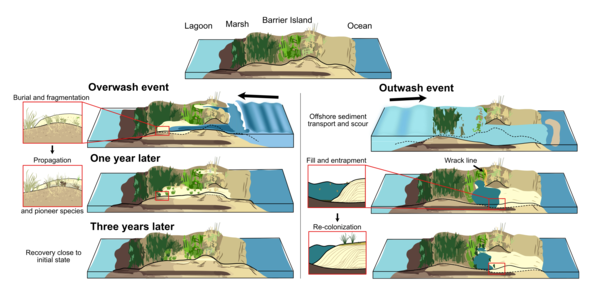
A recent USGS study highlights the impacts of #hurricanes and #storms on #barrierislands, focusing on the outwash process, where flooding from behind the dunes removes sand, plants, and seeds, washing them into the #ocean.
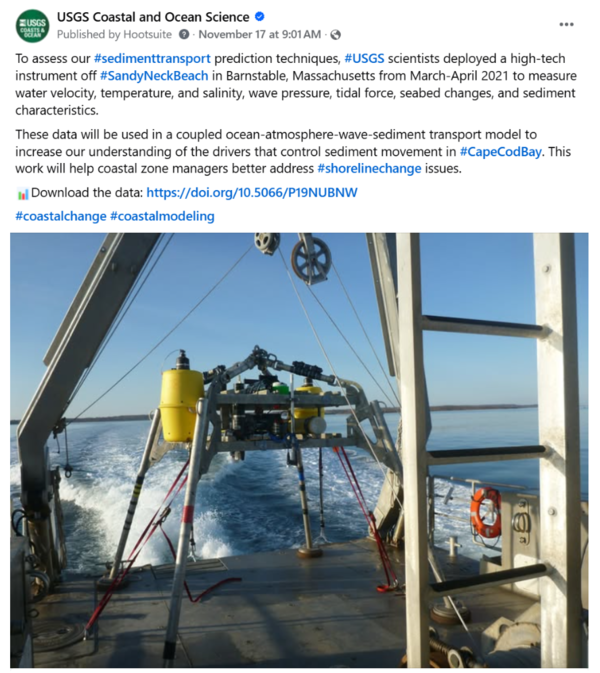
Preparing equipment to map the geologic framework of Nantucket Sound, offshore Cape Cod, Massachusetts.
The USGS used #drones to collect aerial remote sensing data across the Lower #DarbyCreek Area Superfund Site and the adjacent #JohnHeinzNationalWildlifeRefuge, about 5 miles outside of #Philadelphia, PA. The data release is now available: https://doi.org/10.5066/P134HU3Y.
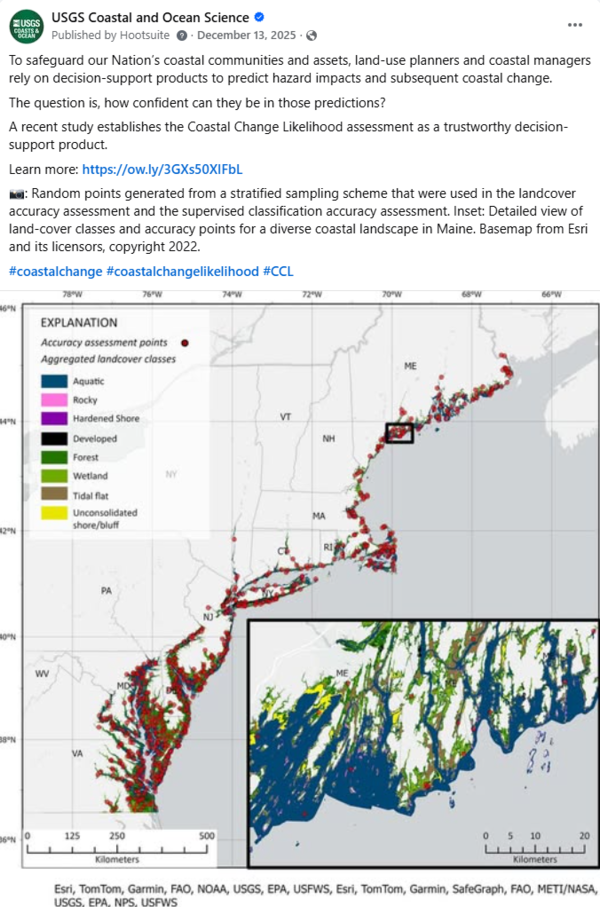
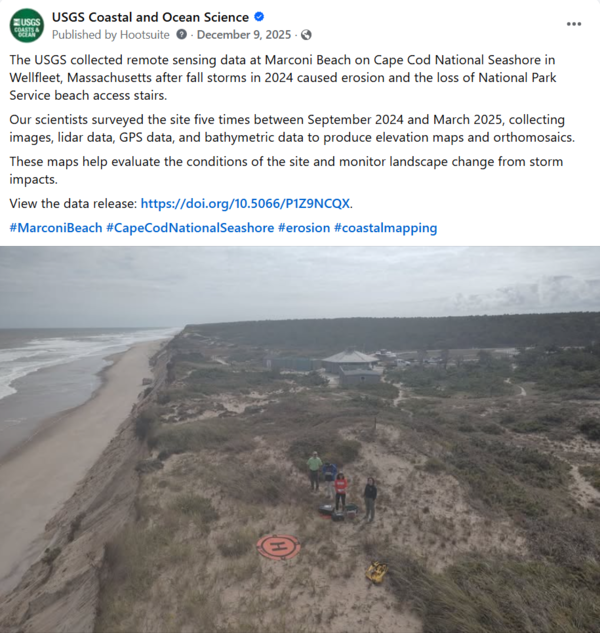
New data release presents an update to the Coastal Response Likelihood model—a spatially explicit, probabilistic model that evaluates coastal response for the Northeastern U.S. under various sea-level scenarios. https://doi.org/10.5066/P13JKJUT
The USGS is actively mapping the seafloor surface and its underlying structure in coastal to deep sea environments. These maps provide the scientific foundation needed to address national priorities, including #publicsafety, #nationalsecurity, #energydominance, and #economicprosperity.
Non-profit organizations Transom Story Lab and Atlantic Public Media hosted a weekend-long science storytelling workshop called "Making Waves." It was attended by 11 scientists from scientific institutions throughout Woods Hole, Massachusetts, including USGS scientists Jin-Si Over, Ellen Lalk, and Sara Zeigler.
USGS marks the spot! Our science is key to understanding seabed resources. Our maps characterizing the seafloor can help find #criticalminerals, precious metals, and other vital resources in high demand.
Non-profit organizations Transom Story Lab and Atlantic Public Media hosted a weekend-long science storytelling workshop called "Making Waves." It was attended by 11 scientists from scientific institutions throughout Woods Hole, Massachusetts, including USGS scientists Jin-Si Over, Ellen Lalk, and Sara Zeigler.