



New England Water Science Center Projects
The New England Water Science Center monitors, analyzes, and communicates information on the quality and movement of surface water and groundwater within the states of Connecticut, Maine, Massachusetts, New Hampshire, Rhode Island, and Vermont.
Explore our projects to learn more about the scientific investigations we conduct. Use keywords and the available filters to narrow your search scope.
Explore Our Projects
Explore Our Projects
Filter Total Items: 102
Determining How New England’s Water Resources Respond to Various Climate Scenarios
Possible changes in temperature and precipitation over the next several decades may have implications for New England’s agricultural community, such as changing plant water availability and crop yield variability. The U.S. Geological Survey, in cooperation with the U.S. Department of Agriculture and the University of Maine, is predicting the potential hydrological effects based on these climatic...
Thermal Imagery to Inform Brook Trout Habitat Suitability and Restoration Potential, Upper Namekagon River, Wisconsin
The U.S. Geological Survey (USGS), in cooperation with the National Park Service (NPS), is using thermal infrared technology to identify cold-water habitat for brook trout and other cold-water species in the upper Namekagon River in Wisconsin. The upper Namekagon River and its tributaries have long served as a stronghold for brook trout and other cold- and cool-water species; however, changing...
Hydrologic Monitoring Branch
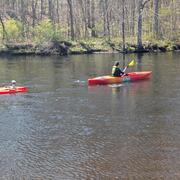
The Hydrologic Monitoring Branch (HMB) provides water data for all six New England states through an expansive network of monitoring locations. The HMB is responsible for a wide range of hydrologic monitoring activities, including collecting and analyzing streamflow, groundwater and coastal water levels, precipitation, and continuous water-quality information, such as water temperature and...

Applied Hydrology Branch
The Applied Hydrology Branch provides hydrologic data, research, and tools to water resource managers, stakeholders and policy makers that inform critical water management decisions throughout New England. This branch is divided into the Hydrology and Hydraulics Section, Water Quality Networks Section, Connecticut Water Quality Monitoring Section, and Massachusetts/Rhode Island Water Quality...
Hydrologic Interpretive Branch
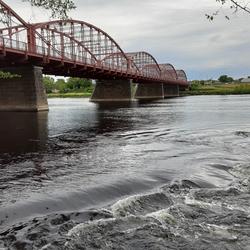
The Hydrologic Interpretive Branch collaborates with stakeholders to design, execute, and publish scientific studies that address issues associated with water resources at local, regional, and national scales. This branch has three sections that focus on watershed and urban hydrology, integrated modeling of hydrologic systems, and the development of new statistical and geospatial tools.
Enhancing Water and Sewer Utility Mapping in Massachusetts
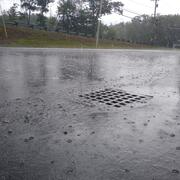
The U.S. Geological Survey (USGS), in cooperation with the Massachusetts Department of Environmental Protection (MassDEP) Water Utility Resilience Program (WURP), is assisting public water and wastewater utilities in transitioning their service infrastructure data to geographic information systems (GIS) and updating related statewide datasets and data visualization tools. Improving access to...
Changes in Nitrogen Contributions from Groundwater to the Niantic River Before and After Sewering
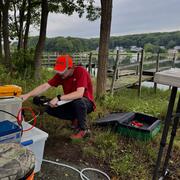
Onsite residential septic systems can be a major nonpoint source of nitrogen contamination. The excess nitrogen entering Connecticut’s Niantic River estuary is associated with high nitrate concentrations in the groundwater of the river’s 28-square-mile watershed, creating unsuitable habitat for the growth and recovery of eelgrass (Zostera marina). In an attempt to improve the river’s water quality...
USGS New England Water Science Center Priorities and Programs
A look at what USGS water science centers do and the New England Water Science Center's current areas of focus and research.

Susceptibility of Water Resources to Water-Quality Impairment from Onsite Wastewater Disposal in Rhode Island
The U.S. Geological Survey (USGS), in cooperation with the Southeast New England Program (SNEP) of the U.S. Environmental Protection Agency and the Rhode Island Department of Environmental Management, is investigating the relationship between onsite wastewater treatment systems and nitrogen loads in water bodies in the Narragansett Bay watershed in Rhode Island.

Estimating Nitrogen Loading from Groundwater and Potential Effects of Sea-Level Rise in Rhode Island's Salt Ponds Region
The U.S. Geological Survey (USGS), in cooperation with the Southeast New England Program of the U.S. Environmental Protection Agency, is estimating the magnitude, spatial distribution, and travel times of nitrogen-loading to ponds and streams in the Salt Ponds region of southern Rhode Island. This information can be used to guide conservation-management efforts aimed at reducing nitrogen inputs to...

Potential Effects of Reductions in Wastewater Return Flow on the Freshwater Flow System in Falmouth, Massachusetts
The U.S. Geological Survey (USGS), in cooperation with the Town of Falmouth, is simulating the potential effects of proposed changes to wastewater return flow on the freshwater system in Falmouth, Massachusetts, using an existing regional groundwater flow model.

Coastal Acidification Monitoring in Long Island Sound
Understanding coastal acidification, as it varies from open ocean acidification, is crucial to identifying the unique problems occurring in coastal ecosystems such as Long Island Sound (LIS). The U.S. Geological Survey (USGS) is monitoring water quality parameters throughout LIS and its embayments to evaluate the status and trends of acidification processes in these waters. This project will...
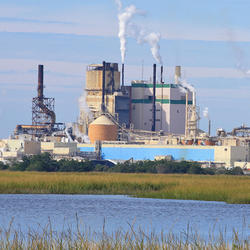
Collaborations with EPA on Contaminated Site Hydrology
The U.S. Geological Survey (USGS), in cooperation with the U.S. Environmental Protection Agency (EPA), is developing tools and methods to help assess the fate and transport of anthropogenic and geologically sourced contaminants in the water cycle at waste sites throughout the nation.

USGS to Improve Water Use Data Management for State of Massachusetts
The USGS New England Water Science Center, in cooperation with the Massachusetts Department of Environmental Protection, is collaborating on a project to improve the data management, visualization, and sharing of the state’s water use information. Additionally, two water management tools will be upgraded. The project team will develop an Executive Office of Energy and Environmental Affairs...

Augmented Site Characterization of PFAS Manufacturing and Processing Facilities
The U.S. Geological Survey (USGS) is supporting the U.S. Environmental Protection Agency (EPA) in assessing facilities nationwide that have historically produced per- and polyfluoroalkyl substances (PFAS) or used them in chemical manufacturing processes. In collaboration with EPA subcontractors, USGS is providing subject-matter expertise in PFAS fate and transport in the vadose zone and...

December 2023 Flood in Maine
The U.S. Geological Survey (USGS) New England Water Science Center, in cooperation with the Federal Emergency Management Agency (FEMA), is conducting a study to characterize the magnitude and extent of the December 18-21, 2023 Flood in various portions of the State of Maine.

July 2023 Flood in Vermont
From July 9 through July 12, 2023, 3 to 9 inches of rain fell within 48 hours across the state of Vermont, causing catastrophic flooding and millions of dollars in damage. The high amount of rain caused several rivers to peak at record levels, in some cases exceeding records set during Tropical Storm Irene in 2011.

Continuous Water Quality Monitoring in the Norwalk River Estuary
The U.S. Geological Survey (USGS), in cooperation with the U.S. Environmental Protection Agency Long Island Sound Study (LISS), is investigating how excess nutrients and low dissolved oxygen affect the water-quality of the lower portion of the Norwalk River Harbor.

Outlining High-Resolution Urban Drainage Systems for Stormwater Management in the Neponset River Watershed
The natural environment and manmade infrastructure must be considered when characterizing hydrology and water quality in urban watersheds. This requirement is critical in stormwater management, which considers water flowing above ground and below ground through stormwater networks. The U.S. Geological Survey (USGS), with support from the U.S. Environmental Protection Agency (EPA), is expanding its...

New England Tribal Engagement
The USGS New England Water Science Center (WSC) is proud to provide science support to Tribal Nations as part of our Federal Trust Responsibility to honor the government-to-government relationships that the United States has with 574 Federally-recognized Tribes. Tribal Nations have ancestral ties with the environment. Natural resources are inextricably connected to sustenance, traditional...

Investigating Connections Between Socioeconomic Data and Populations Susceptible to Private Well-Water Concerns in New Hampshire
The U.S. Geological Survey (USGS) New England Water Science Center, in cooperation with the New Hampshire Department of Environmental Services, is investigating the presence of statistical associations between socioeconomic data (or proxy data) and the susceptibility of private wells to water quality or quantity concerns in New Hampshire.