Scientist collects water sample in the Grand Canyon
Scientist collects water sample in the Grand CanyonUSGS scientist collects a water-quality sample in the Grand Canyon, Arizona.


Official websites use .gov
A .gov website belongs to an official government organization in the United States.

Secure .gov websites use HTTPS
A lock () or https:// means you’ve safely connected to the .gov website. Share sensitive information only on official, secure websites.

See our science through the images below.

USGS scientist collects a water-quality sample in the Grand Canyon, Arizona.
USGS scientist collects a water-quality sample in the Grand Canyon, Arizona.

Water samples are extracted for pesticides at the USGS Organic Chemistry Research Laboratory.
Photo credit: Elisabeth LaBarbera
Water samples are extracted for pesticides at the USGS Organic Chemistry Research Laboratory.
Photo credit: Elisabeth LaBarbera

Suspect screening/non-target analysis is done with LC-HRMS at the Organic Chemistry Research Laboratory (OCRL) in Sacramento, CA.
Photo credit: Michelle Hladik
Suspect screening/non-target analysis is done with LC-HRMS at the Organic Chemistry Research Laboratory (OCRL) in Sacramento, CA.
Photo credit: Michelle Hladik

Composite image showing five life stages of a Long-tailed duck, from hatch to subadult.
Composite image showing five life stages of a Long-tailed duck, from hatch to subadult.

Monitoring bumble bees and flowering plants in alpine meadows at Glacier National Park, photo by Lindsay Dose (USGS contractor)
Monitoring bumble bees and flowering plants in alpine meadows at Glacier National Park, photo by Lindsay Dose (USGS contractor)

USGS scientist Tylor Rosera analyzes dragonfly larvae samples for mercury as part of the Dragonfly Mercury Project.
USGS scientist Tylor Rosera analyzes dragonfly larvae samples for mercury as part of the Dragonfly Mercury Project.

A USGS scientist analyzes dragonfly larvae samples for mercury as part of the Dragonfly Mercury Project.
A USGS scientist analyzes dragonfly larvae samples for mercury as part of the Dragonfly Mercury Project.

Bumble bees being prepped for pesticide residue analysis at the USGS Organic Chemistry Research Laboratory (OCRL), California.
Bumble bees being prepped for pesticide residue analysis at the USGS Organic Chemistry Research Laboratory (OCRL), California.

Co-extracted matrix is removed from biosolids prior to analysis at the USGS Organic Chemistry Research Laboratory (OCRL).
Photo Credit: Gabby Black.
Co-extracted matrix is removed from biosolids prior to analysis at the USGS Organic Chemistry Research Laboratory (OCRL).
Photo Credit: Gabby Black.

Long-tailed duck diving for underwater hearing testing in an experimental chamber in which the birds’ diving behavior can be studied under various environmental conditions.
Long-tailed duck diving for underwater hearing testing in an experimental chamber in which the birds’ diving behavior can be studied under various environmental conditions.

Candling (the process of using light to help determine the quality of an egg) of a grey catbird egg to determine viability.
Candling (the process of using light to help determine the quality of an egg) of a grey catbird egg to determine viability.

Surf Scoter completing an underwater behavioral hearing test in an experimental chamber in which the birds’ diving behavior can be studied under various environmental conditions.
Surf Scoter completing an underwater behavioral hearing test in an experimental chamber in which the birds’ diving behavior can be studied under various environmental conditions.

Two researchers working with an autonomous environmental DNA sampler deployed at the Bighorn Reservoir in Wyoming.
Two researchers working with an autonomous environmental DNA sampler deployed at the Bighorn Reservoir in Wyoming.

Scientists travel by raft to collect various samples on the Colorado River in the Grand Canyon.
Scientists travel by raft to collect various samples on the Colorado River in the Grand Canyon.

The Adélie penguin is a sea-ice obligate species so ocean habitats in the Southern Ocean surrounding Antarctica are crucial during all stages of the species annual cycle.
The Adélie penguin is a sea-ice obligate species so ocean habitats in the Southern Ocean surrounding Antarctica are crucial during all stages of the species annual cycle.
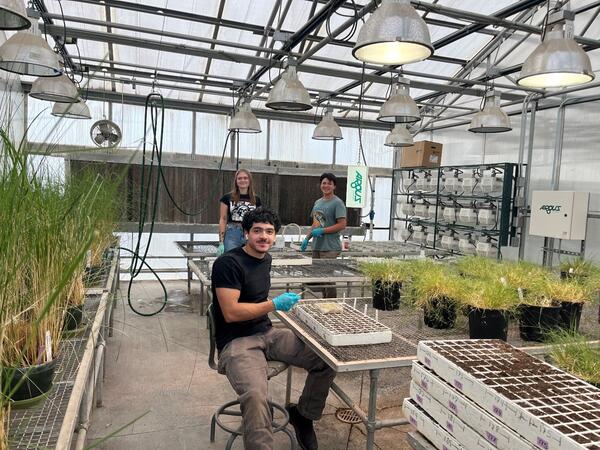
Implementing the Seed Strategy creates jobs and provides career-building opportunities for students and early career professionals.
Implementing the Seed Strategy creates jobs and provides career-building opportunities for students and early career professionals.
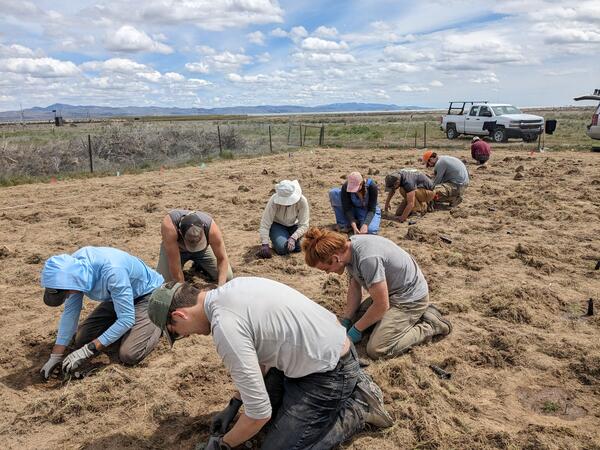
The USGS Fire, Invasives, Restoration, and Ecology in Sagebrush Steppe (FIREss Team) plants a common garden of rubber rabbitbrush (Ericameria nauseosa) near Boise, Idaho in collaboration with USFS.
The USGS Fire, Invasives, Restoration, and Ecology in Sagebrush Steppe (FIREss Team) plants a common garden of rubber rabbitbrush (Ericameria nauseosa) near Boise, Idaho in collaboration with USFS.

Juvenile Coho salmon (Oncorhynchus kisutch) behavior is assessed following exposure to 6PPD-quinone, a derivative of the compound 6PPD which is used in tires to prevent wear.
Juvenile Coho salmon (Oncorhynchus kisutch) behavior is assessed following exposure to 6PPD-quinone, a derivative of the compound 6PPD which is used in tires to prevent wear.

The Adélie penguin is a sea-ice obligate species so ocean habitats in the Southern Ocean surrounding Antarctica are crucial during all stages of the species annual cycle.
The Adélie penguin is a sea-ice obligate species so ocean habitats in the Southern Ocean surrounding Antarctica are crucial during all stages of the species annual cycle.

Due to multiple reasons including the widespread use of microplastics, their environmental persistence, the global connectedness of aquatic environments, and the long-range transport of microplastics, these particles have been documented in every environmental compartment (e.g., air, water, soils).
Due to multiple reasons including the widespread use of microplastics, their environmental persistence, the global connectedness of aquatic environments, and the long-range transport of microplastics, these particles have been documented in every environmental compartment (e.g., air, water, soils).

The Adélie penguin is a sea-ice obligate species so ocean habitats in the Southern Ocean surrounding Antarctica are crucial during all stages of the species annual cycle.
The Adélie penguin is a sea-ice obligate species so ocean habitats in the Southern Ocean surrounding Antarctica are crucial during all stages of the species annual cycle.