



Global Seabed Mineral Resources
Providing stakeholders with best available science regarding potential resources and environmental impacts associated with accessing those resources
Providing stakeholders with best available science regarding potential resources and environmental impacts associated with accessing those resources
Major Update to Satellite-Based Datasets Used to Assess Salt Marsh Vulnerability Nationwide
Seafloor Seismographs Rapidly Deployed Following Major Earthquake Offshore Northern California
Coral reef restoration
Cost-benefit study confirms coral reef restoration could be a cost-effective way to save lives and money
Cost-benefit study confirms coral reef restoration could be a cost-effective way to save lives and money
Ocean
USGS science improves our understanding of ocean processes, marine resources and submarine geohazards.
USGS science improves our understanding of ocean processes, marine resources and submarine geohazards.
Coasts
USGS provides critical science that informs risk reduction, protecting people, businesses, infrastructure, and resources along our coastlines, where 40% of our population lives.
USGS provides critical science that informs risk reduction, protecting people, businesses, infrastructure, and resources along our coastlines, where 40% of our population lives.
Meet the Coastal Science Navigator
Learn more about this new product to help you find useful USGS coastal data and tools
Learn more about this new product to help you find useful USGS coastal data and tools
Coastal and Marine Hazards and Resources Program
Scientists and staff study coastal and ocean processes, from shorelines to the deep sea, to identify hazards and provide critical information on our nation's resources. This work supports preparedness, emergency response, and the protection of people and resources in coastal and ocean environments.
Sound Waves Newsletter
Sound Waves Newsletter

Coastal and marine news from across the U.S. Geological Survey

News
USGS monitors California's coastal hazards during the 2026-2027 El Niño event
USGS monitors California's coastal hazards during the 2026-2027 El Niño event
SPCMSC Repairs Madeira Beach, FL Coastal Camera
SPCMSC Repairs Madeira Beach, FL Coastal Camera
SPCMSC Scientists Perform Fieldwork on the Coral-Rubble Keys Protecting Dry Tortugas National Park
SPCMSC Scientists Perform Fieldwork on the Coral-Rubble Keys Protecting Dry Tortugas National Park
Publications
Permeability and compressibility of “seal” sediment overlying the B1 sand gas hydrate reservoir: Hydrate 02 Geo Data Well, Prudhoe Bay unit, Alaska North Slope Permeability and compressibility of “seal” sediment overlying the B1 sand gas hydrate reservoir: Hydrate 02 Geo Data Well, Prudhoe Bay unit, Alaska North Slope
An important element in evaluating the viability of extracting methane from a gas hydrate-bearing reservoir is establishing the effectiveness of the overlying bounding sediment as a seal to prevent gas loss, to enable effective depressurization, and to prevent fluid from entering the reservoir during production. This laboratory study presents results for index properties (e.g., grain...
Strength, stiffness, and Poisson’s ratio measurements for cements used in the well completions for the extended-duration gas production test on the Alaskan North Slope Strength, stiffness, and Poisson’s ratio measurements for cements used in the well completions for the extended-duration gas production test on the Alaskan North Slope
As part of an extended-duration production test from a natural gas hydrate reservoir on the Alaska North Slope, a suite of optical-fiber sensors was encased in the completion cement to provide stable downhole monitoring around each of the four project wells. How the sensors respond to changes in the reservoir over time depends in part on properties of the LiteCRETE, ArcticCem, or Tuned...
A methods framework for evaluating measurement consistency across spectrometers for multispectral uncrewed aerial system vegetation mapping applications A methods framework for evaluating measurement consistency across spectrometers for multispectral uncrewed aerial system vegetation mapping applications
The U.S. Geological Survey collects remote sensing data to support national scientific assessments of natural resources, hazards, and landscape change. Spectrometers and spectroradiometers are essential for gathering point-based spectral measurements used in applications such as uncrewed aerial systems (UAS) multispectral image calibration, validation, and analysis. Evaluating how...
Science
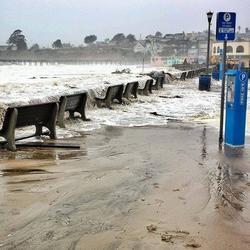
El Niño Coastal Hazards (2026-2027)
The 2026-2027 El Niño is projected to be the largest and most intense on record. Pacific storms during previous El Niño events have caused widespread coastal hazards along the California coast from flooding and erosion. The USGS is uniquely positioned to assist with coastal monitoring, data collection, science and communications with partners about these pending hazards.

Digital Shoreline Analysis System (DSAS)
Software for calculating positional boundary change over time The Digital Shoreline Analysis System (DSAS) version 6 is a standalone application that calculates shoreline or boundary change over time. The GIS of a user’s choice is used to prepare the data for DSAS. Like previous versions, DSAS v.6 enables a user to calculate rate-of-change statistics from multiple historical shoreline positions...

COAWST: A Coupled-Ocean-Atmosphere-Wave-Sediment Transport Modeling System
Understanding the processes responsible for coastal change is important for managing both our natural and economic coastal resources. Storms are one of the primary driving forces causing coastal change from a coupling of wave- and wind-driven flows. To better understand storm impacts and their effects on our coastlines, there is an international need to better predict storm paths and intensities...