U.S. flag

An official website of the United States government

Images

Hawaiian Volcano Observatory images of eruptive activity, field work, and more.

Filter Total Items: 3744
A scientists wearing and orange flight suit and a white flight helmet samples black, cooled lava.
September 24, 2025 — Sampling episode 33 lava in Halemaʻumaʻu at the summit of Kīlauea

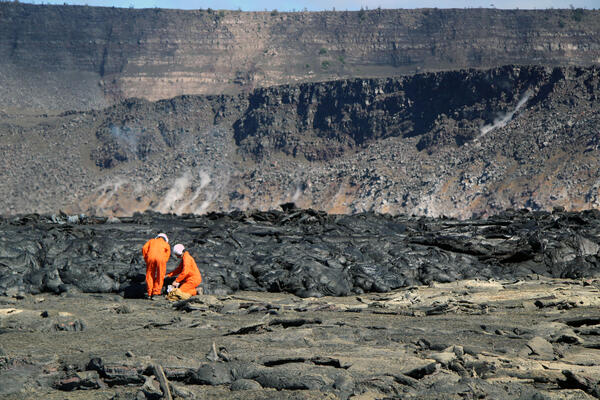
On September 24, 2025, USGS Hawaiian Volcano Observatory field crews collected samples from a cooled 'a'ā lava flow erupted during episode 33 (left half of photo in foreground) at Kīlauea volcano. This was part of a morning monitoring helicopter overflight of Kīlauea summit.

On September 24, 2025, USGS Hawaiian Volcano Observatory field crews collected samples from a cooled 'a'ā lava flow erupted during episode 33 (left half of photo in foreground) at Kīlauea volcano. This was part of a morning monitoring helicopter overflight of Kīlauea summit.

Color thermal map indicating that the floor of crater is all warm, and areas of recent flows are hottest.
September 24, 2025— Kīlauea thermal map

This thermal map shows the temperature distribution on the crater floor at the summit of Kīlauea. The ongoing eruption has covered the crater floor in successive layers of new lava flows. This thermal map shows that the flows that erupted during episode 33 (September 19) remain warm, and are visible along the north and south margins of the crater.

This thermal map shows the temperature distribution on the crater floor at the summit of Kīlauea. The ongoing eruption has covered the crater floor in successive layers of new lava flows. This thermal map shows that the flows that erupted during episode 33 (September 19) remain warm, and are visible along the north and south margins of the crater.

color photo looking down at cooled black lava and pale gray steam.
September 24, 2025 — North and south vents at the summit of Kīlauea

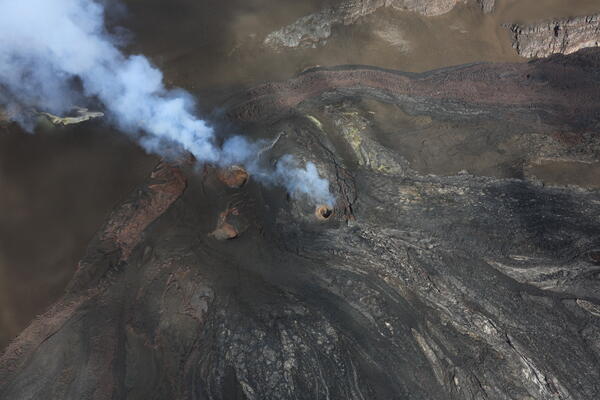
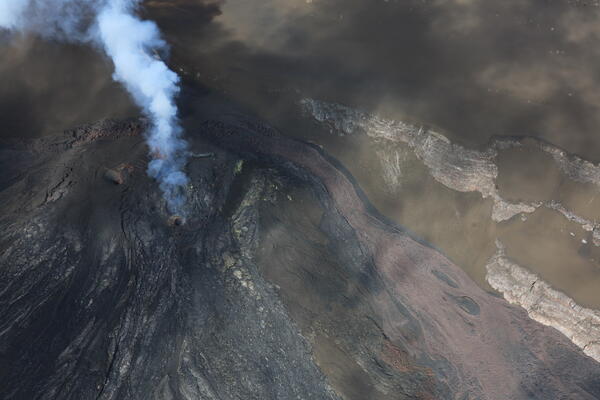
USGS Hawaiian Volcano Observatory scientists took this oblique angle view of north (center) and south vents (to the right and closer to top of photo) during a Kīlauea summit monitoring overflight on September 24. The brown sand-like material that covers the right and top parts of the photo are tephra erupted during episode 33.

USGS Hawaiian Volcano Observatory scientists took this oblique angle view of north (center) and south vents (to the right and closer to top of photo) during a Kīlauea summit monitoring overflight on September 24. The brown sand-like material that covers the right and top parts of the photo are tephra erupted during episode 33.

color photo of the Kaluapele with the steaming vents in the distance.
September 24, 2025 — Overview of Kaluapele

The USGS Hawaiian Volcano Observatory's helicopter overflight on September 24 provided aerial views of Kaluapele (Kīlauea caldera) from the east looking west. The vents of the eruption that started on December 23, 2024 are degassing on the western side of Halema‘uma‘u crater. Mauna Loa can be seen in the background. USGS photo by N. Deligne.
The USGS Hawaiian Volcano Observatory's helicopter overflight on September 24 provided aerial views of Kaluapele (Kīlauea caldera) from the east looking west. The vents of the eruption that started on December 23, 2024 are degassing on the western side of Halema‘uma‘u crater. Mauna Loa can be seen in the background. USGS photo by N. Deligne.
color photo looking towards the lava fountain producing a large stream cloud
September 19, 2025 – Episode 33 from Volcano House

Episode 33 lava fountain from the north vent, as seen from Volcano House, on the morning of September 19, 2025, at approximately 7:15 am. The lava fountain was approximately 300–400 feet (90–120 meters). Photo by USGS geologist D. Downs.

Episode 33 lava fountain from the north vent, as seen from Volcano House, on the morning of September 19, 2025, at approximately 7:15 am. The lava fountain was approximately 300–400 feet (90–120 meters). Photo by USGS geologist D. Downs.

color photo of a man's hand holding a large, black lava bomb about the size of a basketball.
September 19, 2025 – A lava bomb from the north vent

A lava bomb from the north vent above the crater rim that was found not long after it landed and cooled. As the molten bombs fly through the air, they cool and form a glassy crust with the interior full of vesicles. Most shatter into many pieces upon impact with the ground, but on rare occasions some stay mostly intact.

A lava bomb from the north vent above the crater rim that was found not long after it landed and cooled. As the molten bombs fly through the air, they cool and form a glassy crust with the interior full of vesicles. Most shatter into many pieces upon impact with the ground, but on rare occasions some stay mostly intact.

color photo of lava fountain visible beyond the end of a broken road.
September 19, 2025 – Lava fountain from the old Crater Rim Drive.

The episode 33 lava fountain from the north vent, at the summit of Kīlauea, is seen beyond the collapsed end of Crater Rim Drive. This portion of Crater Rim Drive was destroyed during the 2018 summit collapse events, and is closed to the public. USGS photo by M. Patrick.

The episode 33 lava fountain from the north vent, at the summit of Kīlauea, is seen beyond the collapsed end of Crater Rim Drive. This portion of Crater Rim Drive was destroyed during the 2018 summit collapse events, and is closed to the public. USGS photo by M. Patrick.

color photo of lava fountain just barely peeking over the crater rim.
September 19, 2025 – Episode 33 from the crater rim.

Photo of the lava fountain peeking over the crater rim and the gas plume in white lofting to the southwest with the trade winds. Photo by USGS geologist D. Downs.

Photo of the lava fountain peeking over the crater rim and the gas plume in white lofting to the southwest with the trade winds. Photo by USGS geologist D. Downs.

color photo of two geologist looking at the lava fountain in the background.
September 19, 2025 – Observing episode 33

HVO geologists collect video and make visual observations of the episode 33 lava fountain, at the summit of Kīlauea. USGS photo by M. Patrick.

HVO geologists collect video and make visual observations of the episode 33 lava fountain, at the summit of Kīlauea. USGS photo by M. Patrick.

color photo of two scientists walking away after observing the lava fountain in the distance.
September 19, 2025 – Lava fountain observed from the old Crater Rim Drive.

HVO geologists make an initial assessment of the episode 33 lava fountain from the collapsed end of Crater Rim Drive, at the summit of Kīlauea. This portion of Crater Rim Drive was destroyed during the 2018 summit collapse events, and is closed to the public. USGS photo by M. Patrick.

HVO geologists make an initial assessment of the episode 33 lava fountain from the collapsed end of Crater Rim Drive, at the summit of Kīlauea. This portion of Crater Rim Drive was destroyed during the 2018 summit collapse events, and is closed to the public. USGS photo by M. Patrick.

color photo of red hot lava flowing out of the vent, which is all black.
September 19, 2025 – Precursory activity at Halema‘uma‘u before episode 33

Activity at the Halema‘uma‘u summit eruption is increasing prior to episode 33. North vent is experiencing gas pistoning cycles (lava fills vent, overflows, drains). Lava flows from north vent are contained to a single dominant channel exiting the cone. North vent is approximately 20 m (65 feet) from base of the vent to the perched lava pond.

Activity at the Halema‘uma‘u summit eruption is increasing prior to episode 33. North vent is experiencing gas pistoning cycles (lava fills vent, overflows, drains). Lava flows from north vent are contained to a single dominant channel exiting the cone. North vent is approximately 20 m (65 feet) from base of the vent to the perched lava pond.

Color photo of bright red lava emerging from lava lake with cooled, black surface.
September 17, 2025 – Lava rises within the north vent during gas pistoning activity

Cyclic rising and falling of the lava pond at the Halema‘uma‘u north vent was indicative of ongoing gas pistoning during the morning of September 17. Seismometers have tracked this gas pistoning since shortly after the end of Kīlauea summit eruptive episode 32 on September 2, but only in the past couple days has lava risen high enough for the cycles to be visible.

Cyclic rising and falling of the lava pond at the Halema‘uma‘u north vent was indicative of ongoing gas pistoning during the morning of September 17. Seismometers have tracked this gas pistoning since shortly after the end of Kīlauea summit eruptive episode 32 on September 2, but only in the past couple days has lava risen high enough for the cycles to be visible.

Color photo of cooled, black lava that overflowed from the north vent.
September 17, 2025 – Remains of overflow from north vent

At 8:38 a.m. HST on September 17, the Halema‘uma‘u north vent overflowed for the first time in advance of Kīlauea summit eruptive episode 33.

Color map of the Manuʻa Islands, American Samoa
September 2025—Topography and bathymetry of the Manuʻa Islands, American Samoa

This reference map depicts the volcanoes of the Manuʻa Islands, American Samoa, which are monitored by the USGS Hawaiian Volcano Observatory.

Color map showing area covered by lava flows in recent volcanic eruption
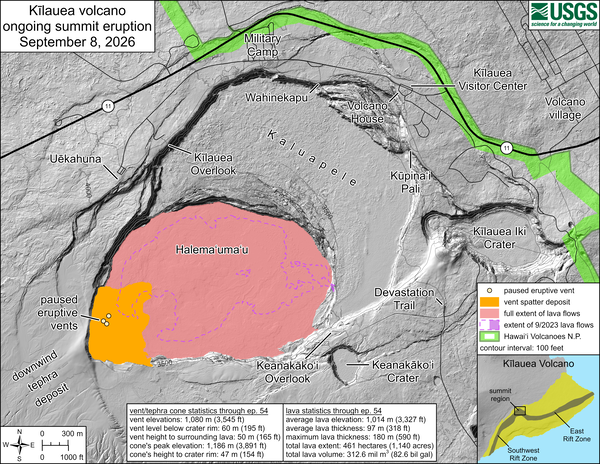
September 12, 2025—Kīlauea summit eruption reference map

This reference map depicts the Kīlauea summit eruption within Halema‘uma‘u crater that began on December 23, 2024. As of this posting on September 12, 2025, the eruption has had thirty-two episodes, with the most recent occurring on September 2.

This reference map depicts the Kīlauea summit eruption within Halema‘uma‘u crater that began on December 23, 2024. As of this posting on September 12, 2025, the eruption has had thirty-two episodes, with the most recent occurring on September 2.

Color photo of a GPS station and solar panel in grass in a tropical setting.
September 3, 2025 – Volcano monitoring GPS station on TAU Island, American Samoa

Photo of the USGS Global Positioning System (GPS) monitoring station on western Ta‘ū Island in the Manuʻa Islands of American Samoa. The station consists of a GPS unit, which can measure very slight movements of the ground, placed on a tripod that is leveled and centered over a benchmark.

Photo of the USGS Global Positioning System (GPS) monitoring station on western Ta‘ū Island in the Manuʻa Islands of American Samoa. The station consists of a GPS unit, which can measure very slight movements of the ground, placed on a tripod that is leveled and centered over a benchmark.

Color photograph of bucket next to mound of volcanic material with person walking in the distance
September 3, 2025 — Tephra mound at Kīlauea summit

A USGS Hawaiian Volcano Observatory geologist descends from the new tephra mound at Kīlauea summit that has been deposited over part of Crater Rim Drive (closed to the public) in Hawai‘i Volcanoes National Park. The short wooden post in the bottom left is the top of a sign post for the road. A tephra collection bucket is situated here for tephra sampling.

A USGS Hawaiian Volcano Observatory geologist descends from the new tephra mound at Kīlauea summit that has been deposited over part of Crater Rim Drive (closed to the public) in Hawai‘i Volcanoes National Park. The short wooden post in the bottom left is the top of a sign post for the road. A tephra collection bucket is situated here for tephra sampling.

Color photograph of road covered with tephra
September 3, 2025 — Kīlauea summit eruption tephra on Crater Rim Drive

South of the active vents at Kīlauea summit, sections of Crater Rim Drive (closed to the public) in Hawai‘i Volcanoes National Park are covered in thinner deposits of tephra. The main axis of deposition of tephra was to the west of the vents, where the tephra has formed a mound over 20 meters (yards) deep over the road. USGS photo by M. Patrick.

South of the active vents at Kīlauea summit, sections of Crater Rim Drive (closed to the public) in Hawai‘i Volcanoes National Park are covered in thinner deposits of tephra. The main axis of deposition of tephra was to the west of the vents, where the tephra has formed a mound over 20 meters (yards) deep over the road. USGS photo by M. Patrick.

Color photograph of degassing volcanic vents
September 3, 2025 — Kīlauea summit volcanic vents degassing

USGS Hawaiian Volcano Observatory geologists visited the caldera rim at Kīlauea summit to assess the aftermath of episode 32 lava fountaining. The vent was quiet, with no audible sounds, and a thick outgassing plume rose from the vents. The broad lava channel that was fed from episode 32 lava fountaining can be seen here extending to the left side of the image.

USGS Hawaiian Volcano Observatory geologists visited the caldera rim at Kīlauea summit to assess the aftermath of episode 32 lava fountaining. The vent was quiet, with no audible sounds, and a thick outgassing plume rose from the vents. The broad lava channel that was fed from episode 32 lava fountaining can be seen here extending to the left side of the image.

Color photo of a large green cliff on an island towering over the blue ocean.
September 3, 2025 – View of Ofu-Olosega Islands, American Samoa

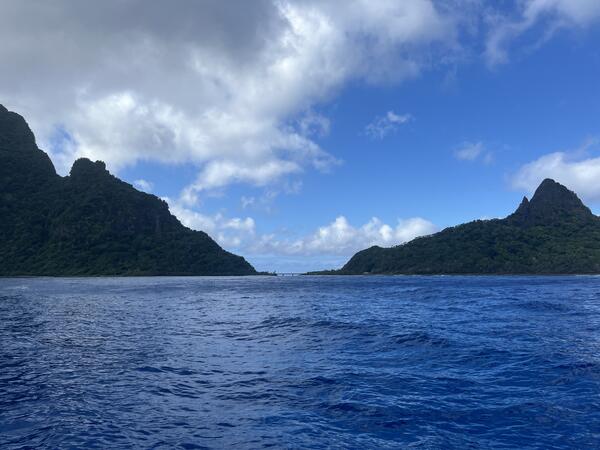
This photo, taken from a boat, shows Olosega Island on the left, and Ofu Island further away on the right, in the Manuʻs Islands of American Samoa. These islands, connected by a one-lane bridge (out of sight), are the top of Ofu-Olosega volcano. USGS photo by N. Deligne.
This photo, taken from a boat, shows Olosega Island on the left, and Ofu Island further away on the right, in the Manuʻs Islands of American Samoa. These islands, connected by a one-lane bridge (out of sight), are the top of Ofu-Olosega volcano. USGS photo by N. Deligne.
Color photo of before and after images of a solar panel covered and then cleared of plants growing over it.
Broadband seismometer site on eastern Taʻū, American Samoa, before and after it was cleared of vegetation.

Broadband seismometer site on eastern Taʻū, American Samoa, before (inset) and after a work party cleared rapidly growing vegetation which had covered the solar panels along with the boulders to the right of the main photo. Due to lack of power from the solar panels being unable to charge during the day, the station was offline for many months.

Broadband seismometer site on eastern Taʻū, American Samoa, before (inset) and after a work party cleared rapidly growing vegetation which had covered the solar panels along with the boulders to the right of the main photo. Due to lack of power from the solar panels being unable to charge during the day, the station was offline for many months.

Was this page helpful?