



On October 17, 1989, at 5:04 pm a magnitude M6.9 earthquake struck near Loma Prieta, California. It was a tragic reminder of the destructive power of earthquakes. However, it was also a watershed moment in seismic research. 30 years later, we revisit the earthquake through the eyes of the scientists who experienced it. And studied it. These are their stories.
Videos
Earthquake Hazards Program videos.
Filter Total Items: 67

October 17, 1989 (Part 4)
On October 17, 1989, at 5:04 pm a magnitude M6.9 earthquake struck near Loma Prieta, California. It was a tragic reminder of the destructive power of earthquakes. However, it was also a watershed moment in seismic research. 30 years later, we revisit the earthquake through the eyes of the scientists who experienced it. And studied it. These are their stories.

Prototype Earthquake Early Warning System (Interview)
Prototype Earthquake Early Warning System (Interview)Retired seismologist David Oppenheimer reflects on the first prototype earthquake early warning system used during the 1989 Loma Prieta earthquake. Scientists deployed an analog system to notify first responders of impending earthquake activity as they worked on rescue efforts at the Cypress Viaduct collapse in Oakland, CA.
Prototype Earthquake Early Warning System (Interview)
Prototype Earthquake Early Warning System (Interview)Retired seismologist David Oppenheimer reflects on the first prototype earthquake early warning system used during the 1989 Loma Prieta earthquake. Scientists deployed an analog system to notify first responders of impending earthquake activity as they worked on rescue efforts at the Cypress Viaduct collapse in Oakland, CA.

Animation of a Scenario M6.9 Earthquake on the Rose Canyon Fault
Animation of a Scenario M6.9 Earthquake on the Rose Canyon FaultThis video presents an animation of computer-simulated ground motions that might occur for a magnitude 6.9 earthquake rupturing the Rose Canyon fault in southern California. The scenario earthquake ruptures a 65-km-long section of the Rose Canyon fault that lies just offshore of San Diego, California, and Tijuana, Mexico.
Animation of a Scenario M6.9 Earthquake on the Rose Canyon Fault
Animation of a Scenario M6.9 Earthquake on the Rose Canyon FaultThis video presents an animation of computer-simulated ground motions that might occur for a magnitude 6.9 earthquake rupturing the Rose Canyon fault in southern California. The scenario earthquake ruptures a 65-km-long section of the Rose Canyon fault that lies just offshore of San Diego, California, and Tijuana, Mexico.

ShakeAlert Sensor and Station
This is b-roll footage of a ShakeAlert earthquake early warning system seismic station. These seismic stations and sensors are deployed around California and are used to monitor earthquake activity.
This is b-roll footage of a ShakeAlert earthquake early warning system seismic station. These seismic stations and sensors are deployed around California and are used to monitor earthquake activity.

Animation of Ridgecrest Foreshock Seq up to M7.1 (Prelim. Results)
Animation of Ridgecrest Foreshock Seq up to M7.1 (Prelim. Results)This animation shows preliminary results from precise relocation of the Ridgecrest foreshock sequence, up to the the time of occurrence of the M 7.1 mainshock. The animation begins in a map view and then transitions into a rotating vertical slice. Earthquakes are colorcoded by time of occurrence, with early events in dark blue and later events (up to the
Animation of Ridgecrest Foreshock Seq up to M7.1 (Prelim. Results)
Animation of Ridgecrest Foreshock Seq up to M7.1 (Prelim. Results)This animation shows preliminary results from precise relocation of the Ridgecrest foreshock sequence, up to the the time of occurrence of the M 7.1 mainshock. The animation begins in a map view and then transitions into a rotating vertical slice. Earthquakes are colorcoded by time of occurrence, with early events in dark blue and later events (up to the

Animation of Ridgecrest Earthquake Seq. thru July 6 (Prelim. Results)
Animation of Ridgecrest Earthquake Seq. thru July 6 (Prelim. Results)This animation shows preliminary results from precise relocation of the Ridgecrest earthquake sequence, through July 6 (UTC), including the foreshock sequence and the first ~20 hours of aftershocks from M 7.1 mainshock. The animation begins in a map view and then transitions into a rotating vertical slice. Earthquakes are colorcoded by time of occurrence
Animation of Ridgecrest Earthquake Seq. thru July 6 (Prelim. Results)
Animation of Ridgecrest Earthquake Seq. thru July 6 (Prelim. Results)This animation shows preliminary results from precise relocation of the Ridgecrest earthquake sequence, through July 6 (UTC), including the foreshock sequence and the first ~20 hours of aftershocks from M 7.1 mainshock. The animation begins in a map view and then transitions into a rotating vertical slice. Earthquakes are colorcoded by time of occurrence

California Earthquakes (July 2019) - Animation Sequence
California Earthquakes (July 2019) - Animation SequenceThis video shows the earthquake events a few hours before the M6.4 on July 4th, 2019 till after the M7.1 on July 8th, 2019. The blue dots are the events associated with the M6.4 and then red dots are events associated with the M7.1
California Earthquakes (July 2019) - Animation Sequence
California Earthquakes (July 2019) - Animation SequenceThis video shows the earthquake events a few hours before the M6.4 on July 4th, 2019 till after the M7.1 on July 8th, 2019. The blue dots are the events associated with the M6.4 and then red dots are events associated with the M7.1

Shaking of Atwood Building, Mw 7.0 November 30, 2018, Anchorage quake
Shaking of Atwood Building, Mw 7.0 November 30, 2018, Anchorage quakeThis video presents a visualization of how the Atwood Building in Anchorage, Alaska, shook during the Mw 7.0 November 30, 2018, Anchorage, Alaska, earthquake. The building was instrumented by the U.S. Geological Survey to obtain data to study its behavior and performance during strong shaking.
Shaking of Atwood Building, Mw 7.0 November 30, 2018, Anchorage quake
Shaking of Atwood Building, Mw 7.0 November 30, 2018, Anchorage quakeThis video presents a visualization of how the Atwood Building in Anchorage, Alaska, shook during the Mw 7.0 November 30, 2018, Anchorage, Alaska, earthquake. The building was instrumented by the U.S. Geological Survey to obtain data to study its behavior and performance during strong shaking.

Shaking of Frontier Building, M7.0 November 30, 2018, Anchorage Quake
Shaking of Frontier Building, M7.0 November 30, 2018, Anchorage QuakeThis video presents a visualization of how the Frontier Building in Anchorage, Alaska, shook during the moment magnitude (Mw) 7.0 November 30, 2018, Anchorage, Alaska, earthquake. The building was instrumented by U.S. Geological Survey to obtain data to study its behavior and performance during strong shaking.
Shaking of Frontier Building, M7.0 November 30, 2018, Anchorage Quake
Shaking of Frontier Building, M7.0 November 30, 2018, Anchorage QuakeThis video presents a visualization of how the Frontier Building in Anchorage, Alaska, shook during the moment magnitude (Mw) 7.0 November 30, 2018, Anchorage, Alaska, earthquake. The building was instrumented by U.S. Geological Survey to obtain data to study its behavior and performance during strong shaking.

Shaking of BP Exploration Building, M7 Nov. 30, 2018, Anchorage Quake
Shaking of BP Exploration Building, M7 Nov. 30, 2018, Anchorage QuakeThis video presents a visualization of how the BP Exploration Building in Anchorage, Alaska, shook during the moment magnitude (Mw) 7.0 November 30, 2018, Anchorage, Alaska, earthquake. The building was instrumented by U.S. Geological Survey (USGS) to obtain data to study its behavior and performance during strong shaking.
Shaking of BP Exploration Building, M7 Nov. 30, 2018, Anchorage Quake
Shaking of BP Exploration Building, M7 Nov. 30, 2018, Anchorage QuakeThis video presents a visualization of how the BP Exploration Building in Anchorage, Alaska, shook during the moment magnitude (Mw) 7.0 November 30, 2018, Anchorage, Alaska, earthquake. The building was instrumented by U.S. Geological Survey (USGS) to obtain data to study its behavior and performance during strong shaking.

PubTalk 9/2018 - Hayward Earthquake
Title: The 150th Anniversary of the Damaging 1868 Hayward Earthquake: Why It Matters and How We Can Prepare for Its Repeat
Title: The 150th Anniversary of the Damaging 1868 Hayward Earthquake: Why It Matters and How We Can Prepare for Its Repeat

Northwest ShakeAlert Sensor Station
Maintenance of a high-quality ShakeAlert sensors, power and telemetry stations.
Maintenance of a high-quality ShakeAlert sensors, power and telemetry stations.

B-Roll California ShakeAlert Sensor
Maintenance of high quality ShakeAlert sensor, power and telemetry station.
Maintenance of high quality ShakeAlert sensor, power and telemetry station.

HayWired Scenario - Movie
The HayWired earthquake scenario, led by the U.S. Geological Survey (USGS), anticipates the impacts of a hypothetical magnitude-7.0 earthquake on the Hayward Fault.
The HayWired earthquake scenario, led by the U.S. Geological Survey (USGS), anticipates the impacts of a hypothetical magnitude-7.0 earthquake on the Hayward Fault.

PubTalk 1/2018 — ShakeAlert: Path to West Coast EQ Early Warning
PubTalk 1/2018 — ShakeAlert: Path to West Coast EQ Early WarningTitle: ShakeAlert: The Path to West Coast Earthquake Early Warning ... how a few seconds can save lives and property
PubTalk 1/2018 — ShakeAlert: Path to West Coast EQ Early Warning
PubTalk 1/2018 — ShakeAlert: Path to West Coast EQ Early WarningTitle: ShakeAlert: The Path to West Coast Earthquake Early Warning ... how a few seconds can save lives and property

Return to the Alaska Wilderness
A team of USGS scientists spent two weeks in the isolated Glacier Bay National Park, exploring one of the fastest-moving faults in North America.
A team of USGS scientists spent two weeks in the isolated Glacier Bay National Park, exploring one of the fastest-moving faults in North America.

Excavating the Teton Trench September 2017 - Day 2
Excavating the Teton Trench September 2017 - Day 2USGS scientists Rich Briggs, Ryan Gold, Chris DuRoss, and Jaime Delano spent September 5-21, 2017 outside of Jackson, Wyoming doing fieldwork at a site to collect paleoseismology data on a segment of the Teton Fault. This video shows the second day of the site excavation inside the flagged the boundaries set up by the group.
Excavating the Teton Trench September 2017 - Day 2
Excavating the Teton Trench September 2017 - Day 2USGS scientists Rich Briggs, Ryan Gold, Chris DuRoss, and Jaime Delano spent September 5-21, 2017 outside of Jackson, Wyoming doing fieldwork at a site to collect paleoseismology data on a segment of the Teton Fault. This video shows the second day of the site excavation inside the flagged the boundaries set up by the group.
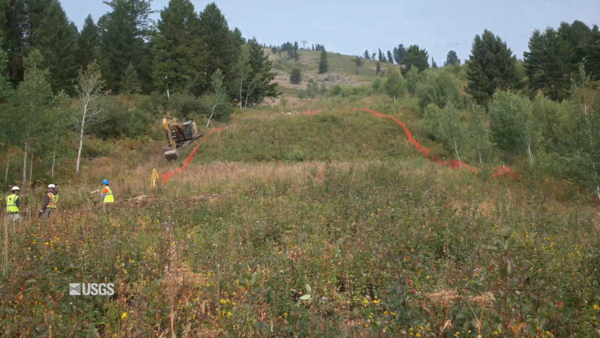
Excavating the Teton Trench September 2017 - Day 1
Excavating the Teton Trench September 2017 - Day 1USGS scientists Rich Briggs, Ryan Gold, Chris DuRoss, and Jaime Delano spent September 5-21, 2017 outside of Jackson, Wyoming doing fieldwork at a site to collect paleoseismology data on a segment of the Teton Fault. This video shows the first day of the site excavation inside the flagged the boundaries set up by the group.
Excavating the Teton Trench September 2017 - Day 1
Excavating the Teton Trench September 2017 - Day 1USGS scientists Rich Briggs, Ryan Gold, Chris DuRoss, and Jaime Delano spent September 5-21, 2017 outside of Jackson, Wyoming doing fieldwork at a site to collect paleoseismology data on a segment of the Teton Fault. This video shows the first day of the site excavation inside the flagged the boundaries set up by the group.

PubTalk 5/2017 — Underwater secrets of the Hayward fault zone
PubTalk 5/2017 — Underwater secrets of the Hayward fault zoneTitle: Underwater Secrets of the Hayward Fault Zone: Integrated 3D imaging to understand earthquake hazards
PubTalk 5/2017 — Underwater secrets of the Hayward fault zone
PubTalk 5/2017 — Underwater secrets of the Hayward fault zoneTitle: Underwater Secrets of the Hayward Fault Zone: Integrated 3D imaging to understand earthquake hazards

USGS Science in Point Reyes National Seashore (California)
USGS Science in Point Reyes National Seashore (California)Interviews with staff at Point Reyes National Seashore tell how this National Park Service unit uses USGS science to educate visitors, and manage the park.
By
Core Science Systems, Ecosystems, Natural Hazards, Coastal and Marine Hazards and Resources Program, Earthquake Hazards, National Land Imaging Program, Landslide Hazards, Climate Adaptation Science Centers, Wildlife Program, Pacific Coastal and Marine Science Center, Western Ecological Research Center (WERC), Communications and Publishing
USGS Science in Point Reyes National Seashore (California)
USGS Science in Point Reyes National Seashore (California)Interviews with staff at Point Reyes National Seashore tell how this National Park Service unit uses USGS science to educate visitors, and manage the park.
By
Core Science Systems, Ecosystems, Natural Hazards, Coastal and Marine Hazards and Resources Program, Earthquake Hazards, National Land Imaging Program, Landslide Hazards, Climate Adaptation Science Centers, Wildlife Program, Pacific Coastal and Marine Science Center, Western Ecological Research Center (WERC), Communications and Publishing

Catching the Quakes - Using Seismic Signals to Track Debris Flows
Catching the Quakes - Using Seismic Signals to Track Debris FlowsUSGS Research Geophysicist Kate Allstadt conducts experiments at the U.S. Geological Survey debris-flow flume, near Eugene, Oregon. Dr. Allstadt and her group are working toward an understanding of how debris flows generate seismic signals.
Catching the Quakes - Using Seismic Signals to Track Debris Flows
Catching the Quakes - Using Seismic Signals to Track Debris FlowsUSGS Research Geophysicist Kate Allstadt conducts experiments at the U.S. Geological Survey debris-flow flume, near Eugene, Oregon. Dr. Allstadt and her group are working toward an understanding of how debris flows generate seismic signals.