



SEABOSS 3.0 Reaches New Milestone with Successful Testing
Explore Global Coastal Research Using the COAWST Applications Catalog
USGS Coastal Change Products Help the EPA Safeguard Long Island Sound Shorelines
Sound Waves Newsletter
Explore coastal and marine science from across the USGS in Sound Waves.
Explore coastal and marine science from across the USGS in Sound Waves.
Woods Hole Coastal and Marine Science Center Newsletter: Spring 2026
Sharing science stories, popular social media posts, recent publications, fieldwork activities, and more center happenings.
Sharing science stories, popular social media posts, recent publications, fieldwork activities, and more center happenings.
A Path to National-Scale Coastal Change Projections
GeoPackage of Seabed Hazards: A Resource for Safeguarding Offshore Infrastructure
We Make Treasure Maps: USGS Charts the Seafloor to Help Locate Critical Minerals, Precious Metals, and Other Vital Resources
Woods Hole Coastal and Marine Science Center
Our center is one of three facilities serving the mission of the USGS Coastal and Marine Hazards and Resources Program.
We study extreme events and physical, biological, and chemical processes that shape our coastal and marine environments. Using this information, we identify hazards and provide critical information on our Nation’s resources. Our research and science-based products provide the strong scientific foundation needed by decisions makers, scientists, and state and federal agencies to address public safety, national security, and resource management across our Nation’s coastal and submerged lands.
Research
Research

Read about our science projects, find out where we are working and why it matters

Highlights
Highlights
- Sound Waves: Coastal and Marine Research News from Across the USGS
- Woods Hole Coastal and Marine Science Center Newsletter
- Annual Reports and General Information Product
- Woods Hole Coastal and Marine Science Center Field Activities
- Employment Opportunities
- Decadal Science Strategy
- Featured USGS Series Report
News
Sound Waves Newsletter: Summer 2026
Sound Waves Newsletter: Summer 2026
Woods Hole Coastal and Marine Science Center: 2025 Annual Report
Woods Hole Coastal and Marine Science Center: 2025 Annual Report
USGS Scientists at the 2026 Long Island Sound Research Conference
USGS Scientists at the 2026 Long Island Sound Research Conference
Publications
Permeability and compressibility of “seal” sediment overlying the B1 sand gas hydrate reservoir: Hydrate 02 Geo Data Well, Prudhoe Bay unit, Alaska North Slope Permeability and compressibility of “seal” sediment overlying the B1 sand gas hydrate reservoir: Hydrate 02 Geo Data Well, Prudhoe Bay unit, Alaska North Slope
An important element in evaluating the viability of extracting methane from a gas hydrate-bearing reservoir is establishing the effectiveness of the overlying bounding sediment as a seal to prevent gas loss, to enable effective depressurization, and to prevent fluid from entering the reservoir during production. This laboratory study presents results for index properties (e.g., grain...
Strength, stiffness, and Poisson’s ratio measurements for cements used in the well completions for the extended-duration gas production test on the Alaskan North Slope Strength, stiffness, and Poisson’s ratio measurements for cements used in the well completions for the extended-duration gas production test on the Alaskan North Slope
As part of an extended-duration production test from a natural gas hydrate reservoir on the Alaska North Slope, a suite of optical-fiber sensors was encased in the completion cement to provide stable downhole monitoring around each of the four project wells. How the sensors respond to changes in the reservoir over time depends in part on properties of the LiteCRETE, ArcticCem, or Tuned...
Lithological control of gas hydrate saturation determined by pressure core analysis in sub-permafrost reservoirs of the Alaska North Slope (HYDRATE 02 Geo Data Well) Lithological control of gas hydrate saturation determined by pressure core analysis in sub-permafrost reservoirs of the Alaska North Slope (HYDRATE 02 Geo Data Well)
Quantitatively degassing pressure cores by controlled depressurization is a key approach to characterizing gas hydrate reservoirs by measuring the gas hydrate saturation (Sh) of sediments. We measured Sh for 53 core sections from the Alaska North Slope during the JOGMEC-DOE-USGS Collaborative Gas Hydrate R&D Project in Alaska, from subpermafrost sediments that were later subjected to an...
Science

COAWST: A Coupled-Ocean-Atmosphere-Wave-Sediment Transport Modeling System
Understanding the processes responsible for coastal change is important for managing both our natural and economic coastal resources. Storms are one of the primary driving forces causing coastal change from a coupling of wave- and wind-driven flows. To better understand storm impacts and their effects on our coastlines, there is an international need to better predict storm paths and intensities...
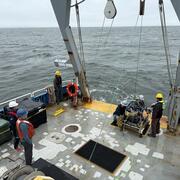
Coastal and Marine Science in Long Island Sound
Long Island Sound is a highly productive estuary and vital natural resource bordering New York and Connecticut. It’s essential for its massive economic impact, generating billions annually by supporting recreation, fisheries, and transportation, as well as its biodiversity, serving as a critical habitat for thousands of marine species. USGS research in Long Island Sound helps protect these...
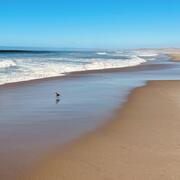
National Shoreline Change Data Publication Catalog
The U.S. Geological Survey (USGS) maintains shoreline positions for the United States from older sources, such as aerial photos and topographic surveys, and contemporary sources like digital elevation models (DEMs) and lidar elevation point cloud data. It's important to maintain, and make available, records of historical shoreline positions to allow monitoring of change over time, and to identify...