



Invasive Species Ecology
Invasive Species Ecology
Filter Total Items: 21
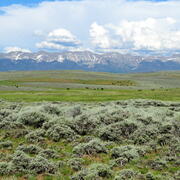
Shrubland, Alpine and Grassland Ecology (SAGE) Wildlife Research Group
The SAGE Wildlife Research Group consists of a large team of research scientists with an interest in conservation and management of wildlife and their ecosystems. Broadly, research involves understanding animal-habitat relationships, with an emphasis on conservation ecology and population demography, and a focus on shrubland, alpine, and grassland ecosystems. We are addressing the effects of...

Supporting energy and mineral development through successful reclamation
Federal lands of the US contain important reserves of oil, gas and other resources important for Unleashing American Energy (SO 3418). After development of these resources is complete, successfully reclaiming disturbed lands is a necessary step towards restoring wildlife habitat, forage production, and maintaining natural resources for future use. To improve reclamation outcomes on these lands and...

USGS Sagebrush Science: Supporting Public Safety and Economic Decision Making Across the West
The sagebrush biome is one of the largest ecosystems in North America. Encompassing nearly one-third of the continental U.S., it provides critical resources for millions of Americans and a home for hundreds of plants and animal species in the West. Natural resource management in sagebrush ecosystems can be complex, and science can support management decisions by providing knowledge and tools to...
By
Core Science Systems Mission Area, Ecosystems Mission Area, Land Management Research Program, Earth Resources Observation and Science (EROS) Center, Forest and Rangeland Ecosystem Science Center, Fort Collins Science Center, Northern Rocky Mountain Science Center, Southwest Biological Science Center, Western Ecological Research Center (WERC), Wildland Fire Science
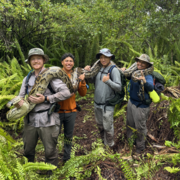
Invasive Burmese python research in the Greater Everglades
USGS leads federal research to control the highly invasive Burmese python ( Python bivittatus), which has become firmly established across the Greater Everglades Ecosystem and poses a serious threat to native wildlife. Capable of reaching over 17 feet long, this massive constrictor is believed to be a key factor in the sharp decline of mammal populations in the region. For over a decade...

USGS Science Syntheses for Public Lands Management
Scientific information is fundamental to understanding how proposed actions on public lands may impact the environment. Development of new science is occurring at rates that can make it challenging for biologists, resource managers, decision makers, private landowners, and other stakeholders to ensure they are using up-to-date, high-quality science information to inform their decisions. Further...

Developing and evaluating a point-of-use environmental DNA test for rapid field detection of highly invasive brown treesnakes
New terrestrial environmental DNA (eDNA) sampling techniques are sensitive tools for early detection of the highly invasive brown treesnakes (BTS). In a new collaborative research effort involving four USGS science centers, scientists have initiated the development of an innovative point-of-use (POU) assay for BTS. POU assays are tests that can be run in the field with minimal equipment and no...

Assessing the Proliferation, Connectivity, and Consequences of Invasive Fine Fuels on the Sagebrush Biome
Invasive annual grasses can replace native vegetation and alter fire behavior, impacting a range of habitats and species. A team of researchers from the U.S. Geological Survey, Colorado State University, the Bureau of Land Management, and the U.S. Fish and Wildlife Service are working to identify factors that influence changes in the distribution and abundance of invasive annual grasses (IAGs)...

Future Aquatic Invaders of the Northeast U.S.: How Climate Change, Human Vectors, and Natural History Could Bring Southern and Western Species North
Researchers will evaluate the potential of aquatic species to invade the Northeast U.S. Following the identification of appropriate target species by regional stakeholders, researchers will gather data from the NAS database and develop models to determine habitat suitability for each species.

Multi-year Burmese Python Vital Rate Research Collaborative in the Greater Everglades
USGS researchers will track juvenile Burmese python within Big Cypress National Preserve (BICY) and collect data on snake growth, habitat use, and causes of mortality. Known-fate models will be used to estimate survival and better understand factors that influence survival.

Siren: The National Early Detection and Rapid Response Information System
Siren: the National Early Detection and Rapid Response (EDRR) Information System is an online resource for invasive species information sharing and collaboration that serves as the information hub of the National EDRR Framework.

The New Mexico Landscapes Field Station
The New Mexico Landscapes Field Station is a place-based, globally connected, ecological research group that studies ecosystem and wildlife dynamics, working with land managers, community leaders, and Tribes to deliver solutions that foster the linked health of human and natural systems. For over three decades, we have focused on shifting research needs from forest watershed health to wildlife...

Developing searchable annotated bibliographies for resource managers
Resource management decisions need to be informed by up-to-date, quality science and data. However there is sometimes an overwhelming number of scientific publications for managers to consider in their decisions. This project provides concise summaries of recent, peer-reviewed science and data products about different resources and topics of management concern, integrated into a searchable tool.