UAS in flight at the USGS Canyonlands Research Station near Moab, Utah
UAS in flight at the USGS Canyonlands Research Station near Moab, UtahUSGS Matt Burgess operating a UAS in flight at the USGS Canyonlands Research Station near Moab, Utah
An official website of the United States government
Here's how you know
Official websites use .gov
A .gov website belongs to an official government organization in the United States.
Secure .gov websites use HTTPS
A lock () or https:// means you’ve safely connected to the .gov website. Share sensitive information only on official, secure websites.
USGS Matt Burgess operating a UAS in flight at the USGS Canyonlands Research Station near Moab, Utah
USGS scientists Victoria Scholl (USGS NUSO) and Armin Howell (USGS Canyonlands Research Station) placing UAS ground control targets at the USGS Canyonlands Research Station near Moab, Utah
USGS scientist Mark Bauer in front of the Arrow Canyon Flood Control Dam in Nevada during a UAS mission
USGS remote pilot Matt Burgess at Arrow Canyon in Clark County, Nevada
USGS scientist Joe Adams preparing a UAS mounted EPA Kolibri emissions sampler at the annual grassland burns at Konza Prairie Biological Station
Image of proposed slack water harbor location of the Arkansas River taken from a natural color sensor mounted on a UAS
USGS researchers Joe Adams and Matt Burgess preparing for UAS flights at the NOAA Table Mountain site just north of Boulder Colorado
USGS scientist Victoria Scholl collecting a spectral measurement in a wetland at Cape Cod, Massachusetts. The PVC pipe quadrat was placed around materials of interest (in this image, pink Salicornia vegetation) and the small panel was used as a white reference prior to spectrometer measurements.
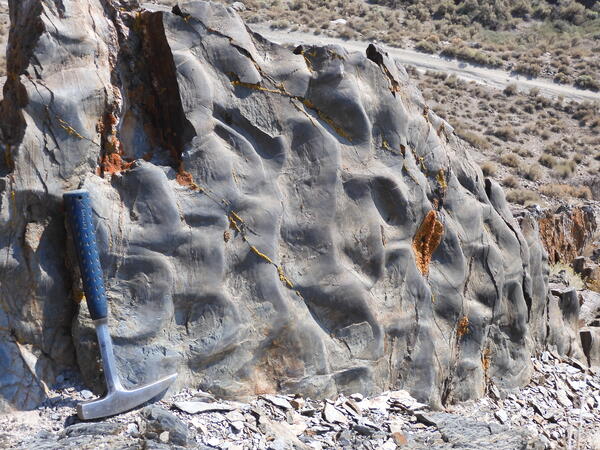
Sedimentary structures, such as ripple bedforms, are used to determine depositional environments and flow directions.
USGS researcher Victoria Scholl (NUSO) returns after collecting previously deployed scale bar and ground control point survey targets along the Paleocene Poison Canyon Formation in the Cimarron Canyon, New Mexico.
UAS ground control point survey targets deployed along the Cimarron Canyon in New Mexico
One of the ground control point survey targets deployed along the Paleocene Poison Canyon Formation in the Cimarron Canyon and used to provide accurate GPS data during the UAS data collection flights.
UAS ground control point survey targets deployed along the Cimarron Canyon in New Mexico
One of the ground control point survey targets deployed along the Paleocene Poison Canyon Formation in the Cimarron Canyon and used to provide accurate GPS data during the UAS data collection flights.
USGS scientist Victoria Scholl (NUSO) places a scale bar and ground control point survey target along the Paleocene Poison Canyon Formation in the Cimarron Canyon. GPS data from these targets and derived from the UAS collected imagery helps ensure high positional and geometric accuracy of georeferenced data products including 3D models.
USGS remote pilot Todd Burton replaces UAS batteries during a mission at the Cimarron Canyon in New Mexico. Batteries last for only around 15 minutes, therefore a minimum of six sets are typically taken into the field which allows each used set to be cooled down, recharged, and then reused in the field.
USGS scientist Mark Bauer reviews the imagery being acquired from a UAS at the Cimarron Canyon in New Mexico
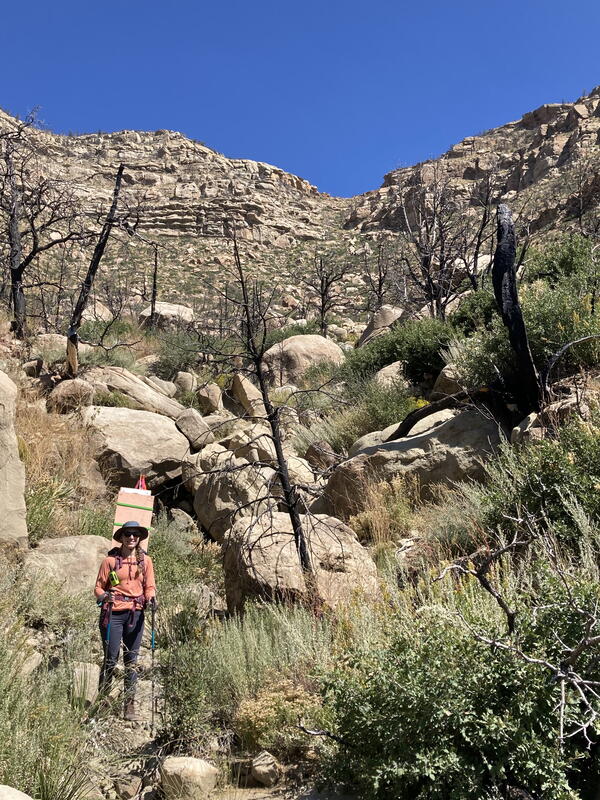
Prior to the UAS flights USGS researchers Amy Gilmer, Theresa Schwartz, and Victoria Scholl hike up Cimarron Canyon in New Mexico to place ground control targets and scale bars.
USGS remote pilot Mark Bauer flies a UAS with a stabilized gimbal with vibration dampening mounted with a Sony A7r camera with a locked focus using a 14mm wide angle lens at the Cimarron Canyon in New Mexico.
USGS scientists hiking to place UAS ground control targets at the Cimarron Canyon in New Mexico
NUSO researchers worked with USGS geologists in September 2021 to establish and test unique photogrammetric data collection techniques utilizing UAS along the Paleocene Poison Canyon Formation in the Cimarron Canyon.
USGS scientists hiking to place UAS ground control targets at the Cimarron Canyon in New Mexico
NUSO researchers worked with USGS geologists in September 2021 to establish and test unique photogrammetric data collection techniques utilizing UAS along the Paleocene Poison Canyon Formation in the Cimarron Canyon.
Along the North Santiam River at the Fishermen’s Bend Recreation Area during a UAS mission
The USGS Oregon Water Science Center teamed up with the NUSO in August 2021 to explore bathymetric and remote sensing techniques to detect periphyton, a complex mixture of algae, cyanobacteria, and microbes in freshwater ecosystems.
Along the North Santiam River at the Fishermen’s Bend Recreation Area during a UAS mission
The USGS Oregon Water Science Center teamed up with the NUSO in August 2021 to explore bathymetric and remote sensing techniques to detect periphyton, a complex mixture of algae, cyanobacteria, and microbes in freshwater ecosystems.
Image taken from a UAS showing a ground control target at the Fishermen’s Bend Recreation Area in Mill City, Oregon
The USGS Oregon Water Science Center teamed up with the NUSO in August 2021 to explore bathymetric and remote sensing techniques to detect periphyton, a complex mixture of algae, cyanobacteria, and microbes in freshwater ecosystems.
Image taken from a UAS showing a ground control target at the Fishermen’s Bend Recreation Area in Mill City, Oregon
The USGS Oregon Water Science Center teamed up with the NUSO in August 2021 to explore bathymetric and remote sensing techniques to detect periphyton, a complex mixture of algae, cyanobacteria, and microbes in freshwater ecosystems.
USGS scientist Victoria Scholl collecting ground data during a UAS mission along the North Santiam River
The USGS Oregon Water Science Center teamed up with the NUSO in August 2021 to explore bathymetric and remote sensing techniques to detect periphyton, a complex mixture of algae, cyanobacteria, and microbes in freshwater ecosystems.
USGS scientist Victoria Scholl collecting ground data during a UAS mission along the North Santiam River
The USGS Oregon Water Science Center teamed up with the NUSO in August 2021 to explore bathymetric and remote sensing techniques to detect periphyton, a complex mixture of algae, cyanobacteria, and microbes in freshwater ecosystems.