U.S. flag

An official website of the United States government

Images

Images intro.
Filter Total Items: 310
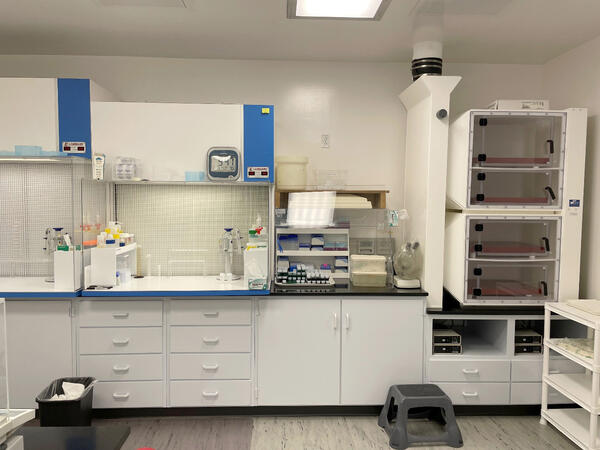
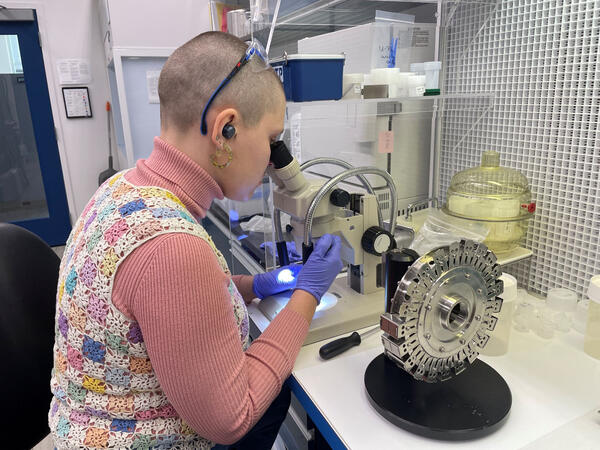
Denver Radiogenic Isotope Lab portion of Class-10,000  clean lab hood
Denver Radiogenic Isotope Lab: Class-10,000 clean lab with HEPA-filtered laminar-flow hoods

Portion of the Class-10,000 clean lab with HEPA-filtered laminar-flow hoods (left) used for chromatographic column separations and four-tier, ULPA-filtered exhausting dry-down boxes with Teflon-coated hotplates for sample digestion and evaporation.

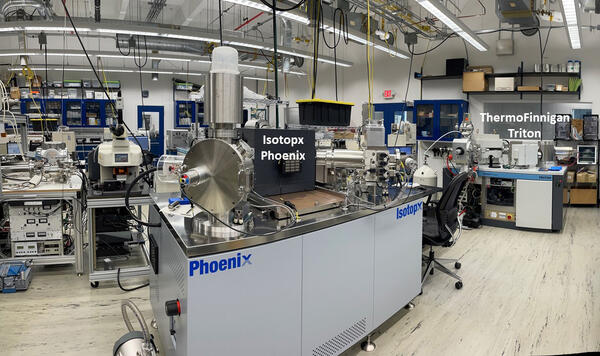
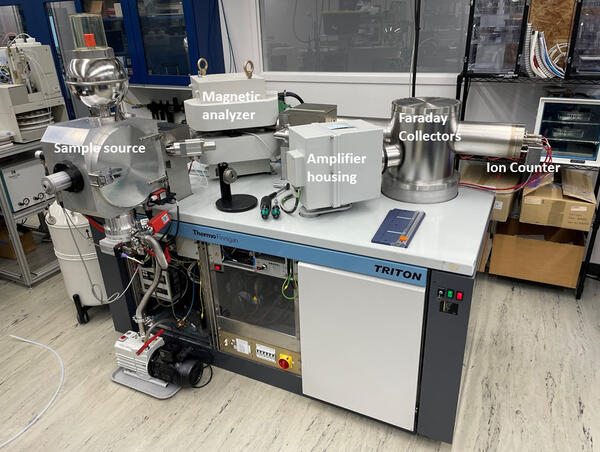
thermal-ionization mass spectrometer
The Triton thermal-ionization mass spectrometer

Labeled photograph of the Triton thermal-ionization mass spectrometer. Indicated parts are "sample source", "magnetic analyzer", "amplifier housing", "Faraday collectors", and "ion counter".

Labeled photograph of the Triton thermal-ionization mass spectrometer. Indicated parts are "sample source", "magnetic analyzer", "amplifier housing", "Faraday collectors", and "ion counter".

USGS scientists conduct a UAS lidar data collection flight at the Vicksburg National Military Park

USGS scientists Joe Adams and Matt Burgess conduct a UAS lidar data collection flight at the Vicksburg National Military Park

NUSO scientists, along with USGS landslide researchers, in December 2022 undertook a topographic analysis of slide-prone areas of the National Park Service Vicksburg National Military Park near Vicksburg, Mississippi.
 

USGS scientists Joe Adams and Matt Burgess conduct a UAS lidar data collection flight at the Vicksburg National Military Park

NUSO scientists, along with USGS landslide researchers, in December 2022 undertook a topographic analysis of slide-prone areas of the National Park Service Vicksburg National Military Park near Vicksburg, Mississippi.
 

USGS scientist checking a UAS with a mounted lidar sensor at Vicksburg National Military Park

USGS scientist Matt Burgess checking a UAS with a mounted lidar sensor at Vicksburg National Military Park 

NUSO scientists, along with USGS landslide researchers, in December 2022 undertook a topographic analysis of slide-prone areas of the National Park Service Vicksburg National Military Park near Vicksburg, Mississippi.

USGS scientist Matt Burgess checking a UAS with a mounted lidar sensor at Vicksburg National Military Park 

NUSO scientists, along with USGS landslide researchers, in December 2022 undertook a topographic analysis of slide-prone areas of the National Park Service Vicksburg National Military Park near Vicksburg, Mississippi.

USGS employee positions a UAS over a calibration panel to capture a multispectral image

USGS employee Joe Adams positions a UAS over a calibration panel to capture a multispectral image with the attached MicaSense Dual multispectral sensor. This calibration image will be used to post-process the imagery in support of radiometric calibration research conducted at the Denver Federal Center in Colorado. 

USGS employee Joe Adams positions a UAS over a calibration panel to capture a multispectral image with the attached MicaSense Dual multispectral sensor. This calibration image will be used to post-process the imagery in support of radiometric calibration research conducted at the Denver Federal Center in Colorado. 

USGS employees from the NUSO and the ECCOE during a UAS test in a Denver Federal Center parking lot
USGS employees from the USGS National Uncrewed Systems Office (NUSO) and the USGS EROS CalVal Center of Excellence (ECCOE) during a UAS test in a Denver Federal Center parking lot

USGS employees from the USGS National Uncrewed Systems Office (NUSO) and the USGS EROS CalVal Center of Excellence (ECCOE) during a UAS test in a Denver Federal Center parking lot.

USGS NUSO scientists act as a visual observer (left) and a UAS remote pilot (right) during a UAS flight at the Denver Federal
USGS NUSO scientists act as a visual observer (left) and a UAS remote pilot (right) during a UAS flight at the Denver Federal Center
Scientist in the field sawing wood for tree ring samples
Sampling remnant wood

Dendrochronologist Becky Brice using laboratory chain saw to sample remnant wood in southern Colorado.

Dendrochronologist Becky Brice using laboratory chain saw to sample remnant wood in southern Colorado.

Scientist cutting section from fire-scarred tree
Sangre de Cristo Mountains fieldwork

Research Geologist Natalie Kehrwald cuts a “cookie” from a fire-scarred tree in the southern Sangre de Cristo Mountains, New Mexico. Cookies are cross-sections of trees that provide information on the interactions between past droughts and fires. 

Research Geologist Natalie Kehrwald cuts a “cookie” from a fire-scarred tree in the southern Sangre de Cristo Mountains, New Mexico. Cookies are cross-sections of trees that provide information on the interactions between past droughts and fires. 

Map of western USA showing sample locations in the USGS North American Packrat Midden Database, Version 5.0
North American Packrat Midden Database sample locations
USGS researcher checks the image quality of photos captured using a UAS over a bog in Alaska

USGS researcher Victoria Scholl (NUSO) checks the image quality of photos captured using the Mavic Pro UAS over a bog in Alaska. These photos will be used to generate a Structure from Motion photogrammetry orthomosaic. 

UAS carrying the methane sensor (left) and a smaller UAS used to collect videos and photos (right) in Alaska

UAS carrying the methane sensor (left) and a smaller UAS used to collect videos and photos (right) in Alaska. Both UAS are resting on wooden pallets that the team set onto the bog for a dry and flat takeoff/landing location.

Victoria Scholl (NUSO), Kristen Manies (GMEG Science Center), and Joe Adams (NUSO)

Victoria Scholl (NUSO), Kristen Manies (GMEG Science Center), and Joe Adams (NUSO) hiked the UAS gear through the woods and across a network of boardwalks to access the bog site at the BNZ LTER.

Image from a UAS acquired natural color video showing the UAS-mounted Kolibri sensor being flown in Alaska

Image from a UAS acquired natural color video showing the UAS-mounted Kolibri sensor being flown through the smoke plume during one of the in-situ oil burns at a Poker Flat Research Range retention pond in Alaska.

Doing USGS fieldwork at Bear Lake, CO showing location, raft, and personnel
Collection of images doing fieldwork at Bear Lake, Colorado

High altitude lakes provide opportunities to examine interactions between fires, drought and human activity across decadal to millennial timescales. The locations of these lakes near tree line make them more susceptible to climate-related changes in vegetation and associated biomass burning. 

High altitude lakes provide opportunities to examine interactions between fires, drought and human activity across decadal to millennial timescales. The locations of these lakes near tree line make them more susceptible to climate-related changes in vegetation and associated biomass burning. 

closeup of a 20-centimeter-long section of sediment core showing holes where samples have been removed.
Sediment core sampling

: A 25-cm section of a lake sediment core with continuous volumetric samples removed (1 cm3). The remaining cavities are filled with closed cell to preserve the core structures for future work.

: A 25-cm section of a lake sediment core with continuous volumetric samples removed (1 cm3). The remaining cavities are filled with closed cell to preserve the core structures for future work.

Was this page helpful?