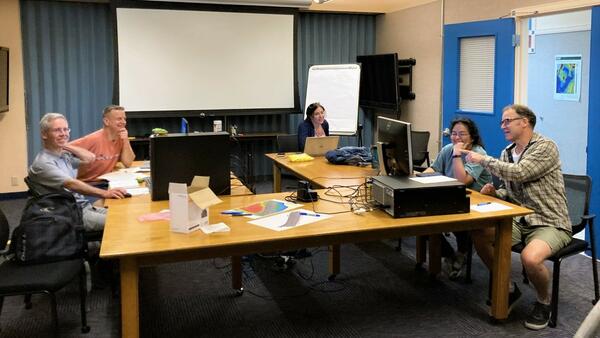
Gerry Hatcher controls SQUID-5 image acquisition over Looe Key Sanctuary Preservation Area (SPA).
Images
Pacific Coastal and Marine Science Center images.
Gerry Hatcher controls SQUID-5 image acquisition over Looe Key Sanctuary Preservation Area (SPA).
Instruments deployed by PCMSC near the bay-marsh edge of Whale's Tail South marsh
Instruments deployed by PCMSC near the bay-marsh edge of Whale's Tail South marshInstruments deployed by PCMSC near the bay-marsh edge of Whale's Tail South marsh in Eden Landing Ecological Reserve, Hayward, CA to measure water level and suspended-sediment concentration. View is to the north, with the San Mateo bridge in the background, and shows waves breaking against the marsh scarp during a rising tide.
Instruments deployed by PCMSC near the bay-marsh edge of Whale's Tail South marsh
Instruments deployed by PCMSC near the bay-marsh edge of Whale's Tail South marshInstruments deployed by PCMSC near the bay-marsh edge of Whale's Tail South marsh in Eden Landing Ecological Reserve, Hayward, CA to measure water level and suspended-sediment concentration. View is to the north, with the San Mateo bridge in the background, and shows waves breaking against the marsh scarp during a rising tide.
Turbidity sensor deployed by PCMSC near the bay-marsh edge of Whale's Tail South marsh
Turbidity sensor deployed by PCMSC near the bay-marsh edge of Whale's Tail South marshin Eden Landing Ecological Reserve, Hayward, CA to measure suspended-sediment concentration.
Turbidity sensor deployed by PCMSC near the bay-marsh edge of Whale's Tail South marsh
Turbidity sensor deployed by PCMSC near the bay-marsh edge of Whale's Tail South marshin Eden Landing Ecological Reserve, Hayward, CA to measure suspended-sediment concentration.
USGS DUNEX Survey underway off of a USACE amphibious vessel
USGS DUNEX Survey underway off of a USACE amphibious vesselA geophysical instrument (chirp) is towed in the water (yellow instrument) from a floating sled to acquire information about the geology below the seafloor in Duck, NC as part of DUNEX. The USACE Field Research Facility can be seen in the background in the upper left corner.
USGS DUNEX Survey underway off of a USACE amphibious vessel
USGS DUNEX Survey underway off of a USACE amphibious vesselA geophysical instrument (chirp) is towed in the water (yellow instrument) from a floating sled to acquire information about the geology below the seafloor in Duck, NC as part of DUNEX. The USACE Field Research Facility can be seen in the background in the upper left corner.
USGS Research Geologist Jennifer Miselis will conduct shoreface geophysical surveys at the USACE Field Research Facility during DUNEX aboard the LARC, which is shown here being set up for the survey.
In the background is the Research Vessel (R/V) Robert Gordon Sproul, operated by Scripps Institution of Oceanography (SIO).
Wave-eroded marsh scarp of Whale's Tail South marsh
Wave-eroded marsh scarp of Whale's Tail South marshWave-eroded marsh scarp of Whale's Tail South marsh in Eden Landing Ecological Reserve, Hayward, CA at low tide, looking south.
Wave-eroded marsh scarp of Whale's Tail South marsh
Wave-eroded marsh scarp of Whale's Tail South marshWave-eroded marsh scarp of Whale's Tail South marsh in Eden Landing Ecological Reserve, Hayward, CA at low tide, looking south.
Science crew from the USGS Pacific Coastal and Marine Science Center work on deployment of seismic streamer on deck of R/V Robert Gordon Sproul. Green cable is the hydrophone streamer and a "bird" is being attached to control depth in the water.
Puerto Rico study area and Hurricane María path and data
Puerto Rico study area and Hurricane María path and data(Left) Map of Puerto Rico showing study area location (red box), the oceanographic buoys (orange triangles), and the track of María with eye timing and locations (black dots) in 6-hour increments and the wind radii of 64-knot winds (gray circular outlines).
Puerto Rico study area and Hurricane María path and data
Puerto Rico study area and Hurricane María path and data(Left) Map of Puerto Rico showing study area location (red box), the oceanographic buoys (orange triangles), and the track of María with eye timing and locations (black dots) in 6-hour increments and the wind radii of 64-knot winds (gray circular outlines).
A diagram showing an overview of the study area and the passage of Hurricane María
A diagram showing an overview of the study area and the passage of Hurricane MaríaOverview of the study area and the passage of Hurricane María.
A diagram showing an overview of the study area and the passage of Hurricane María
A diagram showing an overview of the study area and the passage of Hurricane MaríaOverview of the study area and the passage of Hurricane María.
Looking across the back deck/stern of the R/V Robert Gordon Sproul. The wire going through the block in the A-frame leads to the CHIRP sonar fish towed in the water. Oil platforms are shown in the distance.
Ocean engineer Gerry Hatcher, of the USGS Pacific Coastal and Marine Science Center (PCMSC), sits at a desk on board the USGS boat Sallenger. He and a team of scientists from PCMSC and sister team St.
A three-dimensional hydrodynamic model of the lower Columbia River (LCR) was constructed using the Delft3D Flexible Mesh (DFM) modeling suite to simulate water levels, flow, and seabed stresses between January 1, 2017, and April 20, 2020
Photograph of the Lake Tahoe lakebed near Dollar Point, in March 2021.
Examples of orthomosaic imagery and digital surface models
Examples of orthomosaic imagery and digital surface modelsExamples of orthomosaic imagery and high-resolution digital surface models of Puget Creek and Dickman Mill Park in Tacoma, WA.
Examples of orthomosaic imagery and digital surface models
Examples of orthomosaic imagery and digital surface modelsExamples of orthomosaic imagery and high-resolution digital surface models of Puget Creek and Dickman Mill Park in Tacoma, WA.
Examples of orthomosaic imagery and digital surface model
Examples of orthomosaic imagery and digital surface modelExamples of orthomosaic imagery and a high-resolution digital surface model of Post Point, Bellingham Bay, WA.
Examples of orthomosaic imagery and digital surface model
Examples of orthomosaic imagery and digital surface modelExamples of orthomosaic imagery and a high-resolution digital surface model of Post Point, Bellingham Bay, WA.
The GeoEel is a multichannel digital streamer system, with hydrophones in a long, green hose. The streamer is towed in the water from a vessel like a long snake, and the hydrophones "listen" for and record the signals from the seismic sound source.
In August of 2020, the enormous CZU wildfire complex consumed over 85,000 acres in San Mateo and Santa Cruz Counties, leaving scarred landscapes in the hilly region. Runoff from large rainstorms in the winter months carry contaminants from the soils within these burned-out forests.
Rilling and a shallow landslide in CZU Fire near Eagle Rock, California. Soil ~3 cm below surface was almost completely dry after the rain storm, highlighting soil water repellancy.
In August of 2020, the enormous CZU wildfire complex consumed over 85,000 acres in San Mateo and Santa Cruz Counties, leaving scarred landscapes in the hilly region. Runoff from large rainstorms in the winter months carry contaminants from the soils within these burned-out forests.