USGS biologist Jeffrey Kohl holds a Lesser Snow Goose
USGS biologist Jeffrey Kohl holds a Lesser Snow GooseUSGS biologist Jeffrey Kohl holds a Lesser Snow Goose marked with a GSM/GPS solar-powered neck collar.
An official website of the United States government
Here's how you know
Official websites use .gov
A .gov website belongs to an official government organization in the United States.
Secure .gov websites use HTTPS
A lock () or https:// means you’ve safely connected to the .gov website. Share sensitive information only on official, secure websites.
See our science through the images below.
USGS biologist Jeffrey Kohl holds a Lesser Snow Goose marked with a GSM/GPS solar-powered neck collar.
A female northern harrier (Circus cyaneus) gazes into the camera at Suisun Marsh, CA.
USGS conducts a health assessment on a mantee in Crystal River, Florida.
Organ pipe cactus are rare in the Sonoran desert in the U.S. They can only be found in and around Organ Pipe Cactus National Monument, shown here. The distribution of Organ Pipe Cactus is limited due to lack of tolerance for cold temperatures. The biota of the Sonoran desert is particularly senstive to disturbance.
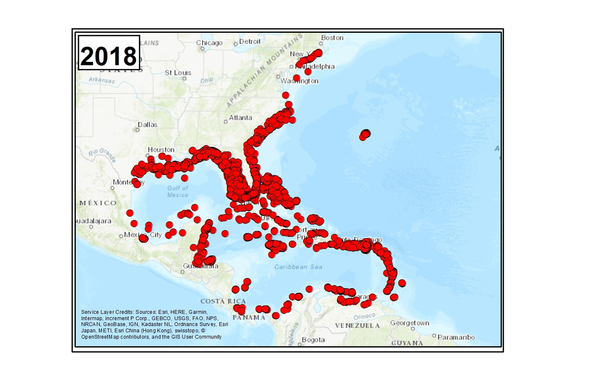
US Fish and Wildlife Service Kodiak amphibious aircraft used in the GoMMAPPS aerial seabird surveys from 2017-2020 and 2022-2023.
Field water-level monitoring gage EDEN 13. Photograph by Michael Oliver, U.S. Geological Survey.
U.S. Geological Survey Fact Sheet 2017–3069
Version 1.1, January 2018
Field water-level monitoring gage EDEN 13. Photograph by Michael Oliver, U.S. Geological Survey.
U.S. Geological Survey Fact Sheet 2017–3069
Version 1.1, January 2018
Early development zebrafish embryos are used as an alternative approach to the use of adult zebrafish in ecotoxicology studies.
This image shows a sea lamprey in its larvae phase.
This microscopic image shows a sun-shaped area within turtle skin cells where chelonid herpesvirus 5 replicates. The virus capsids, or protein shells, are arrayed like a corona around the circle. ChHV5 is associated with fibropapillomatosisa tumor disease affecting endangered green turtles.
This image shows the blue version of sylvatic plague vaccine bait for prairie dogs.
Prairie dogs in the wild are less likely to succumb to a deadly disease called sylvatic plague after they ingest peanut-butter-flavored bait that contains a vaccine against the disease.
This image shows the blue version of sylvatic plague vaccine bait for prairie dogs.
Prairie dogs in the wild are less likely to succumb to a deadly disease called sylvatic plague after they ingest peanut-butter-flavored bait that contains a vaccine against the disease.
Introduced Phragmites australis, also called the common reed, is an invasive grass in the Great Lakes.
The arrows in this image point to mouths of individual corallimorphs, which are a type of invasive anemone that typically thrives in coral reefs that have been degraded by environmental or man-made disturbances. Each corallimorph mouth is surrounded by a corona of tentacles.
Dawn Childs SCUBA dives on the Great Barrier Reef, Australia, at night. Dawn is an Information Specialist with the Cooperative Fish and Wildlife Research Units Program in the Ecosystems Mission Area, USGS.
A part of the National Elk Refuge showing an example of the habitat diversity on the refuge’s landscape with flat grassland, grassland-covered hills, and tree-covered hills depicted. Sheep Mountain (not part of the refuge) is in the background.
Rangelands of the desert Southwest can be in a degraded condition and lacking perennial vegetation, which can lead to exposed soil and erosion.
Monarch butterfly on a Joe Pyeweed plant.
A monarch butterfly on a hairy puccoon plant.
Bats hibernating in a cave.
Coral reefs are prone to phase shifts where they quickly transition from coral-dominated to a uniformity of other organisms, typically algae. The Palmyra Atoll National Wildlife Refuge in the Central Pacific is a unique case where a transition from corals to corallimorphs occurred.
A USGS intern preparing to examine a black carp captured from the wild. This fish and others were examined for various aspects of their life history, including age, the environments in which they have lived and whether they were naturally reproduced. Credit: USGS.
USGS scientist Sarah Fitzgerald holds a surf scoter that has been fitted with a satellite tag that works by transmitting the location of the birds to satellites that are orbiting the Earth. (Jonathan Fiely, USGS)