U.S. flag

An official website of the United States government

Images

Images related to natural hazards.

Filter Total Items: 7266
USGS maps identify lava inundation zones for Mauna Loa...
USGS maps identify lava inundation zones for Mauna Loa

Close up of Sheet 2 of "Lava inundation zone maps for Mauna Loa, Island of Hawai‘i," recently published by the U.S. Geological Survey. Colors depict lava Inundation zones for the Kaumana, Waiākea, and Volcano-Mountain View regions on Mauna Loa. Yellow indicates the volcano's Northeast Rift Zone, one area along which lava could erupt.

Close up of Sheet 2 of "Lava inundation zone maps for Mauna Loa, Island of Hawai‘i," recently published by the U.S. Geological Survey. Colors depict lava Inundation zones for the Kaumana, Waiākea, and Volcano-Mountain View regions on Mauna Loa. Yellow indicates the volcano's Northeast Rift Zone, one area along which lava could erupt.

Mount Adams viewed from the southeast....
Mount Adams viewed from SE.
New USGS video about Kīlauea Volcano's summit eruption is now onlin...
New USGS video about Kīlauea's summit eruption is now online

The lava lake within Halema‘uma‘u, a crater at the summit of Kīlauea, was about 30 m (98 ft) below the vent rim on the day of this photo (January 7, 2016).

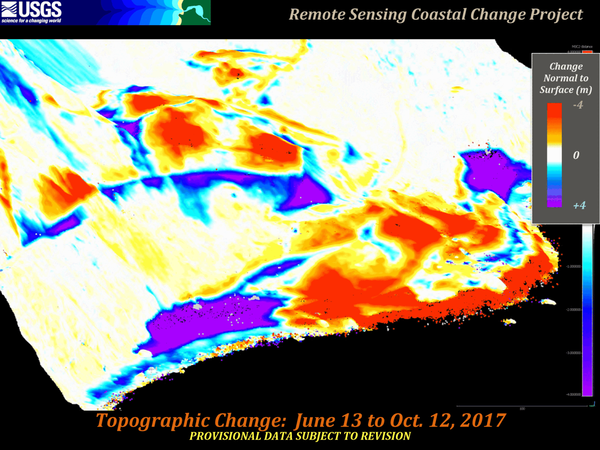
A series of images showing a steep cliff along the coast from two different dates and the change between them.
Mud Creek Topo Change June 13-October 12 2017 View 2

In 2017, the massive Mud Creek landslide buried a quarter-mile of the famous coastal route, California’s Highway 1, with rocks and dirt more than 65 feet deep. USGS monitors erosion along the landslide-prone cliffs of Big Sur, collecting aerial photos frequently throughout the year.

In 2017, the massive Mud Creek landslide buried a quarter-mile of the famous coastal route, California’s Highway 1, with rocks and dirt more than 65 feet deep. USGS monitors erosion along the landslide-prone cliffs of Big Sur, collecting aerial photos frequently throughout the year.

A series of images showing a steep cliff along the coast from two different dates and the change between them.
Mud Creek Topo Change June 13-October 12 2017 View 1

In 2017, the massive Mud Creek landslide buried a quarter-mile of the famous coastal route, California’s Highway 1, with rocks and dirt more than 65 feet deep. USGS monitors erosion along the landslide-prone cliffs of Big Sur, collecting aerial photos frequently throughout the year.

In 2017, the massive Mud Creek landslide buried a quarter-mile of the famous coastal route, California’s Highway 1, with rocks and dirt more than 65 feet deep. USGS monitors erosion along the landslide-prone cliffs of Big Sur, collecting aerial photos frequently throughout the year.

A series of images showing a steep cliff along the coast from two different dates and the change between them.
Mud Creek Topo Change June 13-October 12 2017 View 3

In 2017, the massive Mud Creek landslide buried a quarter-mile of the famous coastal route, California’s Highway 1, with rocks and dirt more than 65 feet deep. USGS monitors erosion along the landslide-prone cliffs of Big Sur, collecting aerial photos frequently throughout the year.

In 2017, the massive Mud Creek landslide buried a quarter-mile of the famous coastal route, California’s Highway 1, with rocks and dirt more than 65 feet deep. USGS monitors erosion along the landslide-prone cliffs of Big Sur, collecting aerial photos frequently throughout the year.

pāhoehoe breakouts on the coastal plain...
pāhoehoe breakouts on the coastal plain

Scattered breakouts today (October 13) on the western 61g flow margin were mapped at 1.3 km (0.8 mi) from the closest portion of the emergency road. The small pāhoehoe breakouts put on a show as they slowly oozed out of growing cracks that were forced open by flow inflation (pictured).

Scattered breakouts today (October 13) on the western 61g flow margin were mapped at 1.3 km (0.8 mi) from the closest portion of the emergency road. The small pāhoehoe breakouts put on a show as they slowly oozed out of growing cracks that were forced open by flow inflation (pictured).

HVO geologists relocate a time-lapse camera on the rim of the west ...
Geologists relocate a time-lapse camera in the Pu‘u ‘Ō‘ō crater.

HVO geologists relocate a time-lapse camera on the rim of the west pit lava pond in the Pu‘u ‘Ō‘ō crater. Over the past several months, the camera has been slowly tilting downward due to soft, altered ground beneath it, and the general instability of the rim. The new location, about 20 m (yards) to the south, appears to be more stable and less altered.

HVO geologists relocate a time-lapse camera on the rim of the west pit lava pond in the Pu‘u ‘Ō‘ō crater. Over the past several months, the camera has been slowly tilting downward due to soft, altered ground beneath it, and the general instability of the rim. The new location, about 20 m (yards) to the south, appears to be more stable and less altered.

A man wearing a hard hat navigates a drone toward a landing target with GPS equipment in the background.
Drone operations on Big Sur landslide, October 12, 2017

Josh Logan, a physical scientist at the USGS Pacific Coastal and Marine Science Center in Santa Cruz, California, operates an unmanned aerial system, or UAS, often called a "drone", that is equipped with a video camera.

Thermal map of flow field...
Thermal map of flow field

This map is similar to the map above but shows a thermal map over the Episode 61g lava flow. Cooler colors (blue and green) show cooled, inactive portions of the flow surface. Hot colors (red and orange) show areas of active surface breakouts.

This map is similar to the map above but shows a thermal map over the Episode 61g lava flow. Cooler colors (blue and green) show cooled, inactive portions of the flow surface. Hot colors (red and orange) show areas of active surface breakouts.

Breakouts remain active on flow field, changes to ocean entry lava ...
Breakouts remain active on flow field

Surface breakouts (light in color) remain active on the upper coastal plain. These breakouts are fed by both the main eastern tube—left of the kipuka and below the tube's fume trace on the pali—and from the eastern June 26 breakout branch, visible to the right of the kipuka.

Surface breakouts (light in color) remain active on the upper coastal plain. These breakouts are fed by both the main eastern tube—left of the kipuka and below the tube's fume trace on the pali—and from the eastern June 26 breakout branch, visible to the right of the kipuka.

View looking downhill towards the ocean and heavy equipment is driving around on dirt roads.
Earth movers on Big Sur landslide, October 12, 2017

View of the huge landslide at Mud Creek on the Big Sur coast, October 12, 2017. USGS is studying the landslide, collecting data and imagery that can be used to monitor changes. USGS provides the data to Caltrans, the California Department of Transportation, whose heavy equipment and earth movers are shown here.

View of the huge landslide at Mud Creek on the Big Sur coast, October 12, 2017. USGS is studying the landslide, collecting data and imagery that can be used to monitor changes. USGS provides the data to Caltrans, the California Department of Transportation, whose heavy equipment and earth movers are shown here.

A view of the upper coastal plain breakouts on the episode 61g flow...
upper coastal plain breakouts on the episode 61g flow field. The ma...

A view of the upper coastal plain breakouts on the episode 61g flow field. The majority of the active surface flows on the coastal plain are being fed by the June 26 breakout branch on the eastern margin of the flow field (right).

A view of the upper coastal plain breakouts on the episode 61g flow field. The majority of the active surface flows on the coastal plain are being fed by the June 26 breakout branch on the eastern margin of the flow field (right).

Four photos looking from the sky at a coastal cliff area on different dates to show a landslide and work to clear it.
Mud Creek from June 13 to October 12, 2017

In 2017, the massive Mud Creek landslide buried a quarter-mile of the famous coastal route, California’s Highway 1, with rocks and dirt more than 65 feet deep. USGS monitors erosion along the landslide-prone cliffs of Big Sur, collecting aerial photos frequently throughout the year.

In 2017, the massive Mud Creek landslide buried a quarter-mile of the famous coastal route, California’s Highway 1, with rocks and dirt more than 65 feet deep. USGS monitors erosion along the landslide-prone cliffs of Big Sur, collecting aerial photos frequently throughout the year.

Map of flow field...
Map of flow field
Map of flow field
Map of flow field

This map shows recent changes to Kīlauea's East Rift Zone lava flow field. The area of the active flow field as of September 21 is shown in pink, while widening and advancement of the active flow as of October 12 is shown in red. Older Pu‘u ‘Ō‘ō lava flows (1983-2016) are shown in gray. The yellow line is the trace of the active lava tube.

This map shows recent changes to Kīlauea's East Rift Zone lava flow field. The area of the active flow field as of September 21 is shown in pink, while widening and advancement of the active flow as of October 12 is shown in red. Older Pu‘u ‘Ō‘ō lava flows (1983-2016) are shown in gray. The yellow line is the trace of the active lava tube.

Today (October 12), the Kamokuna lava delta was measured at roughly...
Today (Oct. 12), the Kamokuna lava delta was measured at roughly 11...

Today (October 12), the Kamokuna lava delta was measured at roughly 11 acres (4.5 hectares) in size. Over the past two months, several lava tube breakouts on the sea cliff have spilled lava onto the delta.

Today (October 12), the Kamokuna lava delta was measured at roughly 11 acres (4.5 hectares) in size. Over the past two months, several lava tube breakouts on the sea cliff have spilled lava onto the delta.

Summer 2017 goes out like a lion with hurricanes and earthquakes: r...

Damage to an unreinforced rock wall at KALAHIKIOLA Church in KAP‘A‘āU, North Kohala, on the Island of Hawai‘i, following the magnitude-6.6 Kīholo and magnitude-6.0 Māhukona earthquakes in October 2006. USGS photo by J. Takahashi.

Damage to an unreinforced rock wall at KALAHIKIOLA Church in KAP‘A‘āU, North Kohala, on the Island of Hawai‘i, following the magnitude-6.6 Kīholo and magnitude-6.0 Māhukona earthquakes in October 2006. USGS photo by J. Takahashi.

Wayne Baldwin, USGS, deploys a sound velocity profiler off the R/V Stephens in Lake Powell, UT-AZ.
Deploying equipment from small boat

Wayne Baldwin, USGS, deploys a sound velocity profiler off the stern of the R/V Stephens in Lake Powell, UT-AZ as part of a collaborative program with the Utah Water Science Center to map the depth and sediments within Lake Powell, UT-AZ.

Wayne Baldwin, USGS, deploys a sound velocity profiler off the stern of the R/V Stephens in Lake Powell, UT-AZ as part of a collaborative program with the Utah Water Science Center to map the depth and sediments within Lake Powell, UT-AZ.

Map view of well recorded historical seismicity at Mount Hood since...

Bottom: Cross-sectional view looking north. Right: Cross-sectional view looking west. Black outline is elevation profile through the summit of Mount Hood. Circles are sized with respect to earthquake magnitude. Earthquake locations from the Pacific Northwest Seismic Network.

Bottom: Cross-sectional view looking north. Right: Cross-sectional view looking west. Black outline is elevation profile through the summit of Mount Hood. Circles are sized with respect to earthquake magnitude. Earthquake locations from the Pacific Northwest Seismic Network.

Breakouts remain active on the coastal plain and pali...
Breakouts remain active on the coastal plain and pali

pāhoehoe breakouts remain scattered on the coastal plain, but have not advanced significantly in recent weeks. In addition, small channelized ‘A‘ā flows have been recently active on the steep slopes of the pali. The pali can be seen in the distance in this photo.

pāhoehoe breakouts remain scattered on the coastal plain, but have not advanced significantly in recent weeks. In addition, small channelized ‘A‘ā flows have been recently active on the steep slopes of the pali. The pali can be seen in the distance in this photo.

Was this page helpful?