U.S. flag

An official website of the United States government

Images

Explore water-related photography, imagery, and illustrations.

Filter Total Items: 2616
Hydrologic Technician admires the view while measuring discharge at the base of the South Cascade Glacier, WA
Hydrologic Technician measuring discharge. South Cascade Glacier, WA.

Hydrologic Technician Dan Restivo of the USGS Washington Water Science Center admires the view while measuring discharge at the base of the South Cascade Glacier station 12181090 South Cascade Middle Tarn near Marblemount, WA.

Collecting Field Parameters During the 2019 Well Inventory at a Farm and Ranch on the Fort Peck Reservation
Collecting Field Parameters During the 2019 Well Inventory

USGS hydrologic technician collecting field parameters during the 2019 well inventory at a farm and ranch in the north central portion of the Fort Peck reservation.

 Fallow field on the left and dryland wheat on the right. Northwestern corner of the Fort Peck Reservation (near Larslan, MT)
Fallow Field (Left) and Dryland Wheat (Right) near Larslan, MT

Fallow field on the left and dryland wheat on the right, northwestern corner of the Fort Peck Reservation (near Larslan, MT)

Hydrologists collect a discrete soil gas sample from soil gas well

Hydrologists Kayla Christian (Left) and Alex Riddle (Right) collect a discrete soil gas sample from soil gas well PGP-07 at the USACE Combined Disposal Facility in East Chicago, Indiana.

Hydrologists Kayla Christian (Left) and Alex Riddle (Right) collect a discrete soil gas sample from soil gas well PGP-07 at the USACE Combined Disposal Facility in East Chicago, Indiana.

Scientists collecting samples on lake Hopatcong
Sampling Hopatcong
Sampling Hopatcong
Sampling Hopatcong

USGS scientists Brad Bjorklund and Jon Cohl collect a water-quality sample at Lake Hopatcong, New Jersey, to monitor a harmful algal bloom on the lake.

USGS scientists Brad Bjorklund and Jon Cohl collect a water-quality sample at Lake Hopatcong, New Jersey, to monitor a harmful algal bloom on the lake.

Photo of scientist standing in water operating equipment next to a boat
USGS intern Kira Waldman collecting water-quality samples

Each summer, interns join USGS offices around the Nation in support of our water studies.

Hydrologist Nora Nelson swapping passive charcoal samplers in a carbonate spring during a fluorescein dye tracer test
Hydrologist Nora Nelson swapping passive charcoal samplers in a test

Hydrologist Nora Nelson swapping passive charcoal samplers in a carbonate spring during a fluorescein dye tracer test Great Basin National Park. Station number 385254114114801 Spring BW2 in the South Fork of Big Wash, Great Basin National Park, NV

Hydrologist Nora Nelson swapping passive charcoal samplers in a carbonate spring during a fluorescein dye tracer test Great Basin National Park. Station number 385254114114801 Spring BW2 in the South Fork of Big Wash, Great Basin National Park, NV

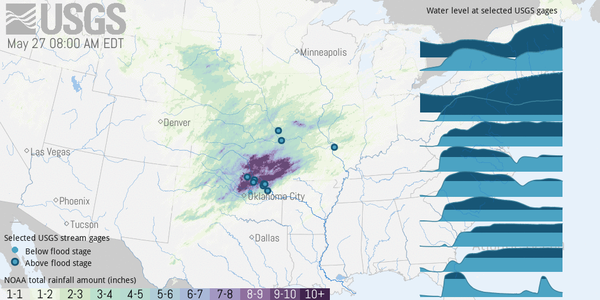
Spring 2019 Midwest flooding data visualization

This DataVisualization shows the severity of flooding in the Midwest . As of June 1, 2019, 17 USGS streamgage sites in red had the highest streamflow for the entire period of record available. Both the Mississippi and the Arkansas rivers are seeing record breaking flows.

This DataVisualization shows the severity of flooding in the Midwest . As of June 1, 2019, 17 USGS streamgage sites in red had the highest streamflow for the entire period of record available. Both the Mississippi and the Arkansas rivers are seeing record breaking flows.

USGS hydro tech taking measurement during major flood

Andrew Clark is measuring the overflow section of a major flood at the Little Arkansas River near Sedgwick, Kansas USGS stream gage 07144100.

Photo of USGS scientist operating drone with ground-penetrating radar system over a river
USGS tests drone-based ground-penetrating radar

USGS hydrographers collect tens of thousands of streamflow measurements every year. In-water work by personnel is one of the most dangerous aspects of USGS hydrologic studies, especially during high-flow conditions. In May 2019, USGS continued testing of a light-weight, self-contained ground-penetrating radar (GPR) system that can be mounted on a small drone.

USGS hydrographers collect tens of thousands of streamflow measurements every year. In-water work by personnel is one of the most dangerous aspects of USGS hydrologic studies, especially during high-flow conditions. In May 2019, USGS continued testing of a light-weight, self-contained ground-penetrating radar (GPR) system that can be mounted on a small drone.

USGS Tests Prototype Ground Penetrating Radar Drone

The USGS, in cooperative research and development with GuidelineGEO, tested an 80 GHz self contained ground penetrating radar unit on a DJI Matrice 600 hexcopter (left). This platform was tested for flight performance and for measurement of river channel cross-sectional area as well as river water depth and river width.

The USGS, in cooperative research and development with GuidelineGEO, tested an 80 GHz self contained ground penetrating radar unit on a DJI Matrice 600 hexcopter (left). This platform was tested for flight performance and for measurement of river channel cross-sectional area as well as river water depth and river width.

USGS LSPIV and Photogrametry Drones

(Left) Frank Engel of the hydrologic remote sensing branch prepares the DJI Mavic Pro quadcopter , while Sean Andrews and Jeff Kinsey of the New England WSC observe. The Mavic was used for Large Scale Particle Image Velocimetry (LSPIV).

(Left) Frank Engel of the hydrologic remote sensing branch prepares the DJI Mavic Pro quadcopter , while Sean Andrews and Jeff Kinsey of the New England WSC observe. The Mavic was used for Large Scale Particle Image Velocimetry (LSPIV).

2019 USGS UAS Aquatic Airshow participants

2019 Aquatic Airshow participants at the Androscoggin River in Auburn Maine, May 1, 2019, photograph by Mario Martin-Alciati USGS.

2019 Aquatic Airshow participants at the Androscoggin River in Auburn Maine, May 1, 2019, photograph by Mario Martin-Alciati USGS.

Doppler Radar Mounted On A Drone for Stream Velocity

The sensor mounted on the drone is called the Qcam and is a Doppler radar sensor providing velocity from a hovering position above the river. USGS hydrologic technician (left) aboard a USGS John Boat mounted with Acoustic Doppler Current Profiler observes the Qcam conducting a measurement.

The sensor mounted on the drone is called the Qcam and is a Doppler radar sensor providing velocity from a hovering position above the river. USGS hydrologic technician (left) aboard a USGS John Boat mounted with Acoustic Doppler Current Profiler observes the Qcam conducting a measurement.

USGS Water Science Center Personnel Conducting Measurements

(Above) New England Water Science Center and Virginia - West Virginia Water Science Center personnel collected measurements use GPS surveying equipment and ADCP to collect ground-truth data and quality assure non-contact data (above left Tom and Andy Massey; above right Andy Massey and Jeff Kinsey; lower left Russ Lotspeich on shore and Jeff Kinsey and Sean Andrews

(Above) New England Water Science Center and Virginia - West Virginia Water Science Center personnel collected measurements use GPS surveying equipment and ADCP to collect ground-truth data and quality assure non-contact data (above left Tom and Andy Massey; above right Andy Massey and Jeff Kinsey; lower left Russ Lotspeich on shore and Jeff Kinsey and Sean Andrews

Photo of drone with ground-penetrating radar system flying close over river surface
USGS Tests drone-based ground-penetrating radar for bathymetry

USGS hydrographers collect tens of thousands of streamflow measurements every year. In-water work by personnel is one of the most dangerous aspects of USGS hydrologic studies, especially during high-flow conditions. In May 2019, USGS continued testing of a light-weight, self-contained ground-penetrating radar (GPR) system that can be mounted on a small drone.

USGS hydrographers collect tens of thousands of streamflow measurements every year. In-water work by personnel is one of the most dangerous aspects of USGS hydrologic studies, especially during high-flow conditions. In May 2019, USGS continued testing of a light-weight, self-contained ground-penetrating radar (GPR) system that can be mounted on a small drone.

Was this page helpful?