



Kelly Smalling
I am interested in the exposure and effects of contaminants including current-use pesticides and other endocrine active compounds on fish and wildlife with a focus on amphibian populations.
I am an environmental organic chemist who has been working with the USGS since 2004. My current research focuses on the occurrence, fate and effects of emerging contaminants including current-use pesticides in the environment. I am the lead for the Amphibian Research and Monitoring Initiative's Contaminants Project, the project coordinator of the "EDC effects on fish and wildlife in the Cheseapeake Bay Watershed" project through the Contaminants Biology Program, and a member of the Toxic Substances Hydrology Program's Pesticide Fate Research Team.
Science and Products
Filter Total Items: 31
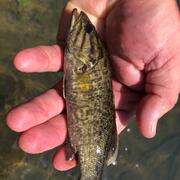
Warmer Temperatures and Disease-Driven Population Declines Can Increase Early Life Growth Rates of Smallmouth Bass
Understanding the factors that affect growth rates of commercially and recreationally important fish species can help fisheries managers make informed stock‑assessment and fishing‑regulation decisions. In this study of smallmouth bass in Pennsylvania rivers, USGS scientists found that warmer temperatures were associated with increased early‑life growth rates, and that growth rates increased...
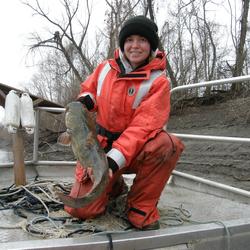
Invasive flathead catfish now top predators in Susquehanna River in Pennsylvania
New study suggests that smallmouth bass and channel catfish are changing what they eat to avoid having to compete with or being eaten by the invader
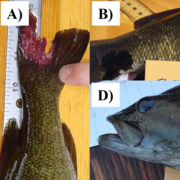
A regional assessment of fish health in the Chesapeake Bay watershed
Fish diseases in freshwater ecosystems pose significant ecological and socioeconomic challenges; yet, monitoring them in wild populations is complex due to interactions between pathogens, hosts, and environmental conditions. External DELT (deformity, erosion, lesion, tumor, and parasite) data (fig. 1) provide a rapid and broad measure of fish health but are a relatively coarse indicator that...
Per and Polyfluoroalkyl Substances (PFAS) in New Jersey Waters
Scientists from the New Jersey Water Science Center are working with drinking-water purveyors to assess the occurrence and distribution of per- and polyfluoroalkyl substances (PFAS) in New Jersey surface waters. These studies will enhance current water-quality assessments in NJ watersheds by characterizing PFAS occurrence in surface water at select locations that have the potential to directly...

Understanding the Dynamics of Per- and Polyfluoroalkyl Substances (PFAS): Insights from USGS Research
The USGS Environmental Health (EH) Program research where per- and polyfluoroalkyl substances PFAS are found, how they move and change in the environment, how they might affect both ecosystems and human health, and ways to reduce their impact. The three teams focusing on these issues within the EH Program include: 1) the PFAS Integrated Science Team, 2) the PFAS Core Technology Team, and 3) the...

Beneath the Surface: Exploring PFAS and Drinking Water on French Island, Wisconsin
The growing concern of finding per- and polyfluoroalkyl substances (PFAS) in drinking water has led USGS scientists to conduct more comprehensive analyses that encompass an extensive list of compounds that can be found in drinking water. These analyses will develop a more complete drinking water contaminant list that managers can use to make more informed public health decisions.

Preliminary Research Sheds Light on Proper Analysis and Sample Handling for the Tire-Derived Contaminants 6PPD and 6PPD-quinone
Tire and road wear particles have been shown to cause acute effects to sensitive aquatic animals and degrade their habitats. U.S. Geological Survey (USGS) scientists developed methods to accurately identify aquatic compounds, such as 6PPD and 6PPD-quinone, that can cause acute mortality events in coho salmon (Oncorhynchus kisutch).
By
Ecosystems Mission Area, Contaminant Biology, Environmental Health Program, Toxic Substances Hydrology, Central Midwest Water Science Center, Eastern Ecological Science Center, New Jersey Water Science Center, Oklahoma-Texas Water Science Center, South Atlantic Water Science Center (SAWSC), Washington Water Science Center, Western Fisheries Research Center

Drinking Water and Wastewater Infrastructure Science Team
The team studies toxicants and pathogens in water resources from their sources, through watersheds, aquifers, and infrastructure to human and wildlife exposures. That information is used to develop decision tools that protect human and wildlife health.

USGS Scientists Develop an Interactive Mapping Tool to Visualize PFAS in Tap Water
A new interactive dashboard is available to visualize PFAS measurements for 716 tap water samples collected at select sites across the nation between 2016 and 2021 from private and public supplies.

Improving Understanding and Coordination of Science Activities for Per- and Polyfluoroalkyl Substances (PFAS) in the Chesapeake Bay Watershed
Issue: Per- and polyfluoroalkyl substances (PFAS) have been manufactured and used in a variety of industries in the United States since the 1940s. PFAS are ubiquitous and persistent in the environment and have the potential to have adverse human and ecological health effects. The Chesapeake Bay Program (CBP) partnerships has concerns about how PFAS will affect the Chesapeake Bay ecosystem. The CBP...

Collaborative Science Provides Understanding of Contaminants in Bottled Water-an Increasingly Common Alternate Drinking Water Source
U.S. Geological Survey researchers and public health experts collaborated to determine what contaminants occur in bottled water, which is an increasingly common alternate drinking water source, to broaden their understanding of human exposure to contaminants in drinking water supply chains. Bottled water, like public-supply and private-well tap water supply chains, contained multiple organic...

USGS Integrates Findings about Endocrine-Disrupting Compounds in the Chesapeake Watershed
Issue: Studies in the Chesapeake Bay Watershed have documented the exposure of fish to toxic contaminants including endocrine-disrupting compounds (EDCs) - compounds which can alter normal hormonal function in organisms. Given the importance of fisheries to the economic and environmental health of the Watershed, observed endocrine disruption and fish kills in the Watershed have raised public and...
Science and Products
Filter Total Items: 31
Warmer Temperatures and Disease-Driven Population Declines Can Increase Early Life Growth Rates of Smallmouth Bass
Understanding the factors that affect growth rates of commercially and recreationally important fish species can help fisheries managers make informed stock‑assessment and fishing‑regulation decisions. In this study of smallmouth bass in Pennsylvania rivers, USGS scientists found that warmer temperatures were associated with increased early‑life growth rates, and that growth rates increased...
Invasive flathead catfish now top predators in Susquehanna River in Pennsylvania
New study suggests that smallmouth bass and channel catfish are changing what they eat to avoid having to compete with or being eaten by the invader
A regional assessment of fish health in the Chesapeake Bay watershed
Fish diseases in freshwater ecosystems pose significant ecological and socioeconomic challenges; yet, monitoring them in wild populations is complex due to interactions between pathogens, hosts, and environmental conditions. External DELT (deformity, erosion, lesion, tumor, and parasite) data (fig. 1) provide a rapid and broad measure of fish health but are a relatively coarse indicator that...
Per and Polyfluoroalkyl Substances (PFAS) in New Jersey Waters
Scientists from the New Jersey Water Science Center are working with drinking-water purveyors to assess the occurrence and distribution of per- and polyfluoroalkyl substances (PFAS) in New Jersey surface waters. These studies will enhance current water-quality assessments in NJ watersheds by characterizing PFAS occurrence in surface water at select locations that have the potential to directly...
Understanding the Dynamics of Per- and Polyfluoroalkyl Substances (PFAS): Insights from USGS Research
The USGS Environmental Health (EH) Program research where per- and polyfluoroalkyl substances PFAS are found, how they move and change in the environment, how they might affect both ecosystems and human health, and ways to reduce their impact. The three teams focusing on these issues within the EH Program include: 1) the PFAS Integrated Science Team, 2) the PFAS Core Technology Team, and 3) the...
Beneath the Surface: Exploring PFAS and Drinking Water on French Island, Wisconsin
The growing concern of finding per- and polyfluoroalkyl substances (PFAS) in drinking water has led USGS scientists to conduct more comprehensive analyses that encompass an extensive list of compounds that can be found in drinking water. These analyses will develop a more complete drinking water contaminant list that managers can use to make more informed public health decisions.
Preliminary Research Sheds Light on Proper Analysis and Sample Handling for the Tire-Derived Contaminants 6PPD and 6PPD-quinone
Tire and road wear particles have been shown to cause acute effects to sensitive aquatic animals and degrade their habitats. U.S. Geological Survey (USGS) scientists developed methods to accurately identify aquatic compounds, such as 6PPD and 6PPD-quinone, that can cause acute mortality events in coho salmon (Oncorhynchus kisutch).
By
Ecosystems Mission Area, Contaminant Biology, Environmental Health Program, Toxic Substances Hydrology, Central Midwest Water Science Center, Eastern Ecological Science Center, New Jersey Water Science Center, Oklahoma-Texas Water Science Center, South Atlantic Water Science Center (SAWSC), Washington Water Science Center, Western Fisheries Research Center
Drinking Water and Wastewater Infrastructure Science Team
The team studies toxicants and pathogens in water resources from their sources, through watersheds, aquifers, and infrastructure to human and wildlife exposures. That information is used to develop decision tools that protect human and wildlife health.
USGS Scientists Develop an Interactive Mapping Tool to Visualize PFAS in Tap Water
A new interactive dashboard is available to visualize PFAS measurements for 716 tap water samples collected at select sites across the nation between 2016 and 2021 from private and public supplies.
Improving Understanding and Coordination of Science Activities for Per- and Polyfluoroalkyl Substances (PFAS) in the Chesapeake Bay Watershed
Issue: Per- and polyfluoroalkyl substances (PFAS) have been manufactured and used in a variety of industries in the United States since the 1940s. PFAS are ubiquitous and persistent in the environment and have the potential to have adverse human and ecological health effects. The Chesapeake Bay Program (CBP) partnerships has concerns about how PFAS will affect the Chesapeake Bay ecosystem. The CBP...
Collaborative Science Provides Understanding of Contaminants in Bottled Water-an Increasingly Common Alternate Drinking Water Source
U.S. Geological Survey researchers and public health experts collaborated to determine what contaminants occur in bottled water, which is an increasingly common alternate drinking water source, to broaden their understanding of human exposure to contaminants in drinking water supply chains. Bottled water, like public-supply and private-well tap water supply chains, contained multiple organic...
USGS Integrates Findings about Endocrine-Disrupting Compounds in the Chesapeake Watershed
Issue: Studies in the Chesapeake Bay Watershed have documented the exposure of fish to toxic contaminants including endocrine-disrupting compounds (EDCs) - compounds which can alter normal hormonal function in organisms. Given the importance of fisheries to the economic and environmental health of the Watershed, observed endocrine disruption and fish kills in the Watershed have raised public and...