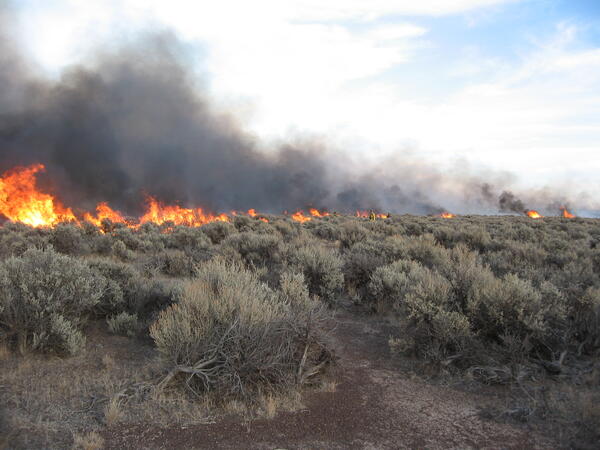
Sagebrush-dominated ecoregions in the western United States (sagebrush cover types shown in various shades of yellow, pink, and blue-grey).
Images
Sagebrush-dominated ecoregions in the western United States (sagebrush cover types shown in various shades of yellow, pink, and blue-grey).
Deformation and geochemical anomalies near South Sister, Oregon
Deformation and geochemical anomalies near South Sister, Oregon(Top) 1996–2000 interferogram draped over a 30-m DEM and showing uplift centered a few kilometers (miles) west of South Sister volcano. (Bottom) Geochemical data on top of the 1996–2000 interferogram. The columns show chloride (Cl) and sulfate (SO4) concentrations at sampled springs.
Deformation and geochemical anomalies near South Sister, Oregon
Deformation and geochemical anomalies near South Sister, Oregon(Top) 1996–2000 interferogram draped over a 30-m DEM and showing uplift centered a few kilometers (miles) west of South Sister volcano. (Bottom) Geochemical data on top of the 1996–2000 interferogram. The columns show chloride (Cl) and sulfate (SO4) concentrations at sampled springs.
Gas Hydrates in Marine Sediments off the Oregon Coast
Gas Hydrates in Marine Sediments off the Oregon CoastDuring Ocean Drilling Program Leg 204, nine sites were cored and wireline logged on the Oregon continental margin to determine the distribution and concentration of gas hydrates in an accretionary ridge setting, investigate the mechanisms that transport methane and other gases into the gas hydrate stability zone, and obtain constraints on physical properties of
Gas Hydrates in Marine Sediments off the Oregon Coast
Gas Hydrates in Marine Sediments off the Oregon CoastDuring Ocean Drilling Program Leg 204, nine sites were cored and wireline logged on the Oregon continental margin to determine the distribution and concentration of gas hydrates in an accretionary ridge setting, investigate the mechanisms that transport methane and other gases into the gas hydrate stability zone, and obtain constraints on physical properties of
Large-scale poster describing USGS work.
The USGS mapped Crater Lake, Oregon using sonar, in cooperation with the National Park Service, the University of New Hampshire, and C&C Technologies.
Large-scale poster describing USGS work.
The USGS mapped Crater Lake, Oregon using sonar, in cooperation with the National Park Service, the University of New Hampshire, and C&C Technologies.
Corbicula sampling in the Bonneville Pool, Columbia River
Corbicula sampling in the Bonneville Pool, Columbia RiverCorbicula sampling in the Bonneville Pool, Columbia River.
Corbicula sampling in the Bonneville Pool, Columbia River
Corbicula sampling in the Bonneville Pool, Columbia RiverCorbicula sampling in the Bonneville Pool, Columbia River.
USGS scientist collecting samples at Crater Lake, Oregon.
View from the SE rim of McDermitt caldera, Nevada and Oregon, of the Thacker Pass area
View from the SE rim of McDermitt caldera, Nevada and Oregon, of the Thacker Pass areaView from the SE rim of McDermitt caldera, Nevada and Oregon, showing rhyolite lavas overlain by thin outflow McDermitt Tuff in the south wall of the caldera. The low area that makes up most of the photo is intracaldera tuffaceous sediment. This is Thacker Pass, the site of largest and highest-grade lithium deposits in the region.
View from the SE rim of McDermitt caldera, Nevada and Oregon, of the Thacker Pass area
View from the SE rim of McDermitt caldera, Nevada and Oregon, of the Thacker Pass areaView from the SE rim of McDermitt caldera, Nevada and Oregon, showing rhyolite lavas overlain by thin outflow McDermitt Tuff in the south wall of the caldera. The low area that makes up most of the photo is intracaldera tuffaceous sediment. This is Thacker Pass, the site of largest and highest-grade lithium deposits in the region.
Rheomorphism in outflow sheets of McDermitt Tuff, Nevada and Oregon
Rheomorphism in outflow sheets of McDermitt Tuff, Nevada and OregonFolds in outflow sheets of McDermitt Tuff, from the eruption that formed McDermitt Caldera in Nevada and Oregon about 16.4 million years ago. The folding is called “rheomorphism” and occurred as the hot ash deposit flowed under its own weight shortly after it was deposited over preexisting topographic highs and lows. The texture resembles that of rhyolit
Rheomorphism in outflow sheets of McDermitt Tuff, Nevada and Oregon
Rheomorphism in outflow sheets of McDermitt Tuff, Nevada and OregonFolds in outflow sheets of McDermitt Tuff, from the eruption that formed McDermitt Caldera in Nevada and Oregon about 16.4 million years ago. The folding is called “rheomorphism” and occurred as the hot ash deposit flowed under its own weight shortly after it was deposited over preexisting topographic highs and lows. The texture resembles that of rhyolit
Thermal infrared mosaic of Quartzville Creek, OR. These images were captured on the year 2000 as part of an airborne thermal infrared survey conducted in the Santiam River basin, OR. The images were orthorectified and mosaicked into a single raster in order to identify and visualize thermal heterogeneity.
Three Sisters volcanoes (left to right - South, Middle, and North)
Three Sisters volcanoes (left to right - South, Middle, and North)Three Sisters volcanoes (left to right - South, Middle, and North) viewed from the south, Oregon. Foreground rhyolite Newberry flow is one of most recent eruptive units (2.2 ka).
Three Sisters volcanoes (left to right - South, Middle, and North)
Three Sisters volcanoes (left to right - South, Middle, and North)Three Sisters volcanoes (left to right - South, Middle, and North) viewed from the south, Oregon. Foreground rhyolite Newberry flow is one of most recent eruptive units (2.2 ka).
Pyroclastic flow from the Aug. 7, 1980 eruption stretches from Moun...
Pyroclastic flow from the Aug. 7, 1980 eruption stretches from Moun...During the May 18, 1980 eruption, at least 17 separate pyroclastic flows descended the flanks of Mount St. Helens. Pyroclastic flows typically move at speeds of over 60 miles per hour (100 kilometers/hour) and reach temperatures of over 800 Degrees Fahrenheit (400 degrees Celsius).
Pyroclastic flow from the Aug. 7, 1980 eruption stretches from Moun...
Pyroclastic flow from the Aug. 7, 1980 eruption stretches from Moun...During the May 18, 1980 eruption, at least 17 separate pyroclastic flows descended the flanks of Mount St. Helens. Pyroclastic flows typically move at speeds of over 60 miles per hour (100 kilometers/hour) and reach temperatures of over 800 Degrees Fahrenheit (400 degrees Celsius).
North Sister's steep NE face, thick summit lava flow makes up "Glis...
North Sister's steep NE face, thick summit lava flow makes up "Glis...Remnant of Villard Glacier is in cirque below. Thick summit lava flow makes up "Glisan Pinnacle," which overlies hundreds of thin rubbly lava flows that are intercalated with red-oxidized agglutinate and scoria falls exposed on 800-m- (2600-ft-) high face below. Flows that form ridge at upper right are thicker than those on most of edifice.
North Sister's steep NE face, thick summit lava flow makes up "Glis...
North Sister's steep NE face, thick summit lava flow makes up "Glis...Remnant of Villard Glacier is in cirque below. Thick summit lava flow makes up "Glisan Pinnacle," which overlies hundreds of thin rubbly lava flows that are intercalated with red-oxidized agglutinate and scoria falls exposed on 800-m- (2600-ft-) high face below. Flows that form ridge at upper right are thicker than those on most of edifice.
Three Sisters viewed from south to North from Broken Top, OR.
Three Sisters viewed from south to North from Broken Top, OR.Three Sisters annotated photograph viewed from south to North from Broken Top, Oregon.
Three Sisters viewed from south to North from Broken Top, OR.
Three Sisters viewed from south to North from Broken Top, OR.Three Sisters annotated photograph viewed from south to North from Broken Top, Oregon.
Erratics located on a cinder cone about 5 km (3 mi) NE of Newberry
Erratics located on a cinder cone about 5 km (3 mi) NE of NewberryErratics located on a cinder cone on the northeast flank of Newberry Volcano, Oregon.
Erratics located on a cinder cone about 5 km (3 mi) NE of Newberry
Erratics located on a cinder cone about 5 km (3 mi) NE of NewberryErratics located on a cinder cone on the northeast flank of Newberry Volcano, Oregon.
Hinmatóowyalahtq̓it (Chief Joseph) of the Nez Perce in 1877
Hinmatóowyalahtq̓it (Chief Joseph) of the Nez Perce in 1877Photo of Hinmatóowyalahtq̓it (Chief Joseph) taken in November 1877 by O.S. Goff in Bismarck. From Wikipedia (https://commons.wikimedia.org/wiki/File:Chief_Joseph-1877.jpg).
Hinmatóowyalahtq̓it (Chief Joseph) of the Nez Perce in 1877
Hinmatóowyalahtq̓it (Chief Joseph) of the Nez Perce in 1877Photo of Hinmatóowyalahtq̓it (Chief Joseph) taken in November 1877 by O.S. Goff in Bismarck. From Wikipedia (https://commons.wikimedia.org/wiki/File:Chief_Joseph-1877.jpg).