Drone’s-eye views of the toe of the Mud Creek landslide
Drone’s-eye views of the toe of the Mud Creek landslideDrone’s-eye views of the toe of the Mud Creek landslide, from videos shot by Shawn Harrison on July 12, 2017


Official websites use .gov
A .gov website belongs to an official government organization in the United States.

Secure .gov websites use HTTPS
A lock () or https:// means you’ve safely connected to the .gov website. Share sensitive information only on official, secure websites.

Pacific Coastal and Marine Science Center images.

Drone’s-eye views of the toe of the Mud Creek landslide, from videos shot by Shawn Harrison on July 12, 2017
Drone’s-eye views of the toe of the Mud Creek landslide, from videos shot by Shawn Harrison on July 12, 2017

Preliminary seafloor bathymetry (shown in colors) collected by the USGS research vessel Parke Snavely on July 11, 2017. Relative depths shown in color, superimposed on a shaded-relief map from the June 26 USGS air-photo survey. Note white data gap next to the shore where water was too shallow for the Snavely to map.
Preliminary seafloor bathymetry (shown in colors) collected by the USGS research vessel Parke Snavely on July 11, 2017. Relative depths shown in color, superimposed on a shaded-relief map from the June 26 USGS air-photo survey. Note white data gap next to the shore where water was too shallow for the Snavely to map.

USGS scientists continue to monitor the slide by collecting imagery every couple of weeks, weather permitting. Pilot Bob Van Wagenen, contracted through the Department of the Interior’s Office of Aviation Services, takes air photos for Jon Warrick’s Big Sur Landslide team, flying out of the Watsonville Municipal Airport in a Cessna 182R.
USGS scientists continue to monitor the slide by collecting imagery every couple of weeks, weather permitting. Pilot Bob Van Wagenen, contracted through the Department of the Interior’s Office of Aviation Services, takes air photos for Jon Warrick’s Big Sur Landslide team, flying out of the Watsonville Municipal Airport in a Cessna 182R.

The Geospace Navigator bird is a streamer depth control device, used with a high-resolution seismic system to regulate and record the depth of the streamer.
The Geospace Navigator bird is a streamer depth control device, used with a high-resolution seismic system to regulate and record the depth of the streamer.

The Geospace Navigator bird is a streamer depth control device, used with a high-resolution seismic system to regulate and record the depth of the streamer.
The Geospace Navigator bird is a streamer depth control device, used with a high-resolution seismic system to regulate and record the depth of the streamer.

The Geospace Navigator bird is a streamer depth control device, used with a high-resolution seismic system to regulate and record the depth of the streamer.
The Geospace Navigator bird is a streamer depth control device, used with a high-resolution seismic system to regulate and record the depth of the streamer.

Multichannel seismic-reflection profile showing deformed and offset sediment layers below the outer continental shelf west of Sitka. The Sitka Sound fault is one of more than a dozen previously unmapped faults discovered in the July 2017 seismic-reflection data.
Multichannel seismic-reflection profile showing deformed and offset sediment layers below the outer continental shelf west of Sitka. The Sitka Sound fault is one of more than a dozen previously unmapped faults discovered in the July 2017 seismic-reflection data.

Research vessel Ocean Starr in Alaska.

Multichannel seismic-reflection profile showing deformed sediment layers on the Pacific plate, just seaward of the Queen Charlotte-Fairweather fault near the south end of the study area. Location of profile shown by southern-most yellow line on trackline map, near Noyes Cyn. (Canyon).
Multichannel seismic-reflection profile showing deformed sediment layers on the Pacific plate, just seaward of the Queen Charlotte-Fairweather fault near the south end of the study area. Location of profile shown by southern-most yellow line on trackline map, near Noyes Cyn. (Canyon).

Columbia River mouth bathymetry from USGS data release
Columbia River mouth bathymetry from USGS data release

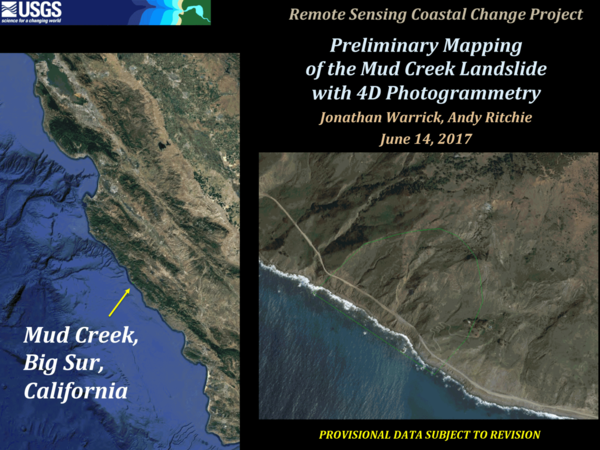
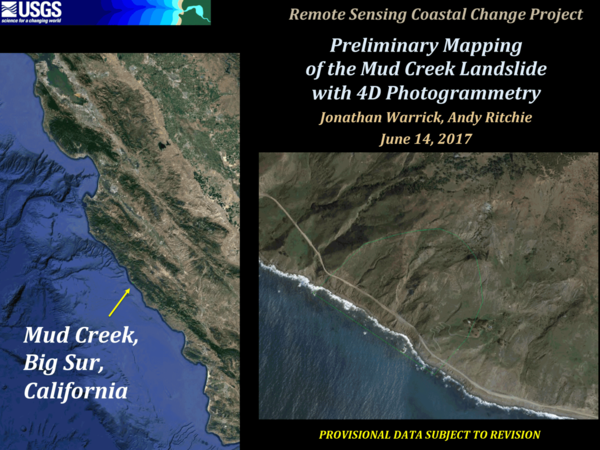
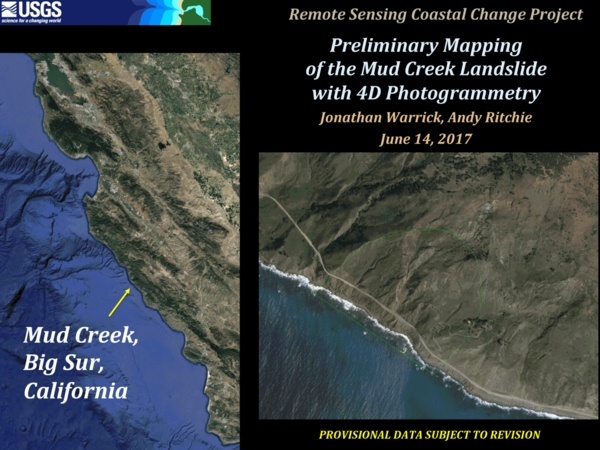
In 2017, the massive Mud Creek landslide buried a quarter-mile of the famous coastal route, California’s Highway 1, with rocks and dirt more than 65 feet deep. USGS monitors erosion along the landslide-prone cliffs of Big Sur, collecting aerial photos frequently throughout the year.
In 2017, the massive Mud Creek landslide buried a quarter-mile of the famous coastal route, California’s Highway 1, with rocks and dirt more than 65 feet deep. USGS monitors erosion along the landslide-prone cliffs of Big Sur, collecting aerial photos frequently throughout the year.

In 2017, the massive Mud Creek landslide buried a quarter-mile of the famous coastal route, California’s Highway 1, with rocks and dirt more than 65 feet deep. USGS monitors erosion along the landslide-prone cliffs of Big Sur, collecting aerial photos frequently throughout the year.
In 2017, the massive Mud Creek landslide buried a quarter-mile of the famous coastal route, California’s Highway 1, with rocks and dirt more than 65 feet deep. USGS monitors erosion along the landslide-prone cliffs of Big Sur, collecting aerial photos frequently throughout the year.
In 2017, the massive Mud Creek landslide buried a quarter-mile of the famous coastal route, California’s Highway 1, with rocks and dirt more than 65 feet deep. USGS monitors erosion along the landslide-prone cliffs of Big Sur, collecting aerial photos frequently throughout the year.
In 2017, the massive Mud Creek landslide buried a quarter-mile of the famous coastal route, California’s Highway 1, with rocks and dirt more than 65 feet deep. USGS monitors erosion along the landslide-prone cliffs of Big Sur, collecting aerial photos frequently throughout the year.
In 2017, the massive Mud Creek landslide buried a quarter-mile of the famous coastal route, California’s Highway 1, with rocks and dirt more than 65 feet deep. USGS monitors erosion along the landslide-prone cliffs of Big Sur, collecting aerial photos frequently throughout the year.
In 2017, the massive Mud Creek landslide buried a quarter-mile of the famous coastal route, California’s Highway 1, with rocks and dirt more than 65 feet deep. USGS monitors erosion along the landslide-prone cliffs of Big Sur, collecting aerial photos frequently throughout the year.

In 2017, the massive Mud Creek landslide buried a quarter-mile of the famous coastal route, California’s Highway 1, with rocks and dirt more than 65 feet deep. USGS monitors erosion along the landslide-prone cliffs of Big Sur, collecting aerial photos frequently throughout the year.
In 2017, the massive Mud Creek landslide buried a quarter-mile of the famous coastal route, California’s Highway 1, with rocks and dirt more than 65 feet deep. USGS monitors erosion along the landslide-prone cliffs of Big Sur, collecting aerial photos frequently throughout the year.
In 2017, the massive Mud Creek landslide buried a quarter-mile of the famous coastal route, California’s Highway 1, with rocks and dirt more than 65 feet deep. USGS monitors erosion along the landslide-prone cliffs of Big Sur, collecting aerial photos frequently throughout the year.
In 2017, the massive Mud Creek landslide buried a quarter-mile of the famous coastal route, California’s Highway 1, with rocks and dirt more than 65 feet deep. USGS monitors erosion along the landslide-prone cliffs of Big Sur, collecting aerial photos frequently throughout the year.

Imagery shows topographic point clouds from photos, first from September 11, 2015 courtesy of California Coastal Records Project, second from March 8, 2017 (USGS photo), third from May 19, 2017 (USGS photo), and fourth from May 27, 2017 (USGS photo) 7 days following the catastrophic Highway 1 landslide.
Imagery shows topographic point clouds from photos, first from September 11, 2015 courtesy of California Coastal Records Project, second from March 8, 2017 (USGS photo), third from May 19, 2017 (USGS photo), and fourth from May 27, 2017 (USGS photo) 7 days following the catastrophic Highway 1 landslide.

USGS air photo of the Mud Creek landslide, taken on May 27, 2017
USGS air photo of the Mud Creek landslide, taken on May 27, 2017

Topographic “point clouds” (or 3D maps) created by computer processing of air photos show what the Mud Creek area looked like on March 8, 2017 (top), May 19 (center), and May 27 (bottom).
Topographic “point clouds” (or 3D maps) created by computer processing of air photos show what the Mud Creek area looked like on March 8, 2017 (top), May 19 (center), and May 27 (bottom).

View from an airplane looking at the Mud Creek landslide on the Big Sur coast that occurred May 20, 2017.
View from an airplane looking at the Mud Creek landslide on the Big Sur coast that occurred May 20, 2017.

Still-image from video camera atop the Dream Inn looks eastward over Main Beach and boardwalk in Santa Cruz, CA.
Still-image from video camera atop the Dream Inn looks eastward over Main Beach and boardwalk in Santa Cruz, CA.