U.S. flag

An official website of the United States government

Images

St. Petersburg Coastal and Marine Science Center images.

Filter Total Items: 708
Winter nor’easters eroded sediments from an artificial dune and moved them seaward to the beach and shoreface
Winter nor’easters eroded sediments from an artificial dune

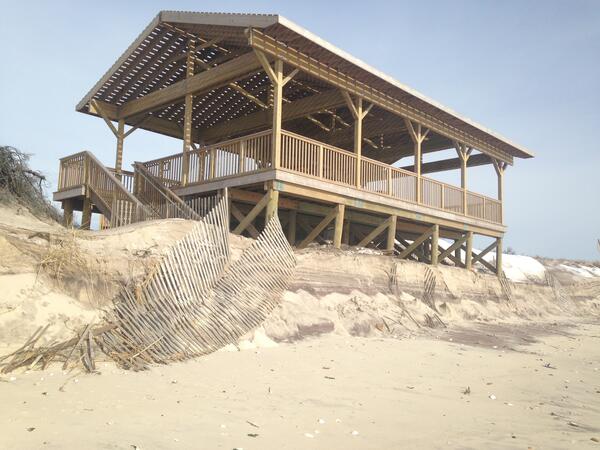
Though often less intense than hurricanes, extratropical storms (e.g., nor’easters) occur more frequently and their impacts can be striking. Here, several years after Hurricane Sandy, winter nor’easters eroded sediments from an artificial dune at Fire Island, NY and moved them onto the beach and shoreface. Such erosion created a steep vertical face, or scarp.

Though often less intense than hurricanes, extratropical storms (e.g., nor’easters) occur more frequently and their impacts can be striking. Here, several years after Hurricane Sandy, winter nor’easters eroded sediments from an artificial dune at Fire Island, NY and moved them onto the beach and shoreface. Such erosion created a steep vertical face, or scarp.

a sandy coastline with heavily eroded dunes with two houses on stilts nearby
Erosion at Fire Island, New York

The impacts of extreme storms can be striking. Here, winter nor’easters eroded sediments from an artificial dune at Fire Island, New York and moved them onto the beach and shoreface. Such erosion created a steep vertical face, or scarp. Erosion and overwash are expected to increase on Fire Island with rising sea levels. 

The impacts of extreme storms can be striking. Here, winter nor’easters eroded sediments from an artificial dune at Fire Island, New York and moved them onto the beach and shoreface. Such erosion created a steep vertical face, or scarp. Erosion and overwash are expected to increase on Fire Island with rising sea levels. 

Photo shows white, bleached coral surrounded by brown coral, with fish swimming
Photograph of shallow-water coral bleaching at Sombrero de Pelo reef

Photograph of shallow-water coral bleaching at Sombrero de Pelo reef in Pacific Panama during the 2015-2016 El Nino event. Because of the influence of internal waves, corals growing at deeper locations at this site did not bleach.

Photograph of shallow-water coral bleaching at Sombrero de Pelo reef in Pacific Panama during the 2015-2016 El Nino event. Because of the influence of internal waves, corals growing at deeper locations at this site did not bleach.

a photograph of a technical piece of equipment on the back of a boat on the water
Nanopod Deployment
Nanopod Deployment
Nanopod Deployment

The USGS Coastal and Estuarine Dynamics Group will be deploying a Nanopod at Pea Island DUNEX experiment site to collect oceanographic information.

Elkhorn coral has died and turned to rubble.
Corals die, turn to rubble

These Elkhorn corals (Acropora palmata) near Buck Island, U.S. Virgin Islands have died and collapsed into rubble. As coral reef structure degrades, valuable habitat for marine life is lost and nearby coastlines become more susceptible to storms, waves and erosion.

These Elkhorn corals (Acropora palmata) near Buck Island, U.S. Virgin Islands have died and collapsed into rubble. As coral reef structure degrades, valuable habitat for marine life is lost and nearby coastlines become more susceptible to storms, waves and erosion.

Near vertical (top, middle) and low angle oblique (bottom) aerial photographs of Bear Inlet, North Carolina.
Aerial photographs of Bear Inlet, North Carolina

Near vertical (top, middle) and low angle oblique (bottom) aerial photographs of Bear Inlet, North Carolina. View looking northwest along the North Carolina shore. High waves and storm surge from Hurricane Joaquin eroded the beaches, moving sand inland (green arrow) and reshaping the flood-tidal shoals.

Near vertical (top, middle) and low angle oblique (bottom) aerial photographs of Bear Inlet, North Carolina. View looking northwest along the North Carolina shore. High waves and storm surge from Hurricane Joaquin eroded the beaches, moving sand inland (green arrow) and reshaping the flood-tidal shoals.

images of the wilderness breac
Aerial images of the wilderness breach

Aerial images of the wilderness breach: a) Aerial photograph taken several days after Hurricane Sandy (photo credit: NOAA); b) Aerial mosaic of the breach in June 2015 showing the location of erosion on the ocean side of the breach and deposition that results in the seasonal formation of a spit (photo credit: Stonybrook University).

Aerial images of the wilderness breach: a) Aerial photograph taken several days after Hurricane Sandy (photo credit: NOAA); b) Aerial mosaic of the breach in June 2015 showing the location of erosion on the ocean side of the breach and deposition that results in the seasonal formation of a spit (photo credit: Stonybrook University).

Image of the unstructured finite element mesh model grid encompassing the Atlantic Ocean, Caribbean Sea and Gulf of America

The advanced circulation (ADCIRC) model unstructured finite element mesh spans the western North Atlantic Tidal domain to the 60-degree west meridian, including the Atlantic Ocean, Caribbean Sea and Gulf of America.

A healthy coral reef at Buck Island, U.S. Virgin Island
Elkhorn coral anchors a healthy reef

Healthy Elkhorn coral (Acropora palmata) near unpopulated Buck Island, U.S. Virgin Islands. Elkhorn coral is one of many important reef-building species that create 3D structure on the seafloor. Coral reef structure provides habitat for marine life and helps break up waves as they approach the coastline.

Healthy Elkhorn coral (Acropora palmata) near unpopulated Buck Island, U.S. Virgin Islands. Elkhorn coral is one of many important reef-building species that create 3D structure on the seafloor. Coral reef structure provides habitat for marine life and helps break up waves as they approach the coastline.

USGS' Owen Brenner wading with GPS backpack
Wading in the breach to precisely measure it

USGS employee Owen Brenner walks across the Fire Island wilderness breach carrying a GPS backpack that allows him to collect precise elevation data in the shallows.

USGS employee Owen Brenner walks across the Fire Island wilderness breach carrying a GPS backpack that allows him to collect precise elevation data in the shallows.

Near vertical (top, middle) and low angle oblique (bottom) aerial photographs of New Drum Inlet, Core Banks, North Carolina
Aerial photographs of New Drum Inlet, Core Banks, North Carolina

Near vertical (top, middle) and low angle oblique (bottom) aerial photographs of New Drum Inlet, Core Banks, North Carolina. View looking northwest along the North Carolina shore.

Near vertical (top, middle) and low angle oblique (bottom) aerial photographs of Camp Lejeune, North Carolina.
Aerial photographs of Camp Lejeune, North Carolina

Near vertical (top, middle) and low angle oblique (bottom) aerial photographs of Camp Lejeune, North Carolina. View looking northwest along the North Carolina shore. Waves and surge from Hurricane Joaquin eroded the beach, causing significant shoreline retreat and a narrower beach.

Near vertical (top, middle) and low angle oblique (bottom) aerial photographs of Camp Lejeune, North Carolina. View looking northwest along the North Carolina shore. Waves and surge from Hurricane Joaquin eroded the beach, causing significant shoreline retreat and a narrower beach.

A time-averaged image from Duck, North Carolina, on September 1, 2015

The relatively new camera stations at Santa Cruz and Madeira Beach have not yet imaged many rip channels, so this is an example from the U.S. Army Corps of Engineers Field Research Facility in Duck, North Carolina. In this time-averaged image from video taken September 1, 2015, the dark horizontal bands perpendicular to the beach indicate rip channels.

The relatively new camera stations at Santa Cruz and Madeira Beach have not yet imaged many rip channels, so this is an example from the U.S. Army Corps of Engineers Field Research Facility in Duck, North Carolina. In this time-averaged image from video taken September 1, 2015, the dark horizontal bands perpendicular to the beach indicate rip channels.

A smiling woman stands on a dock by the water, and the tail end of a big ship, in the background, is tied up to the dock.
Lisa Robbins near R/V Atlantis

USGS scientist Lisa Robbins next to the research vessel (R/V) Atlantis, which is owned by the U.S. Navy and operated by the Woods Hole Oceanographic Institution.

USGS scientist Lisa Robbins next to the research vessel (R/V) Atlantis, which is owned by the U.S. Navy and operated by the Woods Hole Oceanographic Institution.

Scientist sets up solar-powered research station amid Fire Island dunes
Setting up a science base in a barrier island wilderness

USGS scientist BJ Reynolds sets up a solar-powered, satellite-uplinked GPS base station in the Fire Island Wilderness Area to support detailed elevation surveys.

Near vertical (top, middle) and low angle oblique (bottom) aerial photographs of Topsail, North Carolina. 
Aerial photographs of Topsail, North Carolina

Near vertical (top, middle) and low angle oblique (bottom) aerial photographs of Topsail, North Carolina. View looking northwest along the North Carolina shore. Elevated storm-induced water levels overtopped the low dunes here causing the dune to overwash. Sand was transported landward, burying the marsh (green arrow).

Near vertical (top, middle) and low angle oblique (bottom) aerial photographs of Topsail, North Carolina. View looking northwest along the North Carolina shore. Elevated storm-induced water levels overtopped the low dunes here causing the dune to overwash. Sand was transported landward, burying the marsh (green arrow).

USGS scientists operating a small research vessel in water near a grassy shoreline.
USGS vessel used to collect single-beam bathymetry

This USGS vessel acquires single-beam bathymetry in shallow nearshore environments. We acquire repeat bathymetry surveys over multiple years and compute changes in bathymetry, thus allowing us to identify hotspots of erosion and deposition on short timescales.

This USGS vessel acquires single-beam bathymetry in shallow nearshore environments. We acquire repeat bathymetry surveys over multiple years and compute changes in bathymetry, thus allowing us to identify hotspots of erosion and deposition on short timescales.

Near vertical (top, middle) and low angle oblique (bottom) aerial photographs of Oregon Inlet, North Carolina. 
Aerial photographs of Oregon Inlet, North Carolina

Near vertical (top, middle) and low angle oblique (bottom) aerial photographs of Oregon Inlet, North Carolina. View looking west along the North Carolina shore. High waves and storm surge from Hurricane Joaquin eroded the beach and inundated the low area in the backshore at Oregon Inlet (A, green box, blue arrows).

Near vertical (top, middle) and low angle oblique (bottom) aerial photographs of Oregon Inlet, North Carolina. View looking west along the North Carolina shore. High waves and storm surge from Hurricane Joaquin eroded the beach and inundated the low area in the backshore at Oregon Inlet (A, green box, blue arrows).

aerial photographs of Hatteras, North Carolina.
Aerial photographs of Hatteras, North Carolina

Near vertical (top, middle) and low angle oblique (bottom) aerial photographs of Hatteras, North Carolina. View looking north along the North Carolina shore. Waves and surge from Hurricane Joaquin eroded the beach, causing significant shoreline retreat and a narrower beach at the location of the Hurricane Isabel breach in 2003 (green arrow).

Near vertical (top, middle) and low angle oblique (bottom) aerial photographs of Hatteras, North Carolina. View looking north along the North Carolina shore. Waves and surge from Hurricane Joaquin eroded the beach, causing significant shoreline retreat and a narrower beach at the location of the Hurricane Isabel breach in 2003 (green arrow).

Was this page helpful?