



Two divers from the CREST research team float underwater near Looe Key, FL to survey fish, urchins, and sponges.
Images
St. Petersburg Coastal and Marine Science Center images.
Filter Total Items: 760

Divers construct transect off of Looe Key
Two divers from the CREST research team float underwater near Looe Key, FL to survey fish, urchins, and sponges.

R/V Sallenger tows SQUID-5 near Looe Key
The SQUID-5 system is pulled behind the USGS research vessel the R/V Sallenger near Looe Key. The SQUID-5 is taking images of the seafloor which will be made into 3-dimensional models.
The SQUID-5 system is pulled behind the USGS research vessel the R/V Sallenger near Looe Key. The SQUID-5 is taking images of the seafloor which will be made into 3-dimensional models.

R/V Sallenger Tows SQUID-5 for 3D Seafloor Mapping
R/V Sallenger Tows SQUID-5 for 3D Seafloor MappingThe R/V Sallenger tows the structure-from-motion quantitative underwater imaging device with 5 cameras (SQUID-5) across the water over Looe Key Reef in the Florida Keys.
R/V Sallenger Tows SQUID-5 for 3D Seafloor Mapping
R/V Sallenger Tows SQUID-5 for 3D Seafloor MappingThe R/V Sallenger tows the structure-from-motion quantitative underwater imaging device with 5 cameras (SQUID-5) across the water over Looe Key Reef in the Florida Keys.

Studying Seafloor Erosion in the Florida Keys
Studying Seafloor Erosion in the Florida Keys
The challenge:
Studying Seafloor Erosion in the Florida Keys
The challenge:

Atlantic and Gulf Coast Sandy Coastline Topo-Bathy Profile and Characteristic Database
Atlantic and Gulf Coast Sandy Coastline Topo-Bathy Profile and Characteristic DatabaseCoverage area for the topo-bathy profiles and their morphologic characteristics across the Atlantic and Gulf coastlines.
Atlantic and Gulf Coast Sandy Coastline Topo-Bathy Profile and Characteristic Database
Atlantic and Gulf Coast Sandy Coastline Topo-Bathy Profile and Characteristic DatabaseCoverage area for the topo-bathy profiles and their morphologic characteristics across the Atlantic and Gulf coastlines.

Carbonate Budget Animation
When carbonate production is high, coral reefs grow, providing more habitat for biodiversity and additional coastal protection. When carbonate production is too low, bioerosion becomes dominant and the reef is eroded, decreasing the amount of habitat available.
When carbonate production is high, coral reefs grow, providing more habitat for biodiversity and additional coastal protection. When carbonate production is too low, bioerosion becomes dominant and the reef is eroded, decreasing the amount of habitat available.

Hurricane Tracks, Puerto Rico
Hurricane tracks for Hugo (1989), Georges (1998), Irma (2017) and Maria (2017). Data provided by NOAA. Base image is intellectual property of Esri and is used herein under license. Copyright Esri and its creator.
Hurricane tracks for Hugo (1989), Georges (1998), Irma (2017) and Maria (2017). Data provided by NOAA. Base image is intellectual property of Esri and is used herein under license. Copyright Esri and its creator.

Diver Examines Submarine Groundwater Well
USGS scientific diver BJ Reynolds examines a submarine groundwater well on the seafloor before hooking up the well to a pump on the surface to ensure the wells are working properly and producing groundwater.
USGS scientific diver BJ Reynolds examines a submarine groundwater well on the seafloor before hooking up the well to a pump on the surface to ensure the wells are working properly and producing groundwater.

Diver at a Submarine Groundwater Well
USGS scientific diver BJ Reynolds next to a submarine groundwater well on the seafloor. Tubing was hooked up the well to pump groundwater to the surface to ensure the wells are working properly and producing groundwater.
USGS scientific diver BJ Reynolds next to a submarine groundwater well on the seafloor. Tubing was hooked up the well to pump groundwater to the surface to ensure the wells are working properly and producing groundwater.

Examining Water From a Submarine Groundwater Well
Dr. Christopher G. Smith pumps water from a submarine groundwater well on the seafloor through tubing to the R/V Halimeda and uses an instrument called a YSI to measure salinity and ensure the wells are working properly and producing groundwater.
Dr. Christopher G. Smith pumps water from a submarine groundwater well on the seafloor through tubing to the R/V Halimeda and uses an instrument called a YSI to measure salinity and ensure the wells are working properly and producing groundwater.

Examining Water From a Submarine Groundwater Well
Dr. Christopher G. Smith pumps water from a submarine groundwater well on the seafloor through tubing to the R/V Halimeda and uses an instrument called a YSI to measure salinity and ensure the wells are working properly and producing groundwater.
Dr. Christopher G. Smith pumps water from a submarine groundwater well on the seafloor through tubing to the R/V Halimeda and uses an instrument called a YSI to measure salinity and ensure the wells are working properly and producing groundwater.

Examining Water From a Submarine Groundwater Well
Dr. Christopher G. Smith pumps water from a submarine groundwater well on the seafloor through tubing to the R/V Halimeda and uses an instrument called a YSI to measure salinity and ensure the wells are working properly and producing groundwater.
Dr. Christopher G. Smith pumps water from a submarine groundwater well on the seafloor through tubing to the R/V Halimeda and uses an instrument called a YSI to measure salinity and ensure the wells are working properly and producing groundwater.

Restored staghorn coral (Acropora cervicornis) at Looe Key reef
Restored staghorn coral (Acropora cervicornis) at Looe Key reefRestored staghorn coral (Acropora cervicornis) at Looe Key reef in the lower Florida Keys outplanted by Mote Marine Laboratory's coral restoration program.
Restored staghorn coral (Acropora cervicornis) at Looe Key reef
Restored staghorn coral (Acropora cervicornis) at Looe Key reefRestored staghorn coral (Acropora cervicornis) at Looe Key reef in the lower Florida Keys outplanted by Mote Marine Laboratory's coral restoration program.

USGS Ocean Research
Our coasts, the most familiar part of the ocean are the gateway to the larger deeper ocean world. USGS studies processes and hazards in the coastal zone and how they affect people, wildlife, and ecosystems.
Our coasts, the most familiar part of the ocean are the gateway to the larger deeper ocean world. USGS studies processes and hazards in the coastal zone and how they affect people, wildlife, and ecosystems.

SPCMSC Core Archive
Photograph of the SPCMSC Core Laboratory’s storage stacks. The SPCMSC Core Laboratory is an archive that houses a collection of nearly 3,000 cores collected by the center and Federal, State, and university partners. These cores have been sampled from diverse study areas including coral reefs, wetlands, beaches, and marine environments from around the world.
Photograph of the SPCMSC Core Laboratory’s storage stacks. The SPCMSC Core Laboratory is an archive that houses a collection of nearly 3,000 cores collected by the center and Federal, State, and university partners. These cores have been sampled from diverse study areas including coral reefs, wetlands, beaches, and marine environments from around the world.

Three successful experimental coral colonies in Dry Tortugas National Park
Three successful experimental coral colonies in Dry Tortugas National ParkThe U.S. Geological Survey is conducting research to guide the restoration and recovery of threatened corals in Dry Tortugas National Park and throughout the western Atlantic. Shown here are two colonies of the threatened elkhorn coral, Acropora palmata, with a colony of staghorn coral, Acropora cervicornis, in the center.
Three successful experimental coral colonies in Dry Tortugas National Park
Three successful experimental coral colonies in Dry Tortugas National ParkThe U.S. Geological Survey is conducting research to guide the restoration and recovery of threatened corals in Dry Tortugas National Park and throughout the western Atlantic. Shown here are two colonies of the threatened elkhorn coral, Acropora palmata, with a colony of staghorn coral, Acropora cervicornis, in the center.

Successful experimental elkhorn coral colony in Dry Tortugas National Park
Successful experimental elkhorn coral colony in Dry Tortugas National ParkThe U.S.

Successful experimental elkhorn coral colony in Dry Tortugas National Park
Successful experimental elkhorn coral colony in Dry Tortugas National ParkThe U.S. Geological Survey is conducting research to guide the restoration and recovery of threatened corals in Dry Tortugas National Park and throughout the western Atlantic. Shown here is a colony of the threatened elkhorn coral, Acropora palmata, that has grown over the sides of a cinderblock experimental platform.
Successful experimental elkhorn coral colony in Dry Tortugas National Park
Successful experimental elkhorn coral colony in Dry Tortugas National ParkThe U.S. Geological Survey is conducting research to guide the restoration and recovery of threatened corals in Dry Tortugas National Park and throughout the western Atlantic. Shown here is a colony of the threatened elkhorn coral, Acropora palmata, that has grown over the sides of a cinderblock experimental platform.
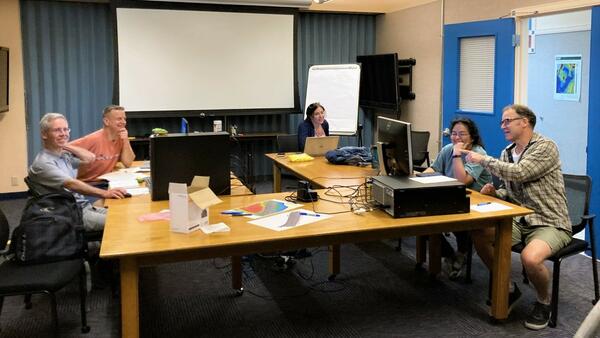
Seafloor Structure-from-Motion (SfM) ad-hoc workshop in St. Petersburg, Florida
Seafloor Structure-from-Motion (SfM) ad-hoc workshop in St. Petersburg, FloridaThe USGS Processes Impacting Seafloor Change and Ecosystem Services (PISCES) project team meeting at the St. Petersburg Coastal and Marine Science Center in May 2022 to coordinate Structure-from-motion (SfM) Quantitative Underwater Imaging Device with 5 cameras (SQUID-5) and diver-based SfM data acquisition and processing for field work.
Seafloor Structure-from-Motion (SfM) ad-hoc workshop in St. Petersburg, Florida
Seafloor Structure-from-Motion (SfM) ad-hoc workshop in St. Petersburg, FloridaThe USGS Processes Impacting Seafloor Change and Ecosystem Services (PISCES) project team meeting at the St. Petersburg Coastal and Marine Science Center in May 2022 to coordinate Structure-from-motion (SfM) Quantitative Underwater Imaging Device with 5 cameras (SQUID-5) and diver-based SfM data acquisition and processing for field work.

Vibracore in shallow water
A vibracore being deployed by USGS staff from the FSU R/V Apalachee for the Naval Research Laboratory (NRL). The objective of this field effort was to establish a baseline environmental characterization for a test bed to predict mobility and burial of unexploded ordnance (UXO) in response to waves and currents.
A vibracore being deployed by USGS staff from the FSU R/V Apalachee for the Naval Research Laboratory (NRL). The objective of this field effort was to establish a baseline environmental characterization for a test bed to predict mobility and burial of unexploded ordnance (UXO) in response to waves and currents.

Retrieving a sediment trap on the R/V Weatherbird II
Retrieving a sediment trap on the R/V Weatherbird IICaitlin Reynolds retrieving one of the sediment traps used by USGS to study sediment flux in the Gulf of America on board the Research Vessel (R/V) Weatherbird II (Florida Institute of Oceanography).
Retrieving a sediment trap on the R/V Weatherbird II
Retrieving a sediment trap on the R/V Weatherbird IICaitlin Reynolds retrieving one of the sediment traps used by USGS to study sediment flux in the Gulf of America on board the Research Vessel (R/V) Weatherbird II (Florida Institute of Oceanography).