



Common Water Issues
Common Water Issues
Water Properties
Emerging Contaminants
Water Quality Topics
Droughts: Things to Know
Find water science information and activities related to popular water topics and problems.


Filter Total Items: 158

Total Water Use
The USGS has estimated water use for the United States every 5 years since 1950. Estimates are provided for groundwater and surface-water sources, for fresh and saline water quality, and by sector or category of use. Estimates have been made at the State level since 1950, and at the county level since 1985. Water-use estimates by watershed were made from 1950 through 1995, first at the water...

Trends in Water Use
Total withdrawals for all categories of use in 2015 were estimated to be 322 billion gallons per day (Bgal/d), a level of withdrawal not reported since before 1970. Total withdrawals in 2015 were 9 percent less than in 2010, continuing a sharp but steady downward trend since 2005. Freshwater withdrawals were also 9 percent less than in 2015.

Surface-Water Use
Surface-water sources include streams and rivers, lakes and reservoirs, and oceans. For the purposes of the USGS water-use reports, surface water with less than 1,000 milligrams per liter (mg/L) of dissolved solids is considered freshwater, and the remainder is considered saline. Surface-water resources are often evaluated by watershed. The most recent USGS water-use estimates by watershed are in...

Groundwater Use
Groundwater refers to all subsurface water, specifically that part of groundwater which is in the saturated zone. Groundwater sources are called aquifers: geologic formations that contain sufficient saturated permeable material to yield significant quantities of water to wells and springs. For the purposes of the USGS water-use reports, groundwater with less than 1,000 milligrams per liter (mg/L)...

Surge, Wave, and Tide Hydrodynamics (SWaTH) Network
During large coastal storms, the storm surge and waves are the main cause of destruction and landscape change, transporting saline water, sediment, and debris inland. The USGS, in collaboration with stakeholders, has constructed a national Surge, Wave, and Tide Hydrodynamics (SWaTH) Network for the Atlantic, Eastern Pacific, and Central Pacific. SWaTH monitors and documents the height, extent, and...
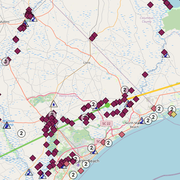
Providing Major Storm and Short-Term Flood Event Data
During major storms or other short-term events, the USGS collects streamflow and additional data to help document high-water events. This data is uploaded to the Short-Term Network (STN) for long-term archival and served out to the public through the Flood Event Viewer (FEV) which provides convenient, map-based access to downloadable event-based data.

Transportation-Related Water Projects
The USGS has a long history of cooperative investigations with the Federal Highway Administration (FHWA) and state highway agencies to provide data and information to address various issues related to water resources and the Nation’s transportation infrastructure. These issues cover a wide spectrum and include items such as regional flow statistics, flood documentation, regional stream...

Fluvial Sediment and Geomorphology: Resources for Monitoring and Analysis
The USGS collects fluvial sediment and geomorphic data and conducts related research at numerous sites across the Nation. This information is essential to informed solutions to sediment-related and overall water resource management issues.

Emerging Contaminants
Emerging contaminants, or contaminants of emerging concern, can refer to many different kinds of chemicals, including medicines, personal care or household cleaning products, lawn care and agricultural products, among others. These chemicals make it into our Nation's lakes and rivers and have a detrimental affect on fish and other aquatic species. That have also been shown to bioaccumulate up the...

Groundwater Quality Research
Every day, millions of gallons of groundwater are pumped to supply drinking water for about 140 million people, almost one-half of the Nation’s population. Learn about the quality and availability of groundwater for drinking, where and why groundwater quality is degraded, and where groundwater quality is changing.

Water Quality in the Nation’s Streams and Rivers – Current Conditions and Long-Term Trends
The Nation's rivers and streams are a priceless resource, but pollution from urban and agricultural areas pose a threat to our water quality. To understand the value of water quality, and to more effectively manage and protect the Nation's water resources, it's critical that we know the current status of water-quality conditions, and how and why those conditions have been changing over time.

Groundwater/Surface-Water Interaction
Water and the chemicals it contains are constantly being exchanged between the land surface and the subsurface. Surface water seeps into the ground and recharges the underlying aquifer—groundwater discharges to the surface and supplies the stream with baseflow. USGS Integrated Watershed Studies assess these exchanges and their effect on surface-water and groundwater quality and quantity.