U.S. flag

An official website of the United States government

Images

Browse our photos of landslide research and post-landslide investigations.

Filter Total Items: 216
postfire debris flow science infographic
Postfire Debris Flow Science Infographic

POSTFIRE DEBRIS FLOW SCIENCE

The U.S. Geological Survey helps local, state, and federal agencies assess debris flow hazards in recently burned areas. We provide information about the likelihood of debris flow activity, where they might happen, and how big they might be.


DEBRIS FLOW ASSESSMENTS

POSTFIRE DEBRIS FLOW SCIENCE

The U.S. Geological Survey helps local, state, and federal agencies assess debris flow hazards in recently burned areas. We provide information about the likelihood of debris flow activity, where they might happen, and how big they might be.


DEBRIS FLOW ASSESSMENTS

Steep hillslope with loose sediment and burned vegetation
Dry ravel in the 2025 Eaton Fire burn area.

A detailed look at a hillslope within the Eaton Fire burn area showing sediment particles, visible in the foreground, moving downslope.  Remnants of burned trees and other vegetation are also visible on the hillslope.

A detailed look at a hillslope within the Eaton Fire burn area showing sediment particles, visible in the foreground, moving downslope.  Remnants of burned trees and other vegetation are also visible on the hillslope.

Steep hillslope denuded of vegetation
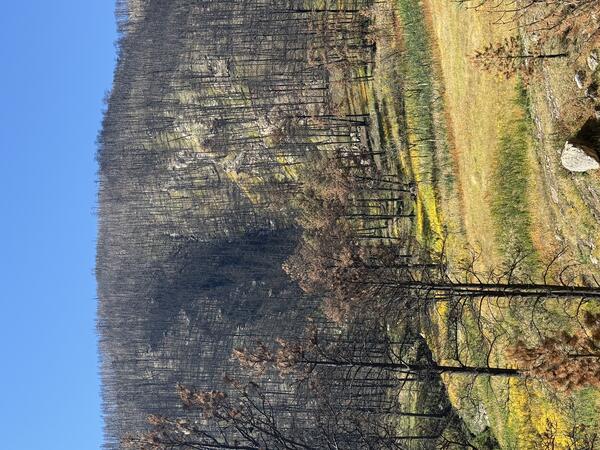
A steep, burned hillside in the 2025 Eaton Fire, Los Angeles County, California.

A steep, burned hillside in the 2025 Eaton Fire, Los Angeles County, California.  The hillside is located near the northern edge of the burn perimeter off of Echo Mountain Low Fire Road.  Unburned, vegetated terrain is visible in the image background. This photo was taken shortly after the Eaton Fire was contained.  
 

A steep, burned hillside in the 2025 Eaton Fire, Los Angeles County, California.  The hillside is located near the northern edge of the burn perimeter off of Echo Mountain Low Fire Road.  Unburned, vegetated terrain is visible in the image background. This photo was taken shortly after the Eaton Fire was contained.  
 

a dump truck and front loader remove debris in a mostly empty basin at the mountain front
West Ravine debris basin in Los Angeles County, California on January 20, 2025.

The West Ravine debris basin in Los Angeles County, California on January 20, 2024. The debris basin is mostly empty, with remnants of debris being cleared by a front loader and dump truck. This photograph was taken following the 2025 Eaton wildfire and prior to any rainfall over the burn area.

The West Ravine debris basin in Los Angeles County, California on January 20, 2024. The debris basin is mostly empty, with remnants of debris being cleared by a front loader and dump truck. This photograph was taken following the 2025 Eaton wildfire and prior to any rainfall over the burn area.

landslide safety infographic
Landslide Safety
Landslide Safety
Landslide Safety

LANDSLIDE SAFETY

If your home or property was damaged by a landslide from Hurricane Helene, be aware of the warning signs of future landslide activity


WATCH FOR WARNING SIGNS

Signs a landslide may be moving include:

LANDSLIDE SAFETY

If your home or property was damaged by a landslide from Hurricane Helene, be aware of the warning signs of future landslide activity


WATCH FOR WARNING SIGNS

Signs a landslide may be moving include:

person walks up a boulder field with trees visible in the background
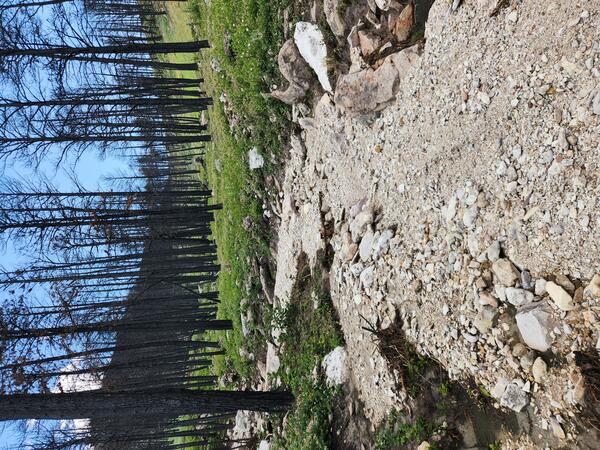
2024 Salt Fire burn area debris-flow deposit

A boulder-rich postfire debris-flow deposit in the 2024 Salt fire burn area.  Flooding and debris flows occurred near Ruidoso, New Mexico during rain events shortly following the 2024 wildfires.  This photo was taken in Bear Canyon, on the Mescalero Reservation, near the central portion of the burn area.  

A boulder-rich postfire debris-flow deposit in the 2024 Salt fire burn area.  Flooding and debris flows occurred near Ruidoso, New Mexico during rain events shortly following the 2024 wildfires.  This photo was taken in Bear Canyon, on the Mescalero Reservation, near the central portion of the burn area.  

person looks up a tree that sits in a channel surrounded by mud and rocks
Damaged tree in the 2024 South Fork Fire burn area, New Mexico

A scientist examines a tree that sits within a mud- and boulder-filled channel in the 2024 South Fork fire burn area.  The sediment filling the channel was deposited by a postfire debris flow or flood that occurred during a rain event following the wildfire.

A scientist examines a tree that sits within a mud- and boulder-filled channel in the 2024 South Fork fire burn area.  The sediment filling the channel was deposited by a postfire debris flow or flood that occurred during a rain event following the wildfire.

A pile of mud- to boulder-sized material on a hillslope
Debris-flow deposit in the 2024 South Fork Fire burn area

A poorly-sorted, debris-flow levee deposited during a rain event following the 2024 South Fork Fire.  Levees form at the margins of debris flows are matrix-supported, and comprised of variably-sized sediment.  Levees are useful for field identification of debris flow deposits and help to differentiate them from flood deposits.

A poorly-sorted, debris-flow levee deposited during a rain event following the 2024 South Fork Fire.  Levees form at the margins of debris flows are matrix-supported, and comprised of variably-sized sediment.  Levees are useful for field identification of debris flow deposits and help to differentiate them from flood deposits.

a person stands in a deep narrow channel that is surrounded by burned, leaning trees
Channel erosion in the 2024 South Fork Fire burn area

A scientist stands within a deeply eroded channel in the 2024 South Fork Fire burn area, New Mexico.  Increased surface runoff on recently burned hillslopes can lead to rapid channel widening and deepening due to rapid erosion.  Straw mulch, which is sometimes used to mitigate flooding, is visible across much of the ground's surface.  

A scientist stands within a deeply eroded channel in the 2024 South Fork Fire burn area, New Mexico.  Increased surface runoff on recently burned hillslopes can lead to rapid channel widening and deepening due to rapid erosion.  Straw mulch, which is sometimes used to mitigate flooding, is visible across much of the ground's surface.  

sediment-filled channel surrounded by hillslopes full of burned trees
Debris-flow deposit in the 2024 South Fork Fire burn area, New Mexico

Mud- to boulder-sized sediment fill a channel in the 2024 South Fork Fire burn area.  The sediment was deposited by flooding and debris flows during rain events following the summer wildfire.  The coarsest material (including several large boulders) was deposited on the south side of the channel, forming a debris-flow levee.

Mud- to boulder-sized sediment fill a channel in the 2024 South Fork Fire burn area.  The sediment was deposited by flooding and debris flows during rain events following the summer wildfire.  The coarsest material (including several large boulders) was deposited on the south side of the channel, forming a debris-flow levee.

channel filled with boulders and mud surrounded by burned trees
Debris-filled channel in the 2024 South Fork Fire burn area

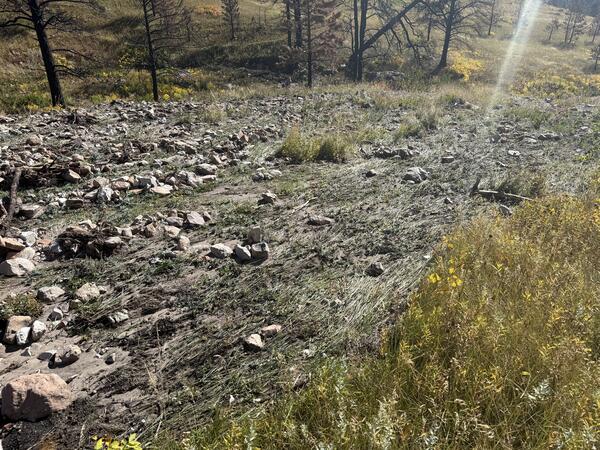
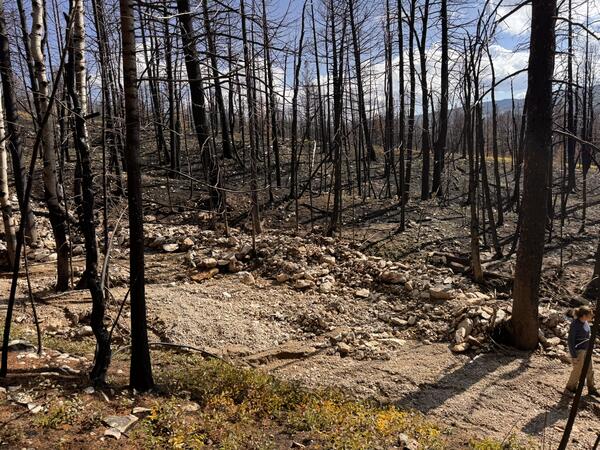
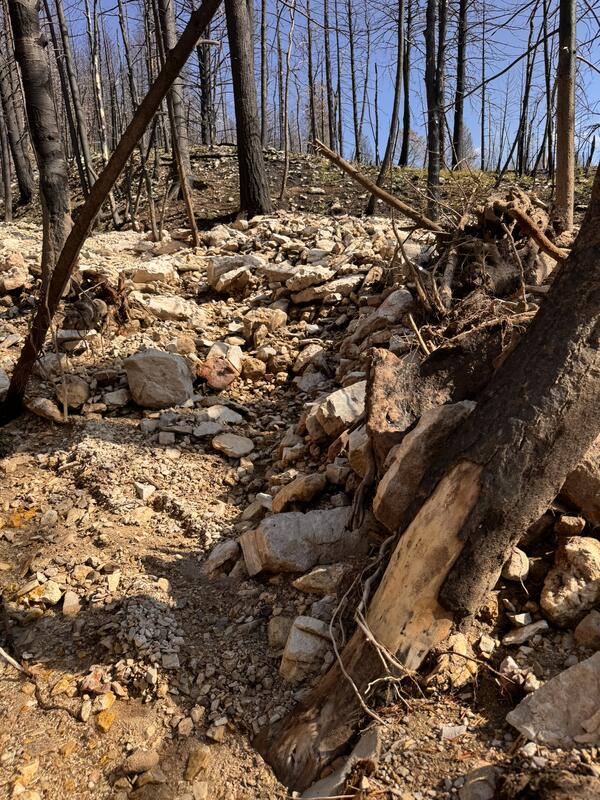
A debris flow or flood that occurred in 2024 South Fork Fire burn area filled the channel with mud- to boulder-sized sediment.  Flooding flows occurred during rain events following the summer wildfire.  Note the removal of bark and damage to trees in and adjacent to the channel.

A debris flow or flood that occurred in 2024 South Fork Fire burn area filled the channel with mud- to boulder-sized sediment.  Flooding flows occurred during rain events following the summer wildfire.  Note the removal of bark and damage to trees in and adjacent to the channel.

a large boulder and pile of dirt sit in a channel with hillslopes visible on either side
Debris-flow deposit in the South Fork Fire burn area

A mud- to boulder-sized debris-flow deposit in the South Fork Fire burn area, New Mexico.  Flooding and debris-flows occurred as a result of rain events shortly following the summer wildfire.  This photo was taken in the South Fork Cedar Creek drainage near the center of the burn area approximately 4 months following the wildfire.  

A mud- to boulder-sized debris-flow deposit in the South Fork Fire burn area, New Mexico.  Flooding and debris-flows occurred as a result of rain events shortly following the summer wildfire.  This photo was taken in the South Fork Cedar Creek drainage near the center of the burn area approximately 4 months following the wildfire.  

debris fan at the mouth of a canyon and hillslopes covered with burned trees
Debris-flow fan in the 2024 South Fork Fire burn area

A debris-flow fan near the outlet of the North Fork Cedar Creek in the South Fork Fire burn area.  Floods and debris flows occurred during rain events following the summer wildfire.  This drainage is located near the center of the burn area and the photo was taken approximately 4 months following the wildfire.  

A debris-flow fan near the outlet of the North Fork Cedar Creek in the South Fork Fire burn area.  Floods and debris flows occurred during rain events following the summer wildfire.  This drainage is located near the center of the burn area and the photo was taken approximately 4 months following the wildfire.  

Aerial view of landslide amongst green trees
Damage caused by a large mudflow in Buck Creek near Marion, NC. - 10/17/2024

Coordinates of photographer: Latitude: 35° 44’ 16.08” N Longitude: 82° 8’ 20.04” W

Date: 10/17/24

Caption: Damage caused by a large mudflow in Buck Creek near Marion, NC.

Taken during Hurricane Helene LASER response

Damage caused by mudflows into Flat Creek near the Garren Creek Fire Station. Some of the initiating landslides are visible in the distance, upper left of photo.
Damage caused by mudflows into Flat Creek near the Garren Creek Fire Station. - 10/17/2024

Coordinates of photographer: Latitude: 35° 33’ 21.75” N, Longitude: 82° 19’ 0.9” W

Date: 10/17/24

Caption: Damage caused by mudflows into Flat Creek near the Garren Creek Fire Station. Some of the initiating landslides are visible in the distance, upper left of photo.

Taken during Hurricane Helene LASER response 

Coordinates of photographer: Latitude: 35° 33’ 21.75” N, Longitude: 82° 19’ 0.9” W

Date: 10/17/24

Caption: Damage caused by mudflows into Flat Creek near the Garren Creek Fire Station. Some of the initiating landslides are visible in the distance, upper left of photo.

Taken during Hurricane Helene LASER response 

Aerial view of landslide amongst green trees in the mountains
Multiple landslides and mudflows in Bat Cave, NC. - 10/13/2024

Coordinates of photographer: Latitude: 35° 27’ 42.48” N Longitude: 82° 16’ 57.75” W

Date: 10/13/24

Caption: Multiple landslides and mudflows in Bat Cave, NC

Taken during Hurricane Helene LASER response 

Coordinates of photographer: Latitude: 35° 27’ 42.48” N Longitude: 82° 16’ 57.75” W

Date: 10/13/24

Caption: Multiple landslides and mudflows in Bat Cave, NC

Taken during Hurricane Helene LASER response 

Aerial view of landslide and flood damage of rural neighborhood in the mountains
Landslide and flood damage near Zionville, NC. - 10/13/2024

Coordinates of photographer: Latitude: 36° 19’ 56.508” N Longitude: 81° 44’ 56.148” W

Date: 10/13/24

Caption: Landslide and flood damage near Zionville, NC.

Taken during Hurricane Helene LASER response

Coordinates of photographer: Latitude: 36° 19’ 56.508” N Longitude: 81° 44’ 56.148” W

Date: 10/13/24

Caption: Landslide and flood damage near Zionville, NC.

Taken during Hurricane Helene LASER response

Aerial view of landslide amongst green trees
A landslide near Vilas, NC. - 10/13/2024

Coordinates of photographer: Latitude: 36° 15’ 31.74” N Longitude: 81° 44’ 32.952” W

Date 10/13/24

Caption: A landslide near Vilas, NC. 

Taken as part of Hurricane Helene LASER response 

Coordinates of photographer: Latitude: 36° 15’ 31.74” N Longitude: 81° 44’ 32.952” W

Date 10/13/24

Caption: A landslide near Vilas, NC. 

Taken as part of Hurricane Helene LASER response 

Screenshot of the Hurricane Helene Landslide Observations Dashboard on 10/2/2024 showing 109 flagged landslides and 125 total
10/3/2024 Screenshot of Hurricane Helene Landslide Observations Dashboard

USGS Hurricane Helene Landslide Dashboard. Screenshot taken on October 3, 2024 at 10:18pm UTC. This is an ongoing, multi-agency effort to map landslides from Hurricane Helene. This dashboard is updated as more information is available. 

Map of the Hurricane Helene landslide hazard estimates with the highest hazard being around the mountains.
Hurricane Helene Landslide Hazard Estimate Map

Relative landslide hazard from Hurricane Helene. Dark purple shows locations expected to have experienced the highest landslide occurrence. Map based on cumulative precipitation estimate (NWS Greenville-Spartanburg from 9/24-9/28) and the USGS Landslide Susceptibility Map. 

Relative landslide hazard from Hurricane Helene. Dark purple shows locations expected to have experienced the highest landslide occurrence. Map based on cumulative precipitation estimate (NWS Greenville-Spartanburg from 9/24-9/28) and the USGS Landslide Susceptibility Map. 

where do landslides occur?
Where Do Landslides Occur?

A map of the United States including Hawaii, Alaska, and Puerto Rico shows landslide susceptibility from yellow (low) to red (high), where the areas without shading represent negligible potential for landslides.

A map of the United States including Hawaii, Alaska, and Puerto Rico shows landslide susceptibility from yellow (low) to red (high), where the areas without shading represent negligible potential for landslides.

Was this page helpful?