



Landsat Updates are prepared periodically and distributed electronically to provide information about Landsat activities and related topics of interest. Read this issue here.
Images
The National Land Imaging Program supports a variety of geospatial data programs and projects, including the USGS Landsat Program. Browse the images below to see some of the imagery produced using NLI-supported data sources.
Filter Total Items: 527

Special Issue: Landsat Update 50th Anniversary
Landsat Updates are prepared periodically and distributed electronically to provide information about Landsat activities and related topics of interest. Read this issue here.

Example of the Landsat Collection 2 Provisional Evapotranspiration science product
Example of the Landsat Collection 2 Provisional Evapotranspiration science productExample of the Landsat Collection 2 Provisional Evapotranspiration science product for agricultural fields on the Fucino plain near San Benedetto dei Marsi, Italy. Left: Landsat 9 Collection 2 Natural Color Surface Reflectance Image. Right: Landsat 9 Collection 2 Actual Evapotranspiration Image.
Example of the Landsat Collection 2 Provisional Evapotranspiration science product
Example of the Landsat Collection 2 Provisional Evapotranspiration science productExample of the Landsat Collection 2 Provisional Evapotranspiration science product for agricultural fields on the Fucino plain near San Benedetto dei Marsi, Italy. Left: Landsat 9 Collection 2 Natural Color Surface Reflectance Image. Right: Landsat 9 Collection 2 Actual Evapotranspiration Image.
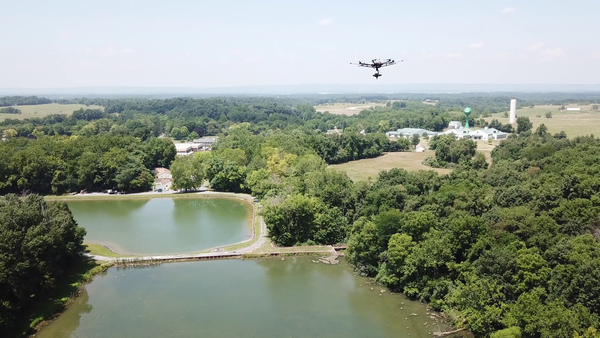
Hyperspectral data collection with drone aircraft
Uncrewed aircraft system (UAS) hyperspectral data collection flight over a reservoir at the Eastern USGS Eastern Ecological Science Center - Leetown Research Laboratory (EESC-LRL) in West Virginia.
Uncrewed aircraft system (UAS) hyperspectral data collection flight over a reservoir at the Eastern USGS Eastern Ecological Science Center - Leetown Research Laboratory (EESC-LRL) in West Virginia.

Landsat 9 image over Svalbard, Norway
Landsat 9 image over Svalbard, Norway. Acquired on July 8, 2022, Path 26 Row 240. For more information on Landsat data, visit the Landsat Mission Website.
Landsat 9 image over Svalbard, Norway. Acquired on July 8, 2022, Path 26 Row 240. For more information on Landsat data, visit the Landsat Mission Website.

Landsat 9 Image of Washburn Fire, Yosemite National Park - July 7, 2022
Landsat 9 Image of Washburn Fire, Yosemite National Park - July 7, 2022The Washburn Fire started July 7, 2022 in the southern part of Yosemite National Park. Landsats 8 and 9 both captured imagery of it a day later. The Landsat 9 image uses shortwave infrared and near-infrared bands to show the active burning.
Landsat 9 Image of Washburn Fire, Yosemite National Park - July 7, 2022
Landsat 9 Image of Washburn Fire, Yosemite National Park - July 7, 2022The Washburn Fire started July 7, 2022 in the southern part of Yosemite National Park. Landsats 8 and 9 both captured imagery of it a day later. The Landsat 9 image uses shortwave infrared and near-infrared bands to show the active burning.

Landsat 8 Image of Washburn Fire, Yosemite National Park - July 7, 2022
Landsat 8 Image of Washburn Fire, Yosemite National Park - July 7, 2022The Landsat 8 thermal image of the Washburn fire was acquired at night to pinpoint the location (bright white) of heat from the fire as it began. Firefighters immediately focused on suppressing the wildfire to minimize any effects on the Mariposa Grove of Giant Sequoias. As of July 18, 2022, the fire covered nearly 5,000 acres.
Landsat 8 Image of Washburn Fire, Yosemite National Park - July 7, 2022
Landsat 8 Image of Washburn Fire, Yosemite National Park - July 7, 2022The Landsat 8 thermal image of the Washburn fire was acquired at night to pinpoint the location (bright white) of heat from the fire as it began. Firefighters immediately focused on suppressing the wildfire to minimize any effects on the Mariposa Grove of Giant Sequoias. As of July 18, 2022, the fire covered nearly 5,000 acres.

Brightness Temperature v. Time chart for TIRS
Over the course of the four-hour eclipse, the TIRS sensors observed the intensity of infrared light radiating from the Moon’s surface. From those radiances, scientists calculated the temperatures required to generate them. This “brightness temperature” of the lunar surface changed as Earth’s shadow marched across the lunar landscape.
Over the course of the four-hour eclipse, the TIRS sensors observed the intensity of infrared light radiating from the Moon’s surface. From those radiances, scientists calculated the temperatures required to generate them. This “brightness temperature” of the lunar surface changed as Earth’s shadow marched across the lunar landscape.

First Experiences with the Collection 1 Landsat 8 Aquatic Reflectance Product
First Experiences with the Collection 1 Landsat 8 Aquatic Reflectance Product

Mapping of Flood Areas Using Landsat with Google Earth Engine Cloud Platform
Mapping of Flood Areas Using Landsat with Google Earth Engine Cloud PlatformUsing Google Earth Engine and Landsat, this team created a rapid and robust tool for mapping historical flood inundation areas. This enhances existing efforts towards flood mitigation, monitoring, and management.
Mapping of Flood Areas Using Landsat with Google Earth Engine Cloud Platform
Mapping of Flood Areas Using Landsat with Google Earth Engine Cloud PlatformUsing Google Earth Engine and Landsat, this team created a rapid and robust tool for mapping historical flood inundation areas. This enhances existing efforts towards flood mitigation, monitoring, and management.

Landsat Looks At The Moon
Two Earth-observing satellites turned to watch a lunar eclipse, revealing dramatic and uneven temperature changes across our closest celestial neighbor.
NASA Earth Image of the Day for July 5, 2022
Instruments:
Landsat 8 — TIRS
Landsat 9 — TIRS-2
Photograph
Two Earth-observing satellites turned to watch a lunar eclipse, revealing dramatic and uneven temperature changes across our closest celestial neighbor.
NASA Earth Image of the Day for July 5, 2022
Instruments:
Landsat 8 — TIRS
Landsat 9 — TIRS-2
Photograph

Landsat 9 image over Norway
Landsat 9 image acquired on June 27, 2022 (Path 198 Row 11) over Norway. For more information on Landsat data, visit the Landsat Mission Website.
Landsat 9 image acquired on June 27, 2022 (Path 198 Row 11) over Norway. For more information on Landsat data, visit the Landsat Mission Website.
Landsat 9 First Light Images
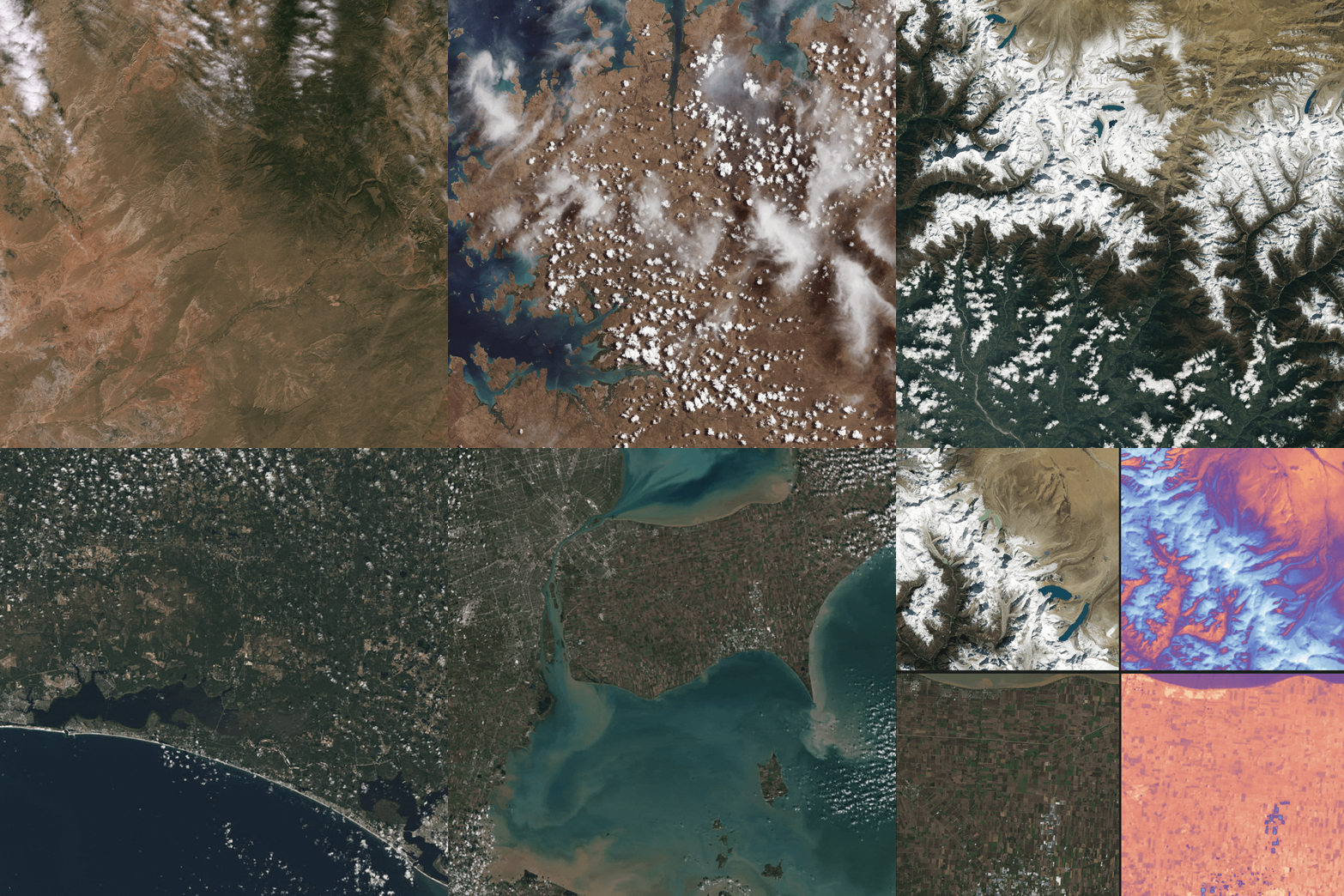
Landsat 9 launched into space on September 27th, 2021. The "first light" images arrived on October 31st. On that day the satellite captured: algal blooms in Lake Erie, the glaciers of the Himalayas, bush fires in Australia's Eucalypt Woodlands, coastal communities on the Florida panhandle, and deserts, mountains and mesas across the Navajo Nation.
Landsat 9 launched into space on September 27th, 2021. The "first light" images arrived on October 31st. On that day the satellite captured: algal blooms in Lake Erie, the glaciers of the Himalayas, bush fires in Australia's Eucalypt Woodlands, coastal communities on the Florida panhandle, and deserts, mountains and mesas across the Navajo Nation.

Landsat Collections Screenshot
This screenshot shows what the Landsat Collections interactive looks like. This storymap collection combines all of the individual satellite storymaps into one location.
This screenshot shows what the Landsat Collections interactive looks like. This storymap collection combines all of the individual satellite storymaps into one location.

How Do You Landsat Overfly
An optimal opportunity for in-flight cross-calibration occurred when Landsat 9 flew underneath Landsat 8 while moving into its final orbit. Since the two satellites nearly identical imaging systems, the underfly event offered ideal cross-calibration conditions.
An optimal opportunity for in-flight cross-calibration occurred when Landsat 9 flew underneath Landsat 8 while moving into its final orbit. Since the two satellites nearly identical imaging systems, the underfly event offered ideal cross-calibration conditions.

Latest in Landsat June Newsletter
In this June 2022 issue read highlights from an international partner meeting, explore published Landsat articles, and dive into new interactive tools. Find the newsletter here: https://www.usgs.gov/latest-landsat-newsletter/latest-landsat-newslette…
In this June 2022 issue read highlights from an international partner meeting, explore published Landsat articles, and dive into new interactive tools. Find the newsletter here: https://www.usgs.gov/latest-landsat-newsletter/latest-landsat-newslette…

Landsat: Celebrating 50 Years
Thumbnail for USGS Earth Resources Observation and Science (EROS) Center video "Landsat: Celebrating 50 Years."
Thumbnail for USGS Earth Resources Observation and Science (EROS) Center video "Landsat: Celebrating 50 Years."

Landsat 8 image of Karymsky volcano, April 20, 2022
Landsat 8 image of Karymsky volcano, April 20, 2022Karymsky volcano, one of the most active volcanoes of Kamchatka's eastern volcanic zone, erupted on April 20, 2022. This pan-sharpened Landsat 8 image captured the event. Overlaying the infrared data over the natural color image highlights the heat signature of the active flows.
Landsat ID: LC08_L1TP_098022_20220420_20220420_02_RT
Landsat 8 image of Karymsky volcano, April 20, 2022
Landsat 8 image of Karymsky volcano, April 20, 2022Karymsky volcano, one of the most active volcanoes of Kamchatka's eastern volcanic zone, erupted on April 20, 2022. This pan-sharpened Landsat 8 image captured the event. Overlaying the infrared data over the natural color image highlights the heat signature of the active flows.
Landsat ID: LC08_L1TP_098022_20220420_20220420_02_RT

HDYL Great Barrier Reef
The largest coral reef ecosystem in the world, the Great Barrier Reef (GBR), is threatened by many human-made impacts. Due to the size of the GBR and limited accessibility, mapping and monitoring has always been a challenging task. Remote Sensing is an effective technique that provides valuable information for the GBR ecosystem.
The largest coral reef ecosystem in the world, the Great Barrier Reef (GBR), is threatened by many human-made impacts. Due to the size of the GBR and limited accessibility, mapping and monitoring has always been a challenging task. Remote Sensing is an effective technique that provides valuable information for the GBR ecosystem.

HDYL Boreal Forest Biome
The boreal forest biome is projected to shift northward due to continued climate change over the coming century. Researchers evaluated early indicators of a boreal forest biome shift using four decades of Landsat observation datasets.
The boreal forest biome is projected to shift northward due to continued climate change over the coming century. Researchers evaluated early indicators of a boreal forest biome shift using four decades of Landsat observation datasets.

Landsat Dashboard.png
Image showing number of Landsat scenes available by location globally over 50 years. Can search by spacecraft identification, sensor identification, year acquired, processing level, and collection category. Maps are interactive and highlight spatial and temporal distribution of the Landsat archive.
Image showing number of Landsat scenes available by location globally over 50 years. Can search by spacecraft identification, sensor identification, year acquired, processing level, and collection category. Maps are interactive and highlight spatial and temporal distribution of the Landsat archive.

Landsat 7 Satellite Orbit Lowering Illustration
On April 6, 2022, the Landsat 7 ETM+ sensor will be placed into “stand-by” mode as a series of spacecraft burns are performed throughout the month of April to lower the satellite’s orbit by 8 kilometers. This graphic displays how the Landsat 7 spacecraft orbit lowers following each of the spacecraft burns.
On April 6, 2022, the Landsat 7 ETM+ sensor will be placed into “stand-by” mode as a series of spacecraft burns are performed throughout the month of April to lower the satellite’s orbit by 8 kilometers. This graphic displays how the Landsat 7 spacecraft orbit lowers following each of the spacecraft burns.