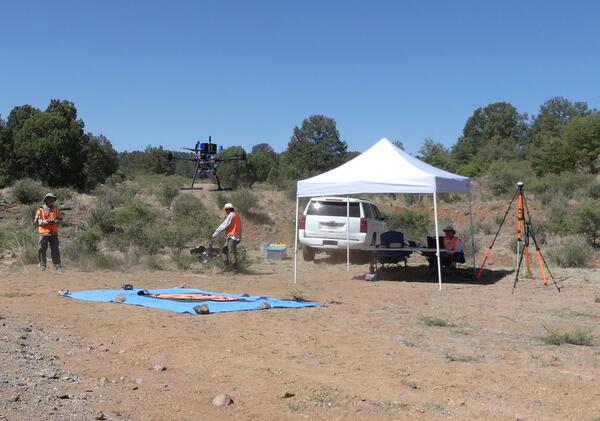
UAS Footage at Marsh-Felch Quarry site in Colorado
UAS Footage at Marsh-Felch Quarry site in ColoradoThe U.S.
An official website of the United States government
Here's how you know
Official websites use .gov
A .gov website belongs to an official government organization in the United States.
Secure .gov websites use HTTPS
A lock () or https:// means you’ve safely connected to the .gov website. Share sensitive information only on official, secure websites.
The U.S. Geological Survey (USGS) National Uncrewed Systems Office (NUSO) leads the research activities needed to make Uncrewed Aircraft Systems (UAS) data collection an efficient, safe, and cost-effective remote sensing tool for Department of the Interior (DOI) and USGS scientists.
We focus on the evaluation of new platforms, integration of new UAS-compatible sensors, development of data specifications and processing techniques, recommendations of UAS data acquisition best-practices, and operational support for new and existing DOI remote pilots.
We are a team of platform and UAS-compatible sensor subject matter experts that, in addition to research, provide operational support to DOI remote pilots and outreach to federal, public, and international audiences. Our office, established on May 8th, 2008, operates as part of the National Land Imaging Program, and contributes to its goal to provide the Federal Government and the public with the remotely sensed data and applications needed to support our Nation’s economic security and environmental vitality.
Products listed below were supported through the use of UAS technologies and resources at USGS.
The U.S.
Victoria Scholl (NUSO) conducts a Skydio X10 UAS 3D Scan flight at the
Marsh-Felch Quarry site.
Victoria Scholl (NUSO) conducts a Skydio X10 UAS 3D Scan flight at the
Marsh-Felch Quarry site.
Field crew standing at the upper overlook on the Marsh-Felch Quarry site.
USGS personnel standing at the overlook to the quarry prior to conducting UAS operations.
Thomas Casadevall (Scientist Emeritus with the Geology, Geophysics, and Geochemistry Science Center), Paco Van Sistine (GECSC), Victoria Scholl (NUSO), Matt Burgess (NUSO)
USGS personnel standing at the overlook to the quarry prior to conducting UAS operations.
Thomas Casadevall (Scientist Emeritus with the Geology, Geophysics, and Geochemistry Science Center), Paco Van Sistine (GECSC), Victoria Scholl (NUSO), Matt Burgess (NUSO)
USGS geologists view the informational sign at the quarry upper overlook in July 2024. The sign describes the history of Professor O.C. Marsh and Marshall P. Felch, the namesakes of the quarry, who worked together to excavate and study dinosaur bones. The sign features a photograph by Israel Cook Russel, a USGS Geologist, in July 1888.
Group photo captured using a drone. Left to right: Matt Burgess (NUSO), Paco Van Sistine (GECSC), Victoria Scholl (NUSO) standing at the overlook for the Marsh-Felch quarry.
Fixed-wing UAS used to map landscape at Corral Bluffs, Colorado
The Department of the Interior (DOI) and U.S. Geological Survey (USGS) took an interest in uncrewed aircraft system (UAS) technologies in the early 2000s, when UAS were predominantly being used for military applications.
Interactive UAS Science Exhibit on display in Reston
Included in this display are some of the earliest UAS platforms operated by the USGS and an interactive touch screen table that provides access to additional information and videos.
Interactive UAS Science Exhibit on display in Reston
Included in this display are some of the earliest UAS platforms operated by the USGS and an interactive touch screen table that provides access to additional information and videos.
Victoria Scholl and Matt Burgess (NUSO) conducting a hyperspectral UAS flight over the Missouri River.
DJI Matrice 600 Pro UAS with hyperspectral sensor hovers over a levee on the south bank of the Missouri River.
DJI Mavic Pro UAS-captured photo showing DJI Matrice 600 Pro UAS with hyperspectral payload approaching the Missouri River.
NUSO remote pilots Matt Burgess and Victoria Scholl prepare the hyperspectral sensor for data collection.
Group photo of the field crew at the Lexington boat ramp on the morning of the dye release in the Missouri River.
Tarp secured to an anchored boat to enable radiometric calibration of the UAS hyperspectral data during post-processing.
Matt Burgess (NUSO) and Brandon Sansom (CERC) compare waypoints in UAS flight plans during field tests the day prior to the dye release. A train travels across the farmland in the background.
NUSO remote pilot Matt Burgess flies a DJI Matrice 600 Pro UAS with hyperspectral payload from a levee on the south bank of the Missouri River.
UAS operations near Moab, Utah for carbon sequestration research on public lands
In support of U.S. Geological Survey (USGS) Southwest Biological Science Center research, the USGS National Uncrewed Systems Office (NUSO) conducted uncrewed aircraft systems (UAS) remote sensing flights near Moab, Utah in May 2023 for multi-scale carbon sequestration research on public lands.
Picture of the Perry Victory and International Peace Memorial from the NPS Visitors Center located on South Bass Island, Put in Bay, Ohio in Lake Erie.
The NUSO and the National Park Service (NPS) Heritage Document Programs partnered in May 2024 to perform a UAS-based 3D scan of Perry’s Victory and International Peace Memorial.
Picture of the Perry Victory and International Peace Memorial from the NPS Visitors Center located on South Bass Island, Put in Bay, Ohio in Lake Erie.
The NUSO and the National Park Service (NPS) Heritage Document Programs partnered in May 2024 to perform a UAS-based 3D scan of Perry’s Victory and International Peace Memorial.
Image of the Perry Victory and International Peace Memorial taken from a drone
The NUSO and the National Park Service (NPS) Heritage Document Programs partnered in May 2024 to perform a UAS-based 3D scan of Perry’s Victory and International Peace Memorial.
Image of the Perry Victory and International Peace Memorial taken from a drone
The NUSO and the National Park Service (NPS) Heritage Document Programs partnered in May 2024 to perform a UAS-based 3D scan of Perry’s Victory and International Peace Memorial.
Image of the Perry Victory and International Peace Memorial taken from a drone
The NUSO and the National Park Service (NPS) Heritage Document Programs partnered in May 2024 to perform a UAS-based 3D scan of Perry’s Victory and International Peace Memorial.
View from the top of Perry Victory and International Peace Memorial looking to the north.
The NUSO and the National Park Service (NPS) Heritage Document Programs partnered in May 2024 to perform a UAS-based 3D scan of Perry’s Victory and International Peace Memorial.
View from the top of Perry Victory and International Peace Memorial looking to the north.
The NUSO and the National Park Service (NPS) Heritage Document Programs partnered in May 2024 to perform a UAS-based 3D scan of Perry’s Victory and International Peace Memorial.
Products listed below were supported through the use of UAS technologies and resources at USGS.
The U.S. Geological Survey (USGS) National Uncrewed Systems Office (NUSO) leads the research activities needed to make Uncrewed Aircraft Systems (UAS) data collection an efficient, safe, and cost-effective remote sensing tool for Department of the Interior (DOI) and USGS scientists.
We focus on the evaluation of new platforms, integration of new UAS-compatible sensors, development of data specifications and processing techniques, recommendations of UAS data acquisition best-practices, and operational support for new and existing DOI remote pilots.
We are a team of platform and UAS-compatible sensor subject matter experts that, in addition to research, provide operational support to DOI remote pilots and outreach to federal, public, and international audiences. Our office, established on May 8th, 2008, operates as part of the National Land Imaging Program, and contributes to its goal to provide the Federal Government and the public with the remotely sensed data and applications needed to support our Nation’s economic security and environmental vitality.
Products listed below were supported through the use of UAS technologies and resources at USGS.
The U.S.
Victoria Scholl (NUSO) conducts a Skydio X10 UAS 3D Scan flight at the
Marsh-Felch Quarry site.
Victoria Scholl (NUSO) conducts a Skydio X10 UAS 3D Scan flight at the
Marsh-Felch Quarry site.
Field crew standing at the upper overlook on the Marsh-Felch Quarry site.
USGS personnel standing at the overlook to the quarry prior to conducting UAS operations.
Thomas Casadevall (Scientist Emeritus with the Geology, Geophysics, and Geochemistry Science Center), Paco Van Sistine (GECSC), Victoria Scholl (NUSO), Matt Burgess (NUSO)
USGS personnel standing at the overlook to the quarry prior to conducting UAS operations.
Thomas Casadevall (Scientist Emeritus with the Geology, Geophysics, and Geochemistry Science Center), Paco Van Sistine (GECSC), Victoria Scholl (NUSO), Matt Burgess (NUSO)
USGS geologists view the informational sign at the quarry upper overlook in July 2024. The sign describes the history of Professor O.C. Marsh and Marshall P. Felch, the namesakes of the quarry, who worked together to excavate and study dinosaur bones. The sign features a photograph by Israel Cook Russel, a USGS Geologist, in July 1888.
Group photo captured using a drone. Left to right: Matt Burgess (NUSO), Paco Van Sistine (GECSC), Victoria Scholl (NUSO) standing at the overlook for the Marsh-Felch quarry.
Fixed-wing UAS used to map landscape at Corral Bluffs, Colorado
The Department of the Interior (DOI) and U.S. Geological Survey (USGS) took an interest in uncrewed aircraft system (UAS) technologies in the early 2000s, when UAS were predominantly being used for military applications.
Interactive UAS Science Exhibit on display in Reston
Included in this display are some of the earliest UAS platforms operated by the USGS and an interactive touch screen table that provides access to additional information and videos.
Interactive UAS Science Exhibit on display in Reston
Included in this display are some of the earliest UAS platforms operated by the USGS and an interactive touch screen table that provides access to additional information and videos.
Victoria Scholl and Matt Burgess (NUSO) conducting a hyperspectral UAS flight over the Missouri River.
DJI Matrice 600 Pro UAS with hyperspectral sensor hovers over a levee on the south bank of the Missouri River.
DJI Mavic Pro UAS-captured photo showing DJI Matrice 600 Pro UAS with hyperspectral payload approaching the Missouri River.
NUSO remote pilots Matt Burgess and Victoria Scholl prepare the hyperspectral sensor for data collection.
Group photo of the field crew at the Lexington boat ramp on the morning of the dye release in the Missouri River.
Tarp secured to an anchored boat to enable radiometric calibration of the UAS hyperspectral data during post-processing.
Matt Burgess (NUSO) and Brandon Sansom (CERC) compare waypoints in UAS flight plans during field tests the day prior to the dye release. A train travels across the farmland in the background.
NUSO remote pilot Matt Burgess flies a DJI Matrice 600 Pro UAS with hyperspectral payload from a levee on the south bank of the Missouri River.
UAS operations near Moab, Utah for carbon sequestration research on public lands
In support of U.S. Geological Survey (USGS) Southwest Biological Science Center research, the USGS National Uncrewed Systems Office (NUSO) conducted uncrewed aircraft systems (UAS) remote sensing flights near Moab, Utah in May 2023 for multi-scale carbon sequestration research on public lands.
Picture of the Perry Victory and International Peace Memorial from the NPS Visitors Center located on South Bass Island, Put in Bay, Ohio in Lake Erie.
The NUSO and the National Park Service (NPS) Heritage Document Programs partnered in May 2024 to perform a UAS-based 3D scan of Perry’s Victory and International Peace Memorial.
Picture of the Perry Victory and International Peace Memorial from the NPS Visitors Center located on South Bass Island, Put in Bay, Ohio in Lake Erie.
The NUSO and the National Park Service (NPS) Heritage Document Programs partnered in May 2024 to perform a UAS-based 3D scan of Perry’s Victory and International Peace Memorial.
Image of the Perry Victory and International Peace Memorial taken from a drone
The NUSO and the National Park Service (NPS) Heritage Document Programs partnered in May 2024 to perform a UAS-based 3D scan of Perry’s Victory and International Peace Memorial.
Image of the Perry Victory and International Peace Memorial taken from a drone
The NUSO and the National Park Service (NPS) Heritage Document Programs partnered in May 2024 to perform a UAS-based 3D scan of Perry’s Victory and International Peace Memorial.
Image of the Perry Victory and International Peace Memorial taken from a drone
The NUSO and the National Park Service (NPS) Heritage Document Programs partnered in May 2024 to perform a UAS-based 3D scan of Perry’s Victory and International Peace Memorial.
View from the top of Perry Victory and International Peace Memorial looking to the north.
The NUSO and the National Park Service (NPS) Heritage Document Programs partnered in May 2024 to perform a UAS-based 3D scan of Perry’s Victory and International Peace Memorial.
View from the top of Perry Victory and International Peace Memorial looking to the north.
The NUSO and the National Park Service (NPS) Heritage Document Programs partnered in May 2024 to perform a UAS-based 3D scan of Perry’s Victory and International Peace Memorial.
Products listed below were supported through the use of UAS technologies and resources at USGS.