



Contaminants of Concern
Contaminants of Concern
Filter Total Items: 98

USGS Environmental Health Program: Integrating Science for Public Health and Resource Management
The USGS Environmental Health Program seeks to understand how environmental factors, especially contaminants and pathogens, influence human health and ecosystems. It focuses on studying the distribution and effects of toxic substances, environmental stressors, and their pathways. The program prioritizes collaboration with State, Federal and local governments; Tribes; non-government organizations...

Understanding the Dynamics of Per- and Polyfluoroalkyl Substances (PFAS): Insights from USGS Research
The USGS Environmental Health (EH) Program research where per- and polyfluoroalkyl substances PFAS are found, how they move and change in the environment, how they might affect both ecosystems and human health, and ways to reduce their impact. The three teams focusing on these issues within the EH Program include: 1) the PFAS Integrated Science Team, 2) the PFAS Core Technology Team, and 3) the...

Beneath the Surface: Exploring PFAS and Drinking Water on French Island, Wisconsin
The growing concern of finding per- and polyfluoroalkyl substances (PFAS) in drinking water has led USGS scientists to conduct more comprehensive analyses that encompass an extensive list of compounds that can be found in drinking water. These analyses will develop a more complete drinking water contaminant list that managers can use to make more informed public health decisions.

Life Cycle of Critical Minerals: A Balanced Approach to Meeting Our Nation's Resource Demands
Critical minerals are essential to the Nation’s economy and security. Demand for critical minerals is increasing, and it is essential to balance the societal need for these minerals with efforts to understand the effects of mining on other natural resources and to develop techniques to minimize these effects. The USGS Minerals Resources Life Cycle Integrated Science Team (IST) focuses on the life...
By
Ecosystems Mission Area, Geology, Energy, and Minerals Mission Area, Contaminant Biology, Environmental Health Program, Mineral Resources Program, Toxic Substances Hydrology, Columbia Environmental Research Center, Geology, Energy & Minerals Science Center, Geology, Geophysics, and Geochemistry Science Center, Geology, Minerals, Energy, and Geophysics Science Center

Decoding Harmful Algal Blooms: Unraveling the Mystery
Harmful algal blooms (HABs) are a significant environmental concern due to their potential effects on health, ecosystems, and economies. Algal toxins, which are toxic compounds produced by certain species of cyanobacteria and algae, are commonly linked to these blooms. It's important to note that algal toxins can still be present even when a bloom is not visible, highlighting the need for ongoing...
By
Ecosystems Mission Area, Contaminant Biology, Environmental Health Program, Toxic Substances Hydrology, California Water Science Center, Caribbean-Florida Water Science Center (CFWSC), Maryland-Delaware-D.C. Water Science Center, National Wildlife Health Center, Nevada Water Science Center, New England Water Science Center, New Jersey Water Science Center, New Mexico Water Science Center, South Atlantic Water Science Center (SAWSC), St. Petersburg Coastal and Marine Science Center, Upper Midwest Environmental Sciences Center, Upper Midwest Water Science Center

Natural Solutions for Reducing PFOS Pollution in Our Environment
Per- and polyfluoroalkyl substances (PFAS) are a group of over 14,000 different man-made compounds that are widely used in various industrial and consumer products and linked to various health issues. Perfluorooctanesulfonic acid (PFOS) is a persistent synthetic chemical within the PFAS group, recognized for its widespread use and persistence in the environment. The U.S. Geological Survey is...
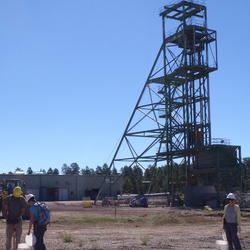
Minerals Resources Life Cycle Integrated Science Team
The Minerals Resources Life Cycle Integrated Science Team focuses on contaminant exposures in the environment that might originate from mineral resource activities including, transportation, storage, extraction and waste management. Perceived health risks to humans and other organisms will be distinguished from actual risks, if any. If actual risks are identified the science produced by this team...

USGS Research on 6PPD-quinone: Where the Rubber Meets the Road
Stormwater and road runoff are recognized forms of pollution that can contain chemicals harmful to fish and other aquatic animals. This includes 6PPD-quinone, the oxidized form of the chemical compound 6PPD that is used to prevent tires from degrading and cracking, ensuring driver safety. As 6PPD-quinone sheds from tires during normal wear it can enter streams in stormwater runoff.

Innovative Sensor Development for Detecting Low-Micrometer Plastics in Freshwater Systems
Plastic pollution is a significant global issue in aquatic ecosystems, with low-micrometer plastics (LMMPs) posing particular risks owing to their small size and prevalence in various environments. The U.S. Geological Survey and collaborators are developing an innovative sensor to detect and analyze LMMPs in freshwater systems, achieving rapid and accurate results without the need for additional...

Food Resources Lifecycle Integrated Science Team
The team studies the movement of toxicants and pathogens that could originate from the growing, raising, and processing/manufacturing of plant and animal products through the environment where exposure can occur. This information is used to understand if there are adverse effects upon exposure and to develop decision tools to protect health.

Preliminary Research Sheds Light on Proper Analysis and Sample Handling for the Tire-Derived Contaminants 6PPD and 6PPD-quinone
Tire and road wear particles have been shown to cause acute effects to sensitive aquatic animals and degrade their habitats. U.S. Geological Survey (USGS) scientists developed methods to accurately identify aquatic compounds, such as 6PPD and 6PPD-quinone, that can cause acute mortality events in coho salmon (Oncorhynchus kisutch).
By
Ecosystems Mission Area, Contaminant Biology, Environmental Health Program, Toxic Substances Hydrology, Central Midwest Water Science Center, Eastern Ecological Science Center, New Jersey Water Science Center, Oklahoma-Texas Water Science Center, South Atlantic Water Science Center (SAWSC), Washington Water Science Center, Western Fisheries Research Center

Statewide Assessment of Iowa Streams Links Landscape Characteristics to Antibiotic Resistance Signatures
U.S. Geological Survey (USGS) scientists conducted the first statewide assessment of antibiotics, antibiotic resistant bacteria (ARB), and antibiotic resistant genes (ARGs) in streams (water column and bed sediment samples) across Iowa. Results indicated that ARB and ARGs were prevalent, and a combination of watershed characteristics (such as land use, livestock population, and human population)...