Fluvial sandstones of the Upper Triassic Chinle Formation
Fluvial sandstones of the Upper Triassic Chinle FormationResearch Geologist A. Kate Souders samples fluvial sandstones of the Upper Triassic Chinle Formation (eastern Nevada, USA).
An official website of the United States government
Here's how you know
Official websites use .gov
A .gov website belongs to an official government organization in the United States.
Secure .gov websites use HTTPS
A lock () or https:// means you’ve safely connected to the .gov website. Share sensitive information only on official, secure websites.
Research Geologist A. Kate Souders samples fluvial sandstones of the Upper Triassic Chinle Formation (eastern Nevada, USA).
Research Geologist A. Kate Souders investigates complexly deformed, middle Cenozoic volcaniclastic rocks of the Death Valley region (California, USA).
Research Geologist Marieke Dechesne describes fluvial deposits of the Paleocene Raton Formation (Raton Basin, Colorado, USA).
The moon sets over an exposure of the Great Unconformity within the Colorado National Monument (Colorado, USA). At this location, Paleoproterozoic granite (foreground) is unconformably overlain by the Upper Triassic Chinle Formation.
Intermountain West Project members Adam Hudson and Michael Frothingham, in collaboration with National Park Service archaeologist Patrick Fristoe, inspect gravel deposits and associated geologic hazards along the Hines Creek fault system, Denali National Park (Alaska, USA).
In an effort to better understand the effects of abandoned mine lands on natural resources, Research Geologists Margaret Berry and Adam Hudson collect samples of ancestral Animas River sediment for geochemical analysis (Durango, Colorado, USA).
Red sedimentary rocks of the Pennsylvanian-Permian Maroon Formation exposed on Avery Peak dip southwestward away from gray igneous rocks of the Cenozoic White Rock pluton.
Intermountain West Project members Theresa Schwartz and Alexander Lusk investigate the Pennsylvanian Honaker Trail Formation at Goosenecks State Park (Utah, USA).
Geologist Alexander Lusk investigates slickenlines on the Moab fault near Arches National Park (Utah, USA).
Wild burros stand guard on the path to Miocene volcaniclastic rocks of the Death Valley region (California, USA).
Geologic Framework of the Intermountain West project members Adam Hudson, Margaret Berry, Harrison Gray, Cal Ruleman, and Samuel Johnstone perform field work for a topographic asymmetry study in the Great Sand Dunes National Park and Preserve (Sangre de Cristo Mountains, Colorado, USA).
Strongly deformed Paleoproterozoic granitic intrusions in biotite schist (Spaghetti Canyon, Lower Granite Gorge, Grand Canyon, Arizona, USA).
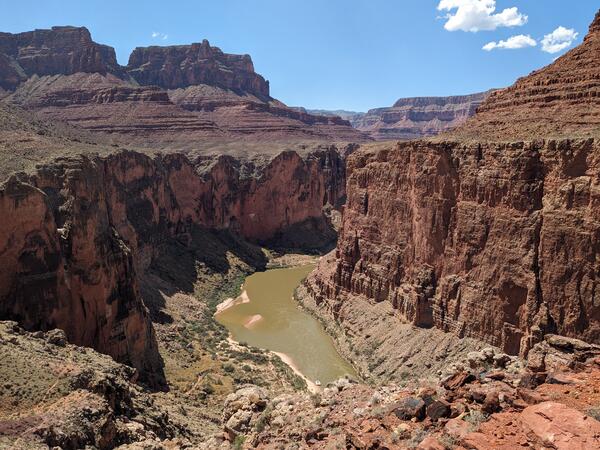
The Colorado River, brown from heightened suspended load following rains, flows through Paleoproteroic basement and overlying Cambrian Tapeats Sandstone in the Grand Canyon (Arizona, USA).
Photography of split sediment cores is calibrated for color/light. This example is from Lake Lucille, Alaska.
USGS UAS pilot Mark Bauer (NUSO) conducts lidar mapping flight over Ackerson Meadow in November 2023
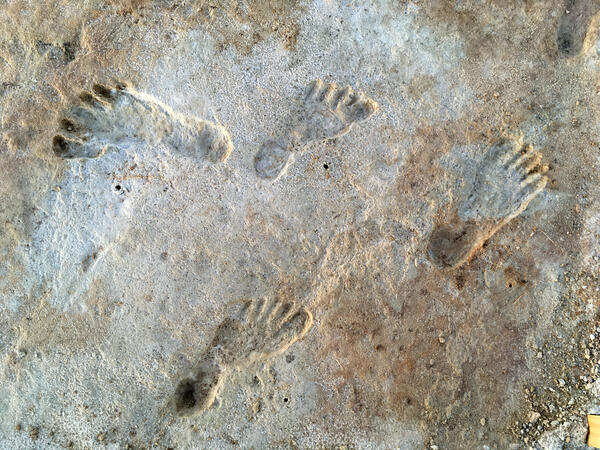
Footprints found in White Sands National Park were dated to the Last Glacial Maximum by USGS Research Geologists Kathleen Springer and Jeff Pigati.
Photograph of the Colorado River in the Grand Canyon, Arizona, USA. Photo taken on September 8, 2023.
In August 2023, the USGS National Uncrewed Systems Office (NUSO) participated in a collaborative field campaign to collect remote sensing data over agricultural crop fields in California's Central Valley. Hyperspectral satellites were commissioned in coordination with hyperspectral UAS flights at an altitude of 300 feet above ground level.
Matt Burgess (NUSO) checking the hyperspectral sensor externally mounted to a UAS (held by Joe Adams NUSO) prior to flights in California
NUSO researchers reviewing hyperspectral data acquired by UAS flown over crops at Firebaugh, CA
UAS in flight at the Alamosa National Wildlife Refuge in Colorado