Installing dissolved oxygen sensors at the Salmon River near East Hampton, Connecticut
Images
Click through our gallery of photographs showcasing New England Water Science Center research projects and monitoring work throughout the region.
Installing dissolved oxygen sensors at the Salmon River near East Hampton, Connecticut
Hydrologic technician making a streamflow measurement
Hydrologic technician making a streamflow measurementHydrologic technician making a streamflow measurement using a FlowTracker ADV in a river.
Hydrologic technician making a streamflow measurement
Hydrologic technician making a streamflow measurementHydrologic technician making a streamflow measurement using a FlowTracker ADV in a river.
Initial construction of trench and metering manhole
Initial construction of trench and metering manholeInitial construction of trench and metering manhole. Trench collects runoff from the respective pavement type and conveys the water to a metering manhole buried adjacent to the highway.
Initial construction of trench and metering manhole
Initial construction of trench and metering manholeInitial construction of trench and metering manhole. Trench collects runoff from the respective pavement type and conveys the water to a metering manhole buried adjacent to the highway.
An outreach event taking place in the vicinity of the USGS-01161280 streamgage site Connecticut River in Northfield MA.
USGS scientists performing a Groundwater Integrity Test by pumping the well with a Grundfos Submersible Pump. One of the scientists checks the pump rate in 5 gallon buckets, while the other one checks the water level and rate drop off in the well with an electric tape.
Sakonnet River, the eastern arm of the Narragansett Bay, Rhode Island
Sakonnet River, the eastern arm of the Narragansett Bay, Rhode IslandView of the Sakonnet River, the eastern arm of the Narragansett Bay, Rhode Island.
Sakonnet River, the eastern arm of the Narragansett Bay, Rhode Island
Sakonnet River, the eastern arm of the Narragansett Bay, Rhode IslandView of the Sakonnet River, the eastern arm of the Narragansett Bay, Rhode Island.
New England WSC hydrologic technician collecting a water-quality sample at Maple Meadow Brook, Wilmington, MA.
Flooding in Soldier Pond, Maine, following rainfall and snowmelt that led to high water levels in the Fish and St. John Rivers in April and May of 2018.
USGS field crews installed a temporary rapid deployment gage on May 2, 2018, at Soldier Pond in the Fish River to monitor flooding near Fort Kent in Maine.
Flooding in Soldier Pond, Maine, following rainfall and snowmelt that led to high water levels in the Fish and St. John Rivers in April and May of 2018.
USGS field crews installed a temporary rapid deployment gage on May 2, 2018, at Soldier Pond in the Fish River to monitor flooding near Fort Kent in Maine.
A horizontal collector is a part of a novel shallow well design that might be able to provide safe drinking water to domestic well users in arsenic-prone parts of the Nation.
A novel shallow well design might be able to provide safe drinking water to domestic well users in arsenic-prone parts of the Nation. Casing and collector being lowered into well excavation during the test.
Completing a novel dug well installation. A study of a novel shallow well design that might be able to provide safe drinking water to domestic well users in arsenic-prone parts of the Nation.
Dug well with instrumentation on a testing site of the novel shallow well design that might be able to provide safe drinking water to domestic well users in arsenic-prone parts of the Nation.
USGS hydrologic technician deploys storm-tide sensor in Cohasset, MA. They are being installed on bridges, piers, and other structures that have a good chance of surviving the storm.
USGS storm-tide sensor bolted to a cement jetty on the Atlantic Ocean coast at Fire Island, New York. USGS scientists deployed over 50 sensors along the coast of Maine, New Hampshire, Massachusetts, Rhode Island, Connecticut, New York, New Jersey and Delaware to study a Nor'easter that affected the Northeast in March of 2018.
Measuring a high-water mark during blizzard of January 2018 in New England
Measuring a high-water mark during blizzard of January 2018 in New EnglandScientist measuring high-water mark at the Yacht Club in Hull, MA. Blizzard of January 2018 in New England.
Measuring a high-water mark during blizzard of January 2018 in New England
Measuring a high-water mark during blizzard of January 2018 in New EnglandScientist measuring high-water mark at the Yacht Club in Hull, MA. Blizzard of January 2018 in New England.
New England WSC Physical Scientist Andy Massey scouting out high water marks associated with the blizzard of January 2018. Houghs Neck Maritime Center, Quincy, MA.
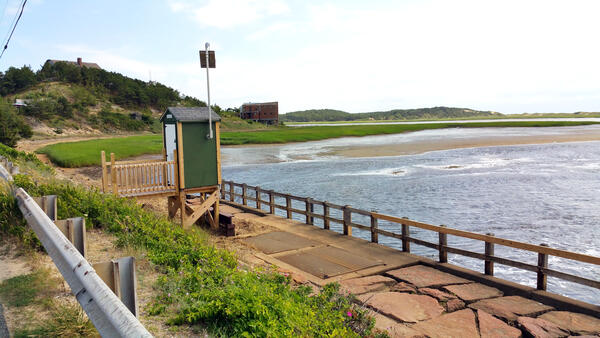
Upstream side of USGS station, Herring River at Chequessett Neck Road Dike, Wellfleet, Massachusetts
Upstream side of USGS station, Herring River at Chequessett Neck Road Dike, Wellfleet, MassachusettsUpstream side of USGS Station 011058798, Herring River at Chequessett Neck Road Dike, Wellfleet, Massachusetts.
Upstream side of USGS station, Herring River at Chequessett Neck Road Dike, Wellfleet, Massachusetts
Upstream side of USGS station, Herring River at Chequessett Neck Road Dike, Wellfleet, MassachusettsUpstream side of USGS Station 011058798, Herring River at Chequessett Neck Road Dike, Wellfleet, Massachusetts.
Sam Banas using a total station to survey points on the covered bridge that is located along the Tioga River in the Belmont, New Hampshire. These survey points will be used in the Winnipesaukee Watershed flood risk analysis mapping project funded by FEMA as part of the National Flood Insurance Program.