



Fish and Wildlife
Fish and Wildlife
Select a topic below, and relevant webpages will show up below the list of topics.
Filter Total Items: 37
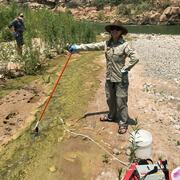
Early detection of aquatic threats: eDNA research in the Colorado River ecosystem & Lake Powell
The USGS and partners are conducting environmental DNA (eDNA) research in the Colorado River downstream from Glen Canyon Dam and in Lake Powell to detect invasive fish species and other aquatic threats before they become established. eDNA is a cutting-edge technology that makes it possible to identify invasive species before they are visible, even in vast or hard-to-survey environments like rivers...

USGS Sagebrush Science: Supporting Public Safety and Economic Decision Making Across the West
The sagebrush biome is one of the largest ecosystems in North America. Encompassing nearly one-third of the continental U.S., it provides critical resources for millions of Americans and a home for hundreds of plants and animal species in the West. Natural resource management in sagebrush ecosystems can be complex, and science can support management decisions by providing knowledge and tools to...
By
Core Science Systems Mission Area, Ecosystems Mission Area, Land Management Research Program, Earth Resources Observation and Science (EROS) Center, Forest and Rangeland Ecosystem Science Center, Fort Collins Science Center, Northern Rocky Mountain Science Center, Southwest Biological Science Center, Western Ecological Research Center (WERC), Wildland Fire Science

Monitoring the Rare Island Night Lizard on San Nicolas Island
The Island Night Lizard ( Xantusia riversiana) was removed from the Federal list of Threatened species in May 2014. This rare and unique species represents an ancient lineage whose members are now sparsely distributed across parts of the Southwest North America, south through Mexico to the New World Tropics. The information on population size and habitat helps to inform and guide conservation and...

Lake Powell Research
Lake Powell is a large arid reservoir that represents about 70% of the water storage capacity for the Upper Colorado River Basin. It is the second largest reservoir in the United States by capacity (second only to Lake Mead). Lake Powell is an oligotrophic reservoir, which means that nutrient concentrations and algal production are generally low. This often results in very clear-water conditions...

SBSC: Providing Unbiased Actionable Science & Information to Support Natural Resource Management Needs of the U.S. & Department of the Interior Priorities
The U.S. Geological Survey Southwest Biological Science Center (SBSC) is uniquely positioned in the Colorado River Basin to provide sound information, specialized expertise, and innovative tools to support the management and sustained use of natural resources on public and Tribal lands in the Southwest U.S.

SBSC science supports invasive species management
Invasive species can harm ecosystems, increase wildfires, damage forests, and outcompete native species. The US Geological Survey's Southwest Biological Science Center conducts research that provides our federal and state partners, cooperators and land managers with the tools, data and strategies to enhance biosecurity management. Scroll through the information below to read about different SBSC...

The Gemini Solar Project
The United States is developing renewable energy resources, especially solar, at a rapid rate. Although renewable energy development is widely perceived by the public as “green technology,” construction, operation, maintenance, and eventual decommissioning of facilities all have known and potential negative impacts to natural resources, including plant communities and wildlife. This is especially...

Study Uncovers Migration Patterns of Native Fish in the Colorado River
A study conducted by the USGS provides new insights into the migration patterns of three native fish species in the Colorado River: humpback chub, flannelmouth sucker, and bluehead sucker. This research highlights the importance of understanding native fish population dynamics within the Colorado River ecosystem in Grand Canyon, AZ.

Smallmouth bass expansion downstream of Glen Canyon Dam
In the Upper Colorado River Basin, smallmouth bass ( Micropterus dolomieu) are considered the greatest threat to native fishes and have been linked to declines in federally protected humpback chub ( Gila cypha), including one population that was rapidly extirpated in the past. Long-term management efforts have been underway to remove smallmouth bass from rivers in the Upper Basin, but smallmouth...

Humpback Chub in the Colorado River, Grand Canyon
Threatened humpback chub are a native fish found only in the Colorado River Basin. Once found in warm-water canyons in the Basin, the largest population now persists in the Colorado River in Grand Canyon National Park, downstream of Glen Canyon Dam and Lake Powell reservoir.

Partners in Science
Partners in Science is a collaborative effort between Grand Canyon Monitoring and Research Center, Grand Canyon Youth, and the National Park Service to provide opportunities for youth to engage in scientific field research in Grand Canyon. This partnership connects youth from diverse backgrounds with the Nation’s natural and cultural resources on 2-3 river-based expeditions on the Colorado River...

SBSC Tribal Partnerships
The Southwest Biological Science Center (SBSC) conducts and provides scientific information as part of our mission and Federal Trust Responsibility to strengthen relationships and build partnerships with sovereign tribal nations. Here, we highlight a few examples of projects with tribal partners.