



Measuring and Monitoring Water
Measuring and Monitoring Water
Next Generation Water Observing System (NGWOS)
National Field Manual for the Collection of Water-Quality Data
Providing detailed, comprehensive, and citable methods and procedures for water-quality sampling and processing
Providing detailed, comprehensive, and citable methods and procedures for water-quality sampling and processing
National Hydrologic Model Infrastructure
Find water science information and activities related to how the USGS measures and monitors water resources.
Hydrologic Instrumentation Facility (HIF)
Hydrologic Instrumentation Facility (HIF)

The HIF provides quality hydrologic equipment and instrumentation
Streamgaging Basics
Streamgaging Basics

The USGS has a nationwide network of over 8,500 sites that measure streamflow and water levels.
Filter Total Items: 182

Surge, Wave, and Tide Hydrodynamics (SWaTH) Network
During large coastal storms, the storm surge and waves are the main cause of destruction and landscape change, transporting saline water, sediment, and debris inland. The USGS, in collaboration with stakeholders, has constructed a national Surge, Wave, and Tide Hydrodynamics (SWaTH) Network for the Atlantic, Eastern Pacific, and Central Pacific. SWaTH monitors and documents the height, extent, and...
Providing Major Storm and Short-Term Flood Event Data
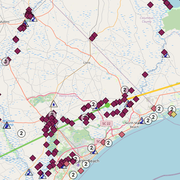
During major storms or other short-term events, the USGS collects streamflow and additional data to help document high-water events. This data is uploaded to the Short-Term Network (STN) for long-term archival and served out to the public through the Flood Event Viewer (FEV) which provides convenient, map-based access to downloadable event-based data.

Transportation-Related Water Projects
The USGS has a long history of cooperative investigations with the Federal Highway Administration (FHWA) and state highway agencies to provide data and information to address various issues related to water resources and the Nation’s transportation infrastructure. These issues cover a wide spectrum and include items such as regional flow statistics, flood documentation, regional stream...

Sediment Acoustics
The U.S. Geological Survey recognizes the need to provide sediment acoustic training and to develop standardized techniques and practices.

Groundwater Quality Research
Every day, millions of gallons of groundwater are pumped to supply drinking water for about 140 million people, almost one-half of the Nation’s population. Learn about the quality and availability of groundwater for drinking, where and why groundwater quality is degraded, and where groundwater quality is changing.

Water Quality in the Nation’s Streams and Rivers – Current Conditions and Long-Term Trends
The Nation's rivers and streams are a priceless resource, but pollution from urban and agricultural areas pose a threat to our water quality. To understand the value of water quality, and to more effectively manage and protect the Nation's water resources, it's critical that we know the current status of water-quality conditions, and how and why those conditions have been changing over time.

Groundwater/Surface-Water Interaction
Water and the chemicals it contains are constantly being exchanged between the land surface and the subsurface. Surface water seeps into the ground and recharges the underlying aquifer—groundwater discharges to the surface and supplies the stream with baseflow. USGS Integrated Watershed Studies assess these exchanges and their effect on surface-water and groundwater quality and quantity.

Hydraulic Fracturing
Hydraulic fracturing, commonly known as fracking, is the process of injecting water, sand, and/or chemicals into a well to break up underground bedrock to free up oil or gas reserves. The USGS monitors the environmental impact of this practice across the country, from potential earthquakes to degraded groundwater quality.

Land Subsidence
More than 80 percent of known land subsidence in the U.S. is a consequence of groundwater use, and is an often overlooked environmental consequence of our land and water-use practices. Increasing land development threatens to exacerbate existing land-subsidence problems and initiate new ones. Subsidence detection and mapping done by the USGS is needed to understand and manage our current and...

Quality Systems Branch (QSB)
The USGS Quality Systems Branch (QSB) represents the Water Resource Mission Area’s commitment to generating environmental data of known quality. QSB produces water and sediment performance-assessment samples and data to provide the USGS laboratory users, USGS laboratories, and field personnel with quantitative performance information to assess data quality.

USGS Cooperative Matching Funds
USGS Cooperative Matching Funds (CMF) support joint projects with our state, regional, tribal, and local partners to provide reliable, impartial, and timely information needed to understand and manage the Nation's water resources.

Focus Area Studies
Focus Area Studies were stakeholder-driven assessments of water availability in river basins with known or potential conflict. They contributed toward ongoing assessments of water availability in large watersheds, provided opportunities to test and improve approaches to water availability assessment, and informed the National Water Census with local information. These studies focused on key water...