



Types of Water
Types of Water
Water In Space: How Does Water Behave in Outer Space?
Glaciers: Things To Know
Rain and Precipitation
Find water science information and activities by type of water body.

Rivers, Streams, and Creeks
Rivers, Streams, and Creeks

Water quality data from state, federal, tribal, and local agencies
Filter Total Items: 170

Integration of sUAS into Hydrogeophysical Studies: Technology Demonstration and Evaluation
The USGS is evaluating the integration of small unoccupied aircraft systems – sUAS or "drones" – into USGS hydrogeophysical studies. The following projects are part of a Water Resources Mission Area demonstration and evaluation effort in collaboration with USGS Water Science Centers (WSCs) starting in June 2018.

Hydrologic and Erosion Responses of Burned Watersheds
The enhanced probability of catastrophic wildfires has increased our need to understand the risk of floods, erosion, and debris and contaminant transport in burned watersheds. This project investigates the relation between rainfall intensity and peak discharge; erosion and deposition processes; and water-quality impacts to minimize the loss of life and property resulting from post-wildfire floods.

Office of the Delaware River Master
In 1954, the U.S. Supreme Court issued a Decree in State of New Jersey v. State of New York and City of New York in which the Court established the position of the Delaware River Master.

Total Water Use
The USGS has estimated water use for the United States every 5 years since 1950. Estimates are provided for groundwater and surface-water sources, for fresh and saline water quality, and by sector or category of use. Estimates have been made at the State level since 1950, and at the county level since 1985. Water-use estimates by watershed were made from 1950 through 1995, first at the water...

Surface-Water Use
Surface-water sources include streams and rivers, lakes and reservoirs, and oceans. For the purposes of the USGS water-use reports, surface water with less than 1,000 milligrams per liter (mg/L) of dissolved solids is considered freshwater, and the remainder is considered saline. Surface-water resources are often evaluated by watershed. The most recent USGS water-use estimates by watershed are in...

Groundwater Use
Groundwater refers to all subsurface water, specifically that part of groundwater which is in the saturated zone. Groundwater sources are called aquifers: geologic formations that contain sufficient saturated permeable material to yield significant quantities of water to wells and springs. For the purposes of the USGS water-use reports, groundwater with less than 1,000 milligrams per liter (mg/L)...

Surge, Wave, and Tide Hydrodynamics (SWaTH) Network
During large coastal storms, the storm surge and waves are the main cause of destruction and landscape change, transporting saline water, sediment, and debris inland. The USGS, in collaboration with stakeholders, has constructed a national Surge, Wave, and Tide Hydrodynamics (SWaTH) Network for the Atlantic, Eastern Pacific, and Central Pacific. SWaTH monitors and documents the height, extent, and...
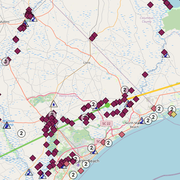
Providing Major Storm and Short-Term Flood Event Data
During major storms or other short-term events, the USGS collects streamflow and additional data to help document high-water events. This data is uploaded to the Short-Term Network (STN) for long-term archival and served out to the public through the Flood Event Viewer (FEV) which provides convenient, map-based access to downloadable event-based data.

Transportation-Related Water Projects
The USGS has a long history of cooperative investigations with the Federal Highway Administration (FHWA) and state highway agencies to provide data and information to address various issues related to water resources and the Nation’s transportation infrastructure. These issues cover a wide spectrum and include items such as regional flow statistics, flood documentation, regional stream...

Sediment Acoustics
The U.S. Geological Survey recognizes the need to provide sediment acoustic training and to develop standardized techniques and practices.

Fluvial Sediment and Geomorphology: Resources for Monitoring and Analysis
The USGS collects fluvial sediment and geomorphic data and conducts related research at numerous sites across the Nation. This information is essential to informed solutions to sediment-related and overall water resource management issues.

Emerging Contaminants
Emerging contaminants, or contaminants of emerging concern, can refer to many different kinds of chemicals, including medicines, personal care or household cleaning products, lawn care and agricultural products, among others. These chemicals make it into our Nation's lakes and rivers and have a detrimental affect on fish and other aquatic species. That have also been shown to bioaccumulate up the...