



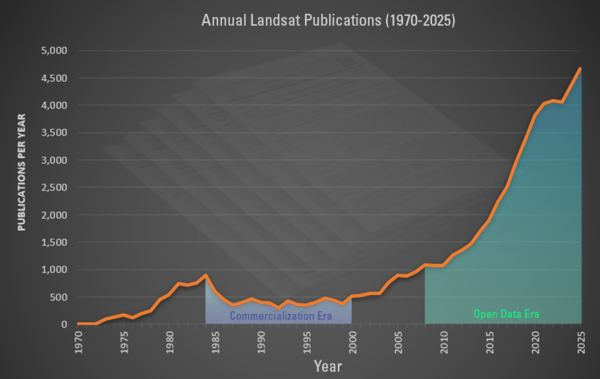
This graphic below displays the number of Landsat-related publications (orange line) starting in 1970. While publications decreased during the Commercialization Era, research rebounded greatly after the USGS open data policy decision in 2008.
Images
The National Land Imaging Program supports a variety of geospatial data programs and projects, including the USGS Landsat Program. Browse the images below to see some of the imagery produced using NLI-supported data sources.
Filter Total Items: 501
Landsat Citations
This graphic below displays the number of Landsat-related publications (orange line) starting in 1970. While publications decreased during the Commercialization Era, research rebounded greatly after the USGS open data policy decision in 2008.
Landsat Global Archive Consolidation WRS 2 Scenes
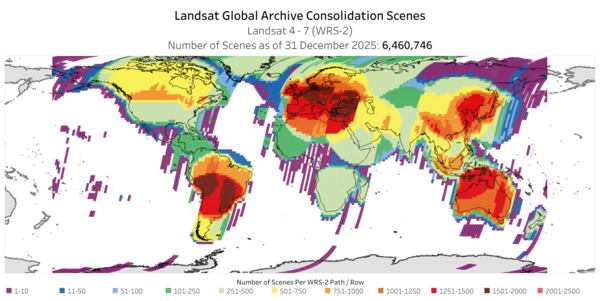
This map displays the scenes acquired by Landsat 4, Landsat 5, and Landsat 7 satellites, on the World Reference System (WRS-2). These scenes were initially downlinked and stored at Landsat International Cooperator Ground Stations.
This map displays the scenes acquired by Landsat 4, Landsat 5, and Landsat 7 satellites, on the World Reference System (WRS-2). These scenes were initially downlinked and stored at Landsat International Cooperator Ground Stations.
Landsat Global Archive Consolidation WRS 1 Scenes
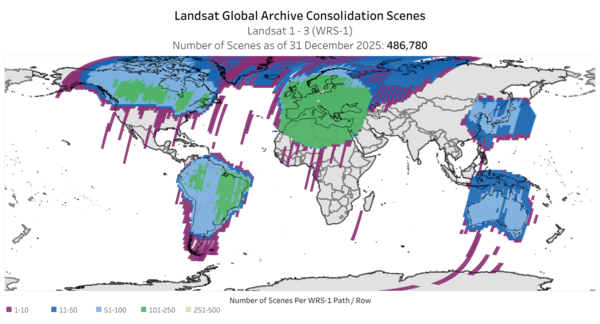
This map displays the scenes acquired by Landsat 1, Landsat 2, and Landsat 3 satellites, on the World Reference System (WRS-1). These scenes were initially downlinked and stored at Landsat International Cooperator Ground Stations.
This map displays the scenes acquired by Landsat 1, Landsat 2, and Landsat 3 satellites, on the World Reference System (WRS-1). These scenes were initially downlinked and stored at Landsat International Cooperator Ground Stations.
Number of Commercial, Government-Civil Earth Observing Satellites Launched
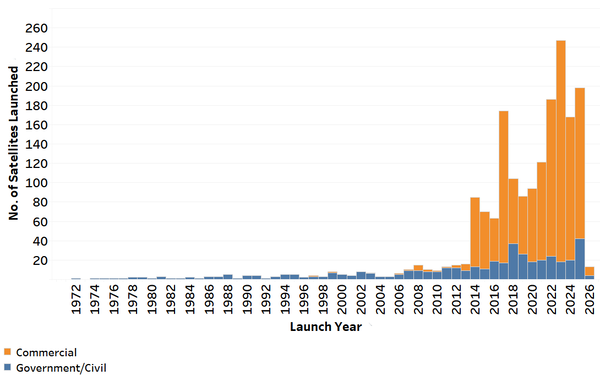
Number of Commercial, Government-Civil Earth Observing Satellites LaunchedThis chart shows the number of commercial and government/civil Earth observing satellites launched each year since 1972. This information is updated quarterly.
Number of Commercial, Government-Civil Earth Observing Satellites Launched
Number of Commercial, Government-Civil Earth Observing Satellites LaunchedThis chart shows the number of commercial and government/civil Earth observing satellites launched each year since 1972. This information is updated quarterly.
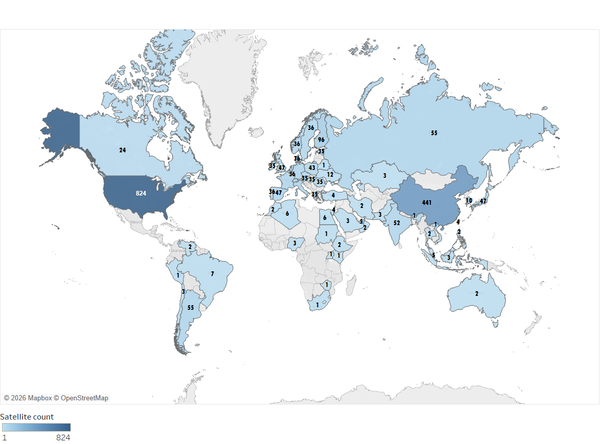
Countries with Earth Observing Satellites
The numbers on this map indicate the number of commercial and government/civil Earth observing satellites launched by the highlighted countries. This image is updated quarterly.
The numbers on this map indicate the number of commercial and government/civil Earth observing satellites launched by the highlighted countries. This image is updated quarterly.
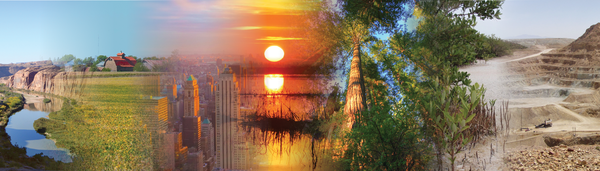
Landsat Benefits Webpage Banner
The Landsat Benefits Webpage Banner displays some ways of how Landsat data benefits the United States.
Visit the Landsat Benefits, State by State webpage to see how Landsat benefits your favorite State!
The Landsat Benefits Webpage Banner displays some ways of how Landsat data benefits the United States.
Visit the Landsat Benefits, State by State webpage to see how Landsat benefits your favorite State!
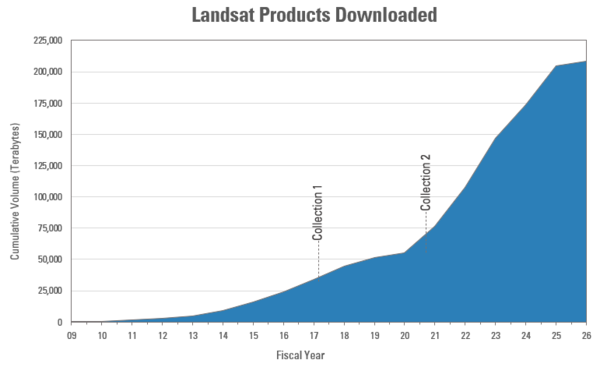
Landsat Product Downloads by Volume
This graphic displays the cumulative volume of all operational Landsat products downloaded from the USGS EROS Landsat archive since December 2008 (FY2009). The release of Landsat Collection 2 products in 2020, which improved data quality and accessibility, helped drive downloads upward.
This graphic displays the cumulative volume of all operational Landsat products downloaded from the USGS EROS Landsat archive since December 2008 (FY2009). The release of Landsat Collection 2 products in 2020, which improved data quality and accessibility, helped drive downloads upward.
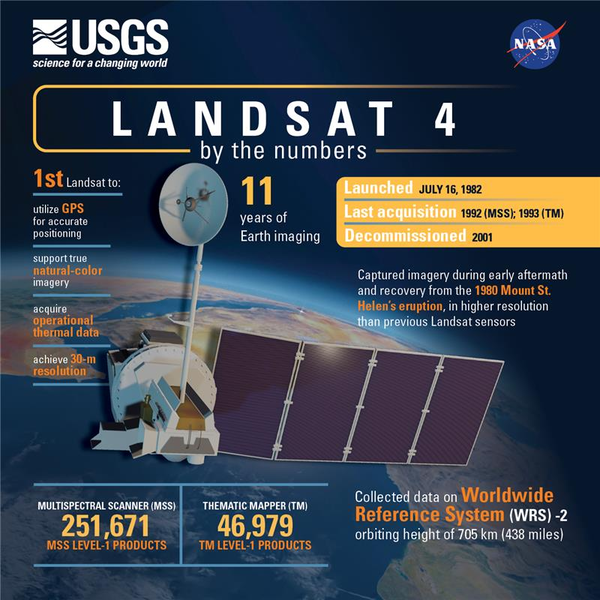
Landsat 4 Mission Infographic
The Landsat 4 satellite was launched July 16, 1982, and ushered in many “firsts” that propelled the Landsat missions that followed.
The Landsat 4 satellite was launched July 16, 1982, and ushered in many “firsts” that propelled the Landsat missions that followed.
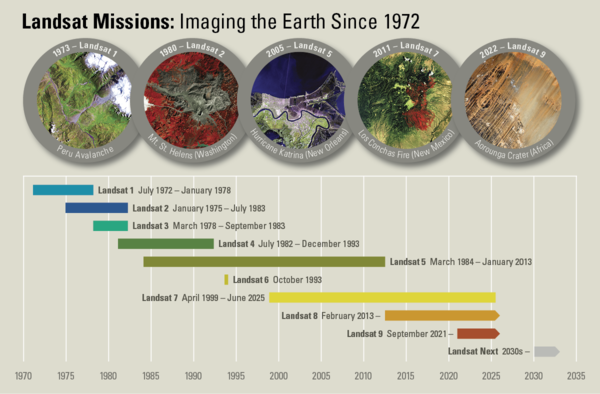
Landsat Missions Timeline
In a September 21, 1966 press release, Secretary of the Interior Stewart Udall announced that the DOI was launching "Project EROS (Earth Resources Observation Satellites)." Udall's vision was to observe the Earth for the benefit of all.
In a September 21, 1966 press release, Secretary of the Interior Stewart Udall announced that the DOI was launching "Project EROS (Earth Resources Observation Satellites)." Udall's vision was to observe the Earth for the benefit of all.

JACIE 2026 Workshop Save the Date
JACIE 2026 Workshop Save the Date
Visit the JACIE 2026 Workshop webpage to keep up with information about the April 2026 meeting.
JACIE 2026 Workshop Save the Date
Visit the JACIE 2026 Workshop webpage to keep up with information about the April 2026 meeting.
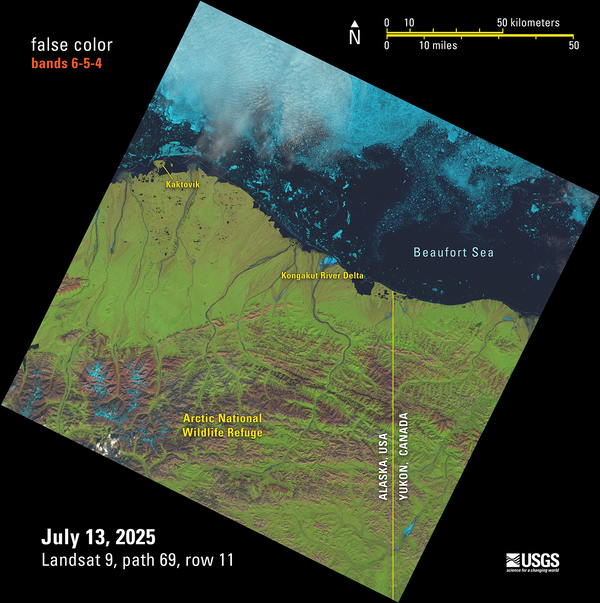
Landsat 9 False Color Image of the Beaufort Sea Shoreline
Landsat 9 False Color Image of the Beaufort Sea ShorelineThis Landsat 9 image showing the Beaufort Sea shoreline off of Alaska and Canada is just one of the scenes captured and processed on July 13, 2025— that day, the USGS EROS archive reached a milestone of one million Landsat 9 Level-1 products. This false color image was made with bands 6,5, and 4 from the Operational Land Imager.
Landsat 9 False Color Image of the Beaufort Sea Shoreline
Landsat 9 False Color Image of the Beaufort Sea ShorelineThis Landsat 9 image showing the Beaufort Sea shoreline off of Alaska and Canada is just one of the scenes captured and processed on July 13, 2025— that day, the USGS EROS archive reached a milestone of one million Landsat 9 Level-1 products. This false color image was made with bands 6,5, and 4 from the Operational Land Imager.
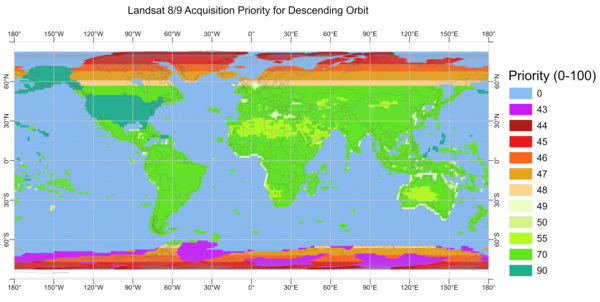
Landsat 8-9 Descending Acquisition Priority Map
This map displays the geographic coverage of descending (daytime) image acquisition priorities for Landsat 8 and Landsat 9 on a typical day. The priority scale denotes 0 (low priority) to 100 (high priority).
This map displays the geographic coverage of descending (daytime) image acquisition priorities for Landsat 8 and Landsat 9 on a typical day. The priority scale denotes 0 (low priority) to 100 (high priority).

Spectral Bandpasses for all Landsat Sensors
This image shows the spectral bandpasses for the sensors on all Landsat satellites.
This image shows the spectral bandpasses for the sensors on all Landsat satellites.
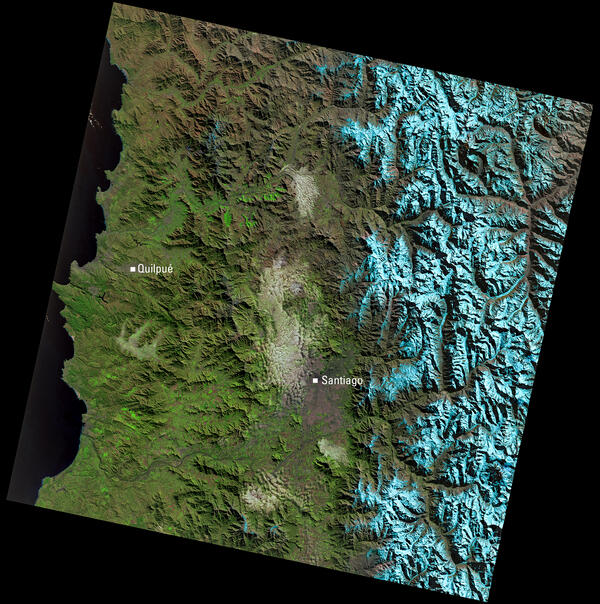
Landsat View of Central Chile and the Andes Mountains
Landsat View of Central Chile and the Andes MountainsThis Landsat 9 image of central Chile, acquired July 10, 2025, uses the shortwave infrared, near infrared, and red spectral bands ( bands 6,5,4) to highlight land cover. In this combination, healthy vegetation appears bright green, while snow and ice in the Andes Mountains show in bright blue.
Landsat View of Central Chile and the Andes Mountains
Landsat View of Central Chile and the Andes MountainsThis Landsat 9 image of central Chile, acquired July 10, 2025, uses the shortwave infrared, near infrared, and red spectral bands ( bands 6,5,4) to highlight land cover. In this combination, healthy vegetation appears bright green, while snow and ice in the Andes Mountains show in bright blue.
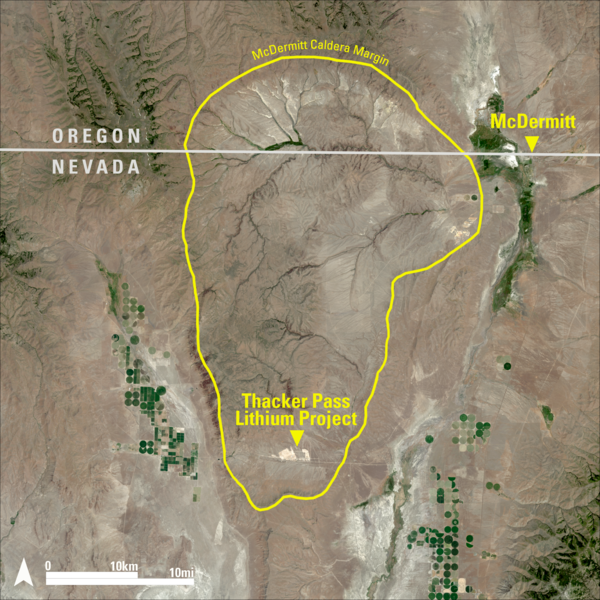
Landsat 8 Image of Thacker Pass
This Landsat 8 image highlights the McDermitt Caldera, which straddles the Nevada–Oregon border. The yellow boundary outlines the caldera margin, a geologic feature formed by a massive volcanic eruption millions of years ago. Over time, weathering of lithium-rich volcanic material led to the formation of clay deposits within the caldera basin.
This Landsat 8 image highlights the McDermitt Caldera, which straddles the Nevada–Oregon border. The yellow boundary outlines the caldera margin, a geologic feature formed by a massive volcanic eruption millions of years ago. Over time, weathering of lithium-rich volcanic material led to the formation of clay deposits within the caldera basin.
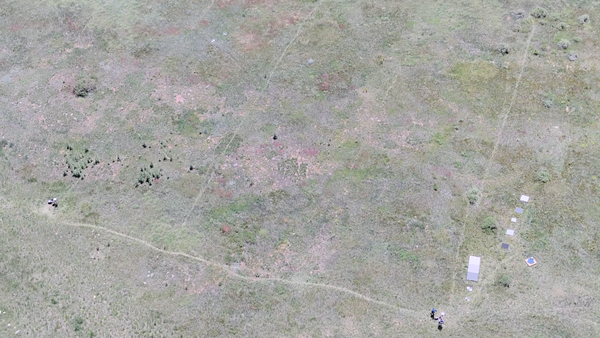
Uncrewed aircraft systems (UAS) instrument validation and calibration
Uncrewed aircraft systems (UAS) instrument validation and calibrationDrone-captured photo of a vegetated field in Golden, Colorado. Faint paths visible across the grass formed from the consistent, repeated pattern walked by a spectrometer operator multiple times per day for multiple days in a row.
Uncrewed aircraft systems (UAS) instrument validation and calibration
Uncrewed aircraft systems (UAS) instrument validation and calibrationDrone-captured photo of a vegetated field in Golden, Colorado. Faint paths visible across the grass formed from the consistent, repeated pattern walked by a spectrometer operator multiple times per day for multiple days in a row.
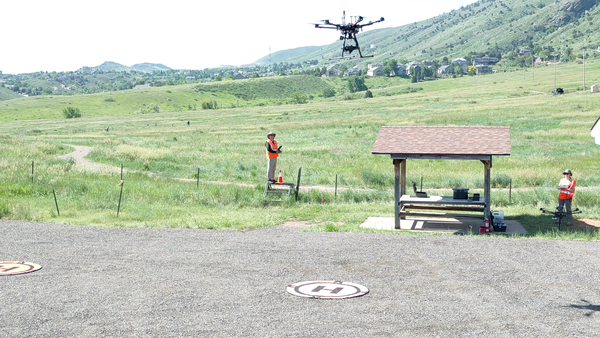
Collecting data using uncrewed aircraft systems (UAS)
Collecting data using uncrewed aircraft systems (UAS)USGS remote pilot Matt Burgess flies a drone to collect hyperspectral data over a field in Golden, Colorado.
Collecting data using uncrewed aircraft systems (UAS)
Collecting data using uncrewed aircraft systems (UAS)USGS remote pilot Matt Burgess flies a drone to collect hyperspectral data over a field in Golden, Colorado.

Landsat 7 Mission - by the Numbers
The Landsat 7 satellite was launched on April 15, 1999. The mission was decommissioned on June 4, 2025. The data collected by the satellite's sensor from 1999 to 2024 is a key part of Landsat’s 50-plus year record of imaging our planet’s surface and are preserved in the USGS Earth Resources Observation and Science (EROS) Center archive.
The Landsat 7 satellite was launched on April 15, 1999. The mission was decommissioned on June 4, 2025. The data collected by the satellite's sensor from 1999 to 2024 is a key part of Landsat’s 50-plus year record of imaging our planet’s surface and are preserved in the USGS Earth Resources Observation and Science (EROS) Center archive.
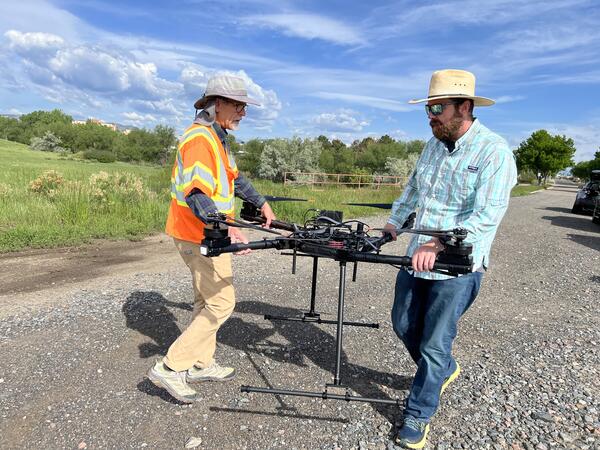
Carrying a drone aircraft
USGS remote pilots Joe Adams and Todd Burton carry a drone during flight training at the Denver Federal Center.
USGS remote pilots Joe Adams and Todd Burton carry a drone during flight training at the Denver Federal Center.
Uncrewed aircraft system (UAS) remote pilot Victoria Scholl
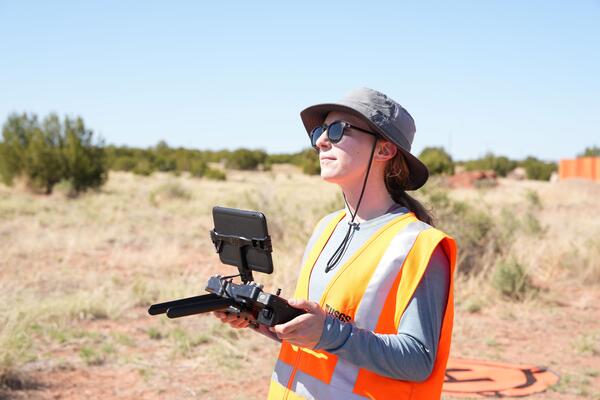
Uncrewed aircraft system (UAS) remote pilot Victoria SchollU.S. Geological Survey remote pilot Victoria Scholl flies a drone with camera payload to capture natural color images for photogrammetric mapping of the Abó Ruins at Salinas Pueblo Missions National Monument in Mountainair, New Mexico.
Uncrewed aircraft system (UAS) remote pilot Victoria Scholl
Uncrewed aircraft system (UAS) remote pilot Victoria SchollU.S. Geological Survey remote pilot Victoria Scholl flies a drone with camera payload to capture natural color images for photogrammetric mapping of the Abó Ruins at Salinas Pueblo Missions National Monument in Mountainair, New Mexico.
Using uncrewed aircraft systems (UAS) to map Abó Ruins
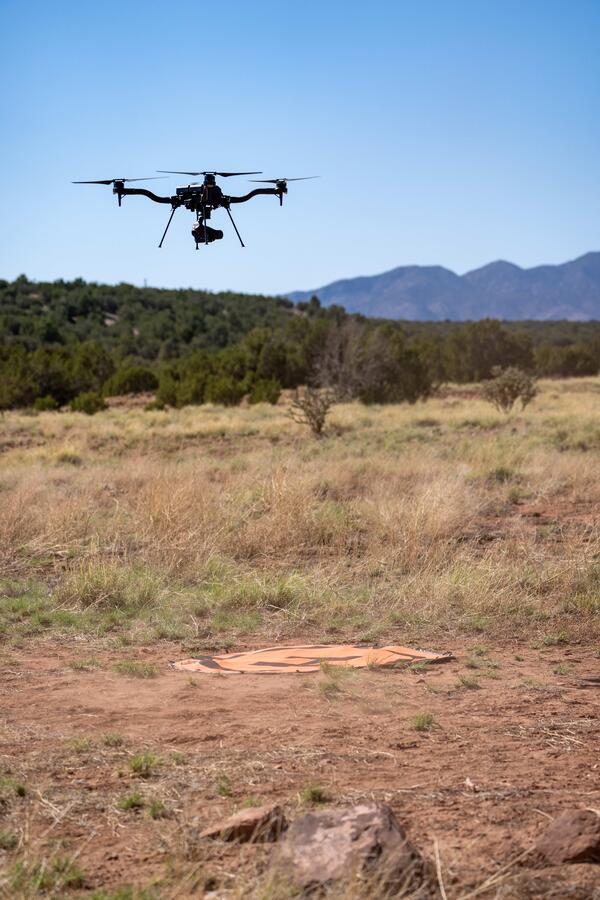
Using uncrewed aircraft systems (UAS) to map Abó RuinsThe U.S. Geological Survey National Uncrewed Systems Office flew uncrewed aircraft systems (UAS) to map the Abó Ruins at Salinas Pueblo Missions National Monument in Mountainair, New Mexico.
Using uncrewed aircraft systems (UAS) to map Abó Ruins
Using uncrewed aircraft systems (UAS) to map Abó RuinsThe U.S. Geological Survey National Uncrewed Systems Office flew uncrewed aircraft systems (UAS) to map the Abó Ruins at Salinas Pueblo Missions National Monument in Mountainair, New Mexico.