On Tuesday December 7, 2021, updates were made to all USGS webpages, including the Landsat Missions Web Site (LMWS).
Learn more here: https://www.usgs.gov/landsat-missions/news/landsat-mission-web-site-cha…
An official website of the United States government
Here's how you know
Official websites use .gov
A .gov website belongs to an official government organization in the United States.
Secure .gov websites use HTTPS
A lock () or https:// means you’ve safely connected to the .gov website. Share sensitive information only on official, secure websites.
Core Science Systems images.
On Tuesday December 7, 2021, updates were made to all USGS webpages, including the Landsat Missions Web Site (LMWS).
Learn more here: https://www.usgs.gov/landsat-missions/news/landsat-mission-web-site-cha…
On Tuesday December 7, 2021, updates were made to all USGS webpages, including the Landsat Missions Web Site (LMWS).
Learn more here: https://www.usgs.gov/landsat-missions/news/landsat-mission-web-site-cha…
On November 23, 2021, the Landsat Archive added its ten millionth image. The Landsat 7 scene was acquired over the Dead Sea and is shown as a false color image using the short-wave infrared, near infrared and red bands (bands 5,4,3).
These images of an area in south central Queensland, Australia were acquired by the instruments onboard both Landsat 8 and Landsat 9 on November 15, 2021, as Landsat 9 flew beneath Landsat 8 as the satellite continued its climb to nominal orbital altitude.
This graphic displays a few of the common band Red-Green-Blue (RGB) combinations of Landsat data. For more information about using Landsat bands in your research, visit the following pages:
Thick vegetation at a Guymon, Oklahoma, site required parking a quarter-mile away. The pickup is visible at the top center of the photo, which was taken on November 11, 2021, the first characterization day there. (Photo by Jeff Irwin, USGS)
Landsat image of Window Rock, Arizona, acquired on November 3, 2021.
For more information about Landsat, please visit www.usgs.gov/Landsat
To download the data, visit earthexplorer.usgs.gov
Landsat image of Window Rock, Arizona, acquired on November 3, 2021.
For more information about Landsat, please visit www.usgs.gov/Landsat
To download the data, visit earthexplorer.usgs.gov
Landsat 5 images of Zhuozhou, China, on September 7, 1999, showing top-of-atmosphere (TOA) reflectance; Level-2 surface reflectance (SR); and Level-2 surface temperature (ST), in Kelvin (K). View fact sheet at Landsat Collection 2 Level-2 Science Products (usgs.gov).
Sediments swirl in Lake Erie and Lake St. Clair in this Landsat 9 image of both Detroit, Michigan, and Windsor, Ontario, from Oct. 31, 2021. The Great Lakes serve as sources of freshwater, recreational activity, transport, and habitat for the upper-midwestern US, and water quality remains a high priority.
The city of Kathmandu, Nepal, seen at the bottom left of this Landsat 9 image, lies in a valley south of the Himalayan Mountainsbetween Nepal and China. Glaciers, and the lakes formed by glacial meltwater, are visible in the top middle of this image.
In the Western U.S., in places like the Navajo Nation as seen in this Landsat 9 image, Landsat and other satellite data help people monitor drought conditions and manage irrigation water. With only 85 rain gauges to cover more than 27,000 square miles, satellite data and climate models are filling the gaps to help the Navajo Nation monitor drought severity.
Image showing a section of Lava River Cave, located in Northern Arizona.
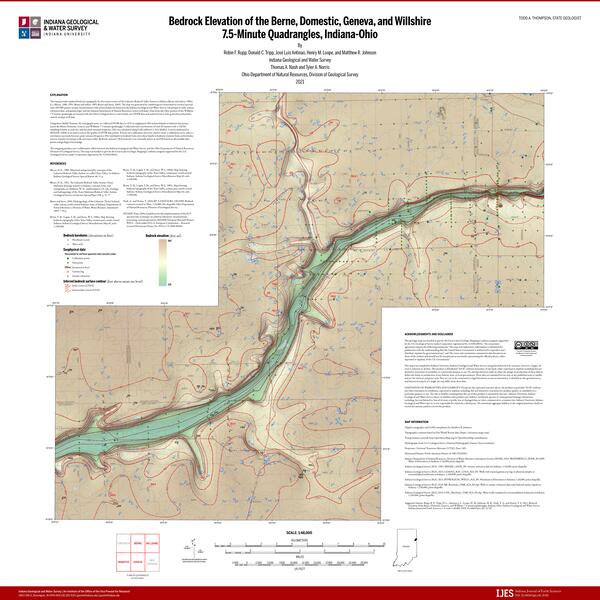
This map details the subsurface contact between the consolidated Paleozoic bedrock surface and the overlying unconsolidated Quaternary-aged sediments. This image is used with the permission of the Ohio Department of Natural Resources, Division of Geological Survey and the Indiana Geological and Water Survey.
From top, Dr. Kyle Rodman, Dr. Zhiliang Zhu, and Dr. Sarah Hart, pictured with the graphic for the USGS EROS podcast "Eyes on Earth."
Example of the Landsat Collection 2 Burned Area Science Product showing the Bootleg Fire in Oregon on July 11, 2021 for tile h006V010. Left: Landsat 8 Collection 2 U.S. Analysis Ready Data Surface Reflectance image (Bands 6,5,4), Middle: Burn Classification (BC), and Right: Burn Probability (BP).
The Menindee Lakes in the Far West of New South Wales, Australia, are seen in this Landsat 8 Collection 2 image from May 14, 2021, and is shown as a natural color composite using the red, green, and blue bands (Bands 4,3,2).
This Landsat 8 Collection 2 image was acquired over the Richat Structure near the western edge of the Sahara Desert on April 25, 2020 and is shown as a natural color composite using the red, green, and blue bands (Bands 4,3,2).
Example of the Landsat Collection 2 Dynamic Surface Water Science Product showing the Confluence of the Wabash and Ohio Rivers on April 12, 2021,for tile h021V010. Left: Landsat Collection 2 U.S. Analysis Ready Data Surface Reflectance image, Right: Dynamic Surface Water Extent (INTR layer)
The image shows the Astrogeology Science Center experimental meteorological station.
Bar graphs comparing three partner funding scenarios for completing nationwide 3D Elevation Program data acquisition by 2023.