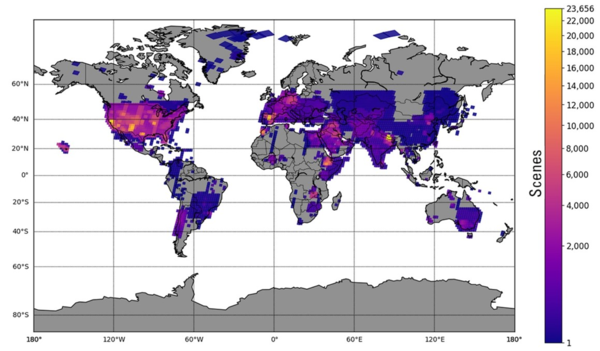
This graph shows the number of Landsat Collection 2 Level-1 scene-based products that are available for download from the USGS Archive. Please note that data from earlier Landsat missions, even those that have ended, continues to be added to the archive through the Landsat Global Archive Consolidation (LGAC) program.
Images
Core Science Systems images.
This graph shows the number of Landsat Collection 2 Level-1 scene-based products that are available for download from the USGS Archive. Please note that data from earlier Landsat missions, even those that have ended, continues to be added to the archive through the Landsat Global Archive Consolidation (LGAC) program.
This graphic displays the number of Landsat Collection 2 Level-2 scene-based science products that are available for download from the USGS Archive. Level-2 science products were first introduced with the Collection 2 release in December, 2020. The Level-2 Science Product includes surface reflection and surface temperature data.
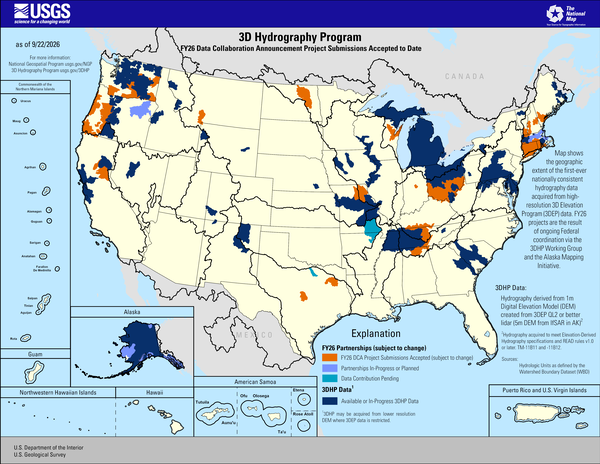
3D Hydrography Program FY25 Partnerships in Alaska
3D Hydrography Program FY25 Partnerships in AlaskaThis map of Alaska shows geographic extent of the first-ever nationally consistent hydrography data acquired from high-resolution 3D Elevation Program (3DEP) data. FY25 projects are the result of ongoing Federal coordination via the 3DHP Working Group and the Alaska Mapping Initiative.
Explanation
3D Hydrography Program FY25 Partnerships in Alaska
3D Hydrography Program FY25 Partnerships in AlaskaThis map of Alaska shows geographic extent of the first-ever nationally consistent hydrography data acquired from high-resolution 3D Elevation Program (3DEP) data. FY25 projects are the result of ongoing Federal coordination via the 3DHP Working Group and the Alaska Mapping Initiative.
Explanation
A primary governmental division of the United States or a United States jurisdiction that is neither a part of one of the several States nor a federal district (for example, the United States Virgin Islands).
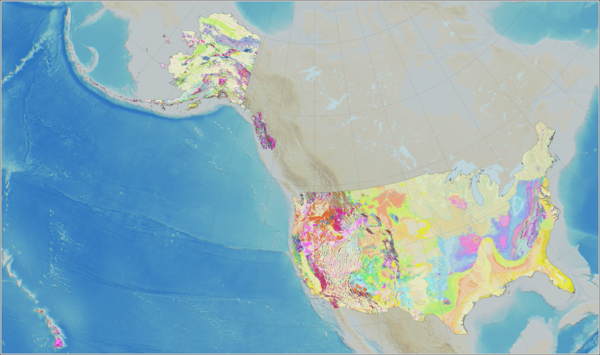
The USGS Cooperative National Geologic Map on a smartphone
The USGS Cooperative National Geologic Map on a smartphoneThe new USGS Cooperative National Geologic Map web tool was designed to be mobile friendly, allowing users to explore geologic data easily from their smartphones or tablets. USGS image.
The USGS Cooperative National Geologic Map on a smartphone
The USGS Cooperative National Geologic Map on a smartphoneThe new USGS Cooperative National Geologic Map web tool was designed to be mobile friendly, allowing users to explore geologic data easily from their smartphones or tablets. USGS image.
The USGS Cooperative National Geologic Map on smartphone
The USGS Cooperative National Geologic Map on smartphoneThe new USGS Cooperative National Geologic Map web tool was designed to also be mobile friendly, allowing users to explore geologic data from smartphones and tablets, in addition to larger devices. USGS image.
The USGS Cooperative National Geologic Map on smartphone
The USGS Cooperative National Geologic Map on smartphoneThe new USGS Cooperative National Geologic Map web tool was designed to also be mobile friendly, allowing users to explore geologic data from smartphones and tablets, in addition to larger devices. USGS image.
Greg Noe has been a Research Ecologist with the U.S. Geological Survey in Reston, VA, since 2002, where he leads the Wetland Ecosystem Ecology & Biogeochemistry Laboratory (WEEBL) in the Florence Bascom Geoscience Center. Dr. Noe’s research centers on wetland ecosystem ecology and watershed processes.
Landsat 9 False Color Image of the Beaufort Sea Shoreline
Landsat 9 False Color Image of the Beaufort Sea ShorelineThis Landsat 9 image showing the Beaufort Sea shoreline off of Alaska and Canada is just one of the scenes captured and processed on July 13, 2025— that day, the USGS EROS archive reached a milestone of one million Landsat 9 Level-1 products. This false color image was made with bands 6,5, and 4 from the Operational Land Imager.
Landsat 9 False Color Image of the Beaufort Sea Shoreline
Landsat 9 False Color Image of the Beaufort Sea ShorelineThis Landsat 9 image showing the Beaufort Sea shoreline off of Alaska and Canada is just one of the scenes captured and processed on July 13, 2025— that day, the USGS EROS archive reached a milestone of one million Landsat 9 Level-1 products. This false color image was made with bands 6,5, and 4 from the Operational Land Imager.
Landsat View of Central Chile and the Andes Mountains
Landsat View of Central Chile and the Andes MountainsThis Landsat 9 image of central Chile, acquired July 10, 2025, uses the shortwave infrared, near infrared, and red spectral bands ( bands 6,5,4) to highlight land cover. In this combination, healthy vegetation appears bright green, while snow and ice in the Andes Mountains show in bright blue.
Landsat View of Central Chile and the Andes Mountains
Landsat View of Central Chile and the Andes MountainsThis Landsat 9 image of central Chile, acquired July 10, 2025, uses the shortwave infrared, near infrared, and red spectral bands ( bands 6,5,4) to highlight land cover. In this combination, healthy vegetation appears bright green, while snow and ice in the Andes Mountains show in bright blue.
This Landsat 8 image highlights the McDermitt Caldera, which straddles the Nevada–Oregon border. The yellow boundary outlines the caldera margin, a geologic feature formed by a massive volcanic eruption millions of years ago. Over time, weathering of lithium-rich volcanic material led to the formation of clay deposits within the caldera basin.
3D View of the Surficial Geology, Bedrock Topography and Water Well Data, Allegan County, Michigan
3D View of the Surficial Geology, Bedrock Topography and Water Well Data, Allegan County, MichiganThis is a preliminary image of the 3D geologic map of Allegan County, Michigan which will be part of the Allegan County web map being created by the Michigan Geological Survey.
3D View of the Surficial Geology, Bedrock Topography and Water Well Data, Allegan County, Michigan
3D View of the Surficial Geology, Bedrock Topography and Water Well Data, Allegan County, MichiganThis is a preliminary image of the 3D geologic map of Allegan County, Michigan which will be part of the Allegan County web map being created by the Michigan Geological Survey.
Collecting data using uncrewed aircraft systems (UAS)
Collecting data using uncrewed aircraft systems (UAS)USGS remote pilot Matt Burgess flies a drone to collect hyperspectral data over a field in Golden, Colorado.
Collecting data using uncrewed aircraft systems (UAS)
Collecting data using uncrewed aircraft systems (UAS)USGS remote pilot Matt Burgess flies a drone to collect hyperspectral data over a field in Golden, Colorado.
Uncrewed aircraft systems (UAS) instrument validation and calibration
Uncrewed aircraft systems (UAS) instrument validation and calibrationDrone-captured photo of a vegetated field in Golden, Colorado. Faint paths visible across the grass formed from the consistent, repeated pattern walked by a spectrometer operator multiple times per day for multiple days in a row.
Uncrewed aircraft systems (UAS) instrument validation and calibration
Uncrewed aircraft systems (UAS) instrument validation and calibrationDrone-captured photo of a vegetated field in Golden, Colorado. Faint paths visible across the grass formed from the consistent, repeated pattern walked by a spectrometer operator multiple times per day for multiple days in a row.
The Landsat 7 satellite was launched on April 15, 1999. The mission was decommissioned on June 4, 2025. The data collected by the satellite's sensor from 1999 to 2024 is a key part of Landsat’s 50-plus year record of imaging our planet’s surface and are preserved in the USGS Earth Resources Observation and Science (EROS) Center archive.
USGS remote pilots Joe Adams and Todd Burton carry a drone during flight training at the Denver Federal Center.
Using uncrewed aircraft systems (UAS) to map Abó Ruins
Using uncrewed aircraft systems (UAS) to map Abó RuinsThe U.S. Geological Survey National Uncrewed Systems Office flew uncrewed aircraft systems (UAS) to map the Abó Ruins at Salinas Pueblo Missions National Monument in Mountainair, New Mexico.
Using uncrewed aircraft systems (UAS) to map Abó Ruins
Using uncrewed aircraft systems (UAS) to map Abó RuinsThe U.S. Geological Survey National Uncrewed Systems Office flew uncrewed aircraft systems (UAS) to map the Abó Ruins at Salinas Pueblo Missions National Monument in Mountainair, New Mexico.
Uncrewed aircraft system (UAS) remote pilot Victoria Scholl
Uncrewed aircraft system (UAS) remote pilot Victoria SchollU.S. Geological Survey remote pilot Victoria Scholl flies a drone with camera payload to capture natural color images for photogrammetric mapping of the Abó Ruins at Salinas Pueblo Missions National Monument in Mountainair, New Mexico.
Uncrewed aircraft system (UAS) remote pilot Victoria Scholl
Uncrewed aircraft system (UAS) remote pilot Victoria SchollU.S. Geological Survey remote pilot Victoria Scholl flies a drone with camera payload to capture natural color images for photogrammetric mapping of the Abó Ruins at Salinas Pueblo Missions National Monument in Mountainair, New Mexico.
U.S. Geological Survey and National Park Service personnel stand with drone technologies used for mapping the Abó Ruins at Salinas Pueblo Missions National Monument in Mountainair, New Mexico.
Landsat View of Glaciers and Fjords in Northern Greenland
Landsat View of Glaciers and Fjords in Northern GreenlandThis Landsat 8 image of northern Greenland, acquired May 10, 2025, uses the natural color combination of red, green, and blue spectral bands (bands 4,3,2). Snow and ice appear bright white and exposed rock appears brown. The scene features the Ryder Glacier, C.H. Ostenfeld Glacier, and Victoria Fjord, along with part of the Greenland Ice Sheet.
Landsat View of Glaciers and Fjords in Northern Greenland
Landsat View of Glaciers and Fjords in Northern GreenlandThis Landsat 8 image of northern Greenland, acquired May 10, 2025, uses the natural color combination of red, green, and blue spectral bands (bands 4,3,2). Snow and ice appear bright white and exposed rock appears brown. The scene features the Ryder Glacier, C.H. Ostenfeld Glacier, and Victoria Fjord, along with part of the Greenland Ice Sheet.
Landsat View of Namibia’s Fish River Canyon and ǀAi-ǀAis / Richtersveld Transfrontier Park
Landsat View of Namibia’s Fish River Canyon and ǀAi-ǀAis / Richtersveld Transfrontier ParkThis Landsat 8 image of southern Namibia, acquired May 7, 2025, uses the shortwave infrared, near infrared, and red spectral bands (bands 6,5,4) to highlight land cover. In this combination, healthy vegetation appears bright green, while bare ground and desert landscapes show in shades of brown and tan.
Landsat View of Namibia’s Fish River Canyon and ǀAi-ǀAis / Richtersveld Transfrontier Park
Landsat View of Namibia’s Fish River Canyon and ǀAi-ǀAis / Richtersveld Transfrontier ParkThis Landsat 8 image of southern Namibia, acquired May 7, 2025, uses the shortwave infrared, near infrared, and red spectral bands (bands 6,5,4) to highlight land cover. In this combination, healthy vegetation appears bright green, while bare ground and desert landscapes show in shades of brown and tan.
Uncrewed Aircraft Systems fieldwork site in Moab, Utah
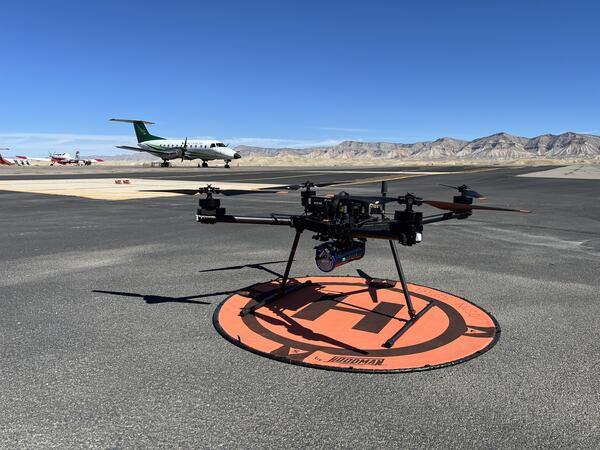
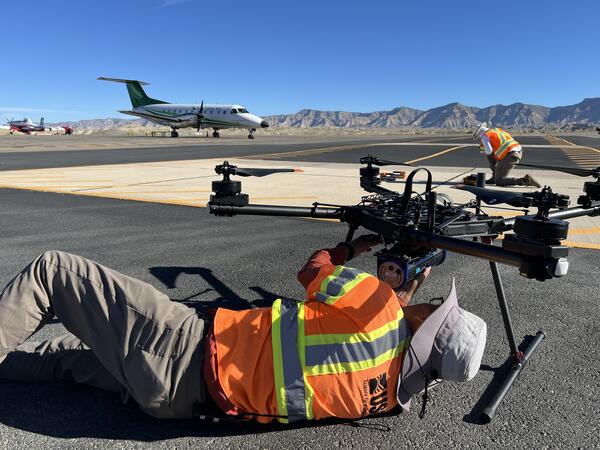
Uncrewed Aircraft Systems fieldwork site in Moab, UtahDrone operations near Moab, Utah to collect spectral remote sensing imagery during a collaborative USGS field campaign in May 2025.
Uncrewed Aircraft Systems fieldwork site in Moab, Utah
Uncrewed Aircraft Systems fieldwork site in Moab, UtahDrone operations near Moab, Utah to collect spectral remote sensing imagery during a collaborative USGS field campaign in May 2025.