U.S. flag

An official website of the United States government

Images

Core Science Systems images.

Filter Total Items: 653
Image of a vehicle with geophysical equipment on a trailer behind; image of two people standing on a road; graphic of signals
Geophysical surveys help explore the subsurface geology (seismic reflection).

Geophysical surveys at the land surface help scientists explore the subsurface geology. Here geologists collect geophysical data using geophones. In the resulting geophysical profile, colors highlight key horizons.

Productivity of Black Oystercatchers in Southwest Alaska

The black oystercatcher, a keystone species in nearshore ecosystems, plays an important role in structuring nearshore systems and is highly susceptible to human disturbance. Current inventory and monitoring efforts may not adequately address the information needs for estimating long-term trends for this species.

The black oystercatcher, a keystone species in nearshore ecosystems, plays an important role in structuring nearshore systems and is highly susceptible to human disturbance. Current inventory and monitoring efforts may not adequately address the information needs for estimating long-term trends for this species.

Landsat 8 image showing northeast Mongolia

Landsat 8 image acquired on November 19, 2020 over northeast Mongolia (Path 127 Row 26). The image is shown using the shortwave infrared 1, near infrared, and red bands (bands 6,5,4).

Landsat Scene ID LC08_L1TP_127026_20201119_20201119_01_RT

Landsat 8 image acquired on November 19, 2020 over northeast Mongolia (Path 127 Row 26). The image is shown using the shortwave infrared 1, near infrared, and red bands (bands 6,5,4).

Landsat Scene ID LC08_L1TP_127026_20201119_20201119_01_RT

Landsat 8 image showing southwest Morocco

Landsat 8 image acquired on November 11, 2020 over southwest Morocco (Path 203 Row 40). The image is shown using the shortwave infrared 2, red, and blue bands (bands 7,4,2).

Landsat Scene ID LO08_L1TP_203040_20201107_20201111_01_T1

Landsat 8 image acquired on November 11, 2020 over southwest Morocco (Path 203 Row 40). The image is shown using the shortwave infrared 2, red, and blue bands (bands 7,4,2).

Landsat Scene ID LO08_L1TP_203040_20201107_20201111_01_T1

Silica Crucible and Glass Desiccator

Geochemists use platinum, silica, and ceramic crucibles, shown here in a glass container called a desiccator.  Silica is used because it is resistant to extremely high temperatures and because it is chemically inert. Silicon, linked up with a pair of oxygen molecules as silicon dioxide, is known as silica. 

Geochemists use platinum, silica, and ceramic crucibles, shown here in a glass container called a desiccator.  Silica is used because it is resistant to extremely high temperatures and because it is chemically inert. Silicon, linked up with a pair of oxygen molecules as silicon dioxide, is known as silica. 

Graphic showing the cumulative number of scenes per path/row in the Landsat archive
Cumulative number of scenes in the Landsat Archive

This graphic shows the cumulative number of scenes by path and row in the Landsat archive from 1972 - 2020. This graphic was created on the anniversary of the 9 millionth scene addition to the USGS Landsat Archive.

This graphic shows the cumulative number of scenes by path and row in the Landsat archive from 1972 - 2020. This graphic was created on the anniversary of the 9 millionth scene addition to the USGS Landsat Archive.

9 Millionth Landsat Scene
The 9 millionth scene added to the USGS Landsat Archive

The USGS Landsat Archive added its 9 millionth scene to the archive on September 18, 2020. The scene was acquired by Landsat 8 over Northern Paraguay and is shown using bands 6,5,4.

Chicago Geiger Mode lidar
Geiger mode lidar over Chicago, IL

Geiger mode 3DEP lidar point cloud over Chicago, IL from 3DEP Project USGS Lidar Point Cloud IL 4County Cook 2017

Geiger mode 3DEP lidar point cloud over Chicago, IL from 3DEP Project USGS Lidar Point Cloud IL 4County Cook 2017

Example of the Landsat 7 ETM+ Collection 2 level-2 science products

Example of the Landsat 7 ETM+ Collection 2 level-2 science products. Left: Landsat 7 level-2 surface reflectance image. Right: Landsat 7 level-2 surface temperature image. The data was acquired on August 19, 2020 (path 179 row 28).

Example of the Landsat 7 ETM+ Collection 2 level-2 science products. Left: Landsat 7 level-2 surface reflectance image. Right: Landsat 7 level-2 surface temperature image. The data was acquired on August 19, 2020 (path 179 row 28).

Landsat 8 image showing Lakes Everard and Harry in S. Australia

Example of the Landsat 8 OLI/TIRS Collection 2 level-1 product. This Landsat 8 image was acquired on August 18, 2020 over Lake Everard and Lake Harry in southern Australia and is shown as a false color composite using the shortwave infrared, near infrared, and red bands (bands 6,5,4).

Example of the Landsat 8 OLI/TIRS Collection 2 level-1 product. This Landsat 8 image was acquired on August 18, 2020 over Lake Everard and Lake Harry in southern Australia and is shown as a false color composite using the shortwave infrared, near infrared, and red bands (bands 6,5,4).

Please click on image for full description for all text.
OUT OF THIS WORLD - USGS Maps to Guide Mars 2020 Mission

When you’re planning to explore someplace new, it’s always a good idea to bring a map so you can avoid dangerous terrain. This is true whether you’re heading out for a hike on Earth or you’re landing a rover on Mars!

When you’re planning to explore someplace new, it’s always a good idea to bring a map so you can avoid dangerous terrain. This is true whether you’re heading out for a hike on Earth or you’re landing a rover on Mars!

Total Estimated Program Cost and Funding Gap to Complete Nationwide 3D Elevation Data Coverage
Total Estimated Program Cost and Funding Gap to Complete Nationwide 3D
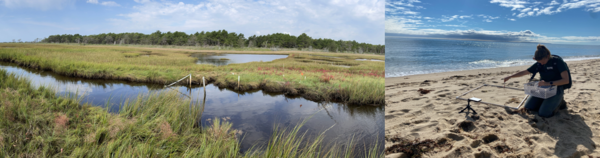
Shannon Fisher pulling sled at Moreau Lake

Photo Contest Winner | Feb. 2020 | People
Shannon Fisher pulling sled at Moreau Lake area after measuring water levels in GW wells surrounding the lake

Photo Contest Winner | Feb. 2020 | People
Shannon Fisher pulling sled at Moreau Lake area after measuring water levels in GW wells surrounding the lake

William T. Pecora
William T. Pecora
William T. Pecora
William T. Pecora

William T. Pecora, Director of the USGS from 1965 to 1971, is largely responsible for two major contributions to science in the public interest: the creation of a national earthquake research center at the USGS facility in Menlo Park, CA, and the Landsat series of Earth observing satellites.

William T. Pecora, Director of the USGS from 1965 to 1971, is largely responsible for two major contributions to science in the public interest: the creation of a national earthquake research center at the USGS facility in Menlo Park, CA, and the Landsat series of Earth observing satellites.

3D Geologic Framework Model of the San Jose Groundwater basin, New Mexico
Three-dimensional (3D) geologic framework model of the Rio San Jose groundwater basin, New Mexico: U.S. Geological Survey data release, https://doi.org/10.5066/P9MPAGA7

3D geologic framework model from west-central New Mexico; graphic shows stratigraphic units in the model being sequentially removed to reveal the deeper units. Faults used in the model appear as vertical “ribbons” as geologic layers are removed.

Colorado Landsat State Mosaic

Denver, the capital of Colorado, is known as the “Mile High City.” The thirteenth step of the capitol building is exactly one mile (5,280 feet) above sea level.

Capital Denver

Image Source Landsat 8

Population 5,773,714

Number of Pixels 299,555,595

Denver, the capital of Colorado, is known as the “Mile High City.” The thirteenth step of the capitol building is exactly one mile (5,280 feet) above sea level.

Capital Denver

Image Source Landsat 8

Population 5,773,714

Number of Pixels 299,555,595

Connecticut Landsat State Mosaic

Groton, Connecticut is home to the USS Nautilus, the first nuclear-powered ship and the first to reach the North Pole, a feat accomplished in 1958. The Nautilus is on display at the Submarine Force Museum.

Capital Hartford

Image Source Landsat 8

Population 3,605,944

Groton, Connecticut is home to the USS Nautilus, the first nuclear-powered ship and the first to reach the North Pole, a feat accomplished in 1958. The Nautilus is on display at the Submarine Force Museum.

Capital Hartford

Image Source Landsat 8

Population 3,605,944

Minnesota Landsat State Mosaic

Minnesota has more shoreline than California, Florida, and Hawaii combined. It is sometimes called the “Land of 10,000 Lakes,” but it actually has 12,000 lakes, three-fourths of which are four hectares (10 acres) or more in size.

Capital St. Paul

Image Source Landsat 8

Minnesota has more shoreline than California, Florida, and Hawaii combined. It is sometimes called the “Land of 10,000 Lakes,” but it actually has 12,000 lakes, three-fourths of which are four hectares (10 acres) or more in size.

Capital St. Paul

Image Source Landsat 8

New Mexico Landsat State Mosaic

Lakes and rivers make up only 0.002 percent of New Mexico’s total surface area–the lowest water-to-land ratio of all fifty states. Most of New Mexico’s lakes are human-made reservoirs.

Capital Santa Fe

Image Source Landsat 8

Population 2,117,522

Lakes and rivers make up only 0.002 percent of New Mexico’s total surface area–the lowest water-to-land ratio of all fifty states. Most of New Mexico’s lakes are human-made reservoirs.

Capital Santa Fe

Image Source Landsat 8

Population 2,117,522

Was this page helpful?