



How We Use Water
How We Use Water
Water Use in the United States
Integrated Water Availability Assessments (IWAAs)
USGS announces 10 IWAAs pilot projects
Supporting the development of national and regional Integrated Water Availability Assessments
Supporting the development of national and regional Integrated Water Availability Assessments
Find water science information and activities related to the different ways we use water.
National Water Availability Assessment Data Companion
National Water Availability Assessment Data Companion

The Data Companion provides model-based estimates of water availability and use.
Data Visualization of Water Use in the U.S. 2015
Data Visualization of Water Use in the U.S. 2015
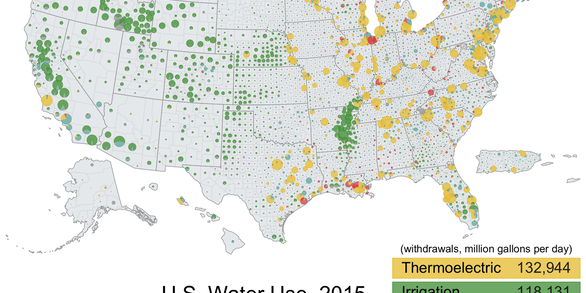
Explore water use data by state and county for 2015
Filter Total Items: 101

Public Supply Wells
Are you among the more than 100 million people in the U.S. who relies on a public-supply well for your drinking water? Although the quality of finished drinking water from public water systems is regulated by the EPA, long-term protection and management of the raw groundwater tapped by public-supply wells requires an understanding of the occurrence of contaminants in this invisible, vital resource...

Domestic (Private) Supply Wells
More than 43 million people—about 15 percent of the U.S. population—rely on domestic (private) wells as their source of drinking water. The quality and safety of water from domestic wells are not regulated by the Federal Safe Drinking Water Act or, in most cases, by state laws. Instead, individual homeowners are responsible for maintaining their domestic well systems and for monitoring water...

Mine Drainage
As settlers traveled west and mined the American landscape, thousands of new mines were created over the centuries and then abandoned. Now, these long forgotten remnants of a bygone area still haunt us, as their operations left behind materials and rock exposures that can be easily eroded and carried downstream. The USGS helps track the sources of acidic mine drainage and helps land managers...

Streamflow Alteration
Humans, just like aquatic organisms, need water. Flood control, urban infrastructure, irrigation of agriculture, and myriad other ways we manage water affect the natural flow of streams and rivers. How do the ways we manage land and water affect the natural patterns of streamflow that ecosystems depend on?

Radionuclides
Many people might be surprised to learn that drinking-water sources, especially groundwater, can contain radioactive elements (radionuclides). Radionuclides in water can be a concern for human health because several are toxic or carcinogenic. Other radionuclides are useful tools for determining the age of groundwater in an aquifer or of sediment deposited at the bottom of a water body.

Recreational Water Quality
People love to play in water. The USGS works to ensure that water in our nation’s streams, lakes, and oceans are suitable for the moments when you just need to jump in.

Linking Selenium Sources to Ecosystems: Local and Global Perspectives
The sources, biogeochemistry, and ecotoxicology of selenium (Se) combine to produce a widespread potential for ecological risk such as deformities in birds and fish. Linking the understanding of source characteristics to a mechanistic, biodynamic dietary model of Se exposure on an ecosystem-scale improves the prediction of Se effects and its potential remediation.

Regional Groundwater Availability Studies
Regional groundwater availability studies enable information about groundwater to be integrated and consistent, so that this resource can be analyzed and understood on an aquifer–wide scale. These studies provide decision–makers with a better understanding of the status and trends in the Nation's groundwater availability.

Groundwater Quality in Principal Aquifers of the Nation, 1991–2010
What’s in your groundwater? Learn about groundwater quality in the Principal Aquifers of nine regions across the United States in informative circulars filled with figures, photos, and water-quality information.

Health-Based Screening Levels for Evaluating Water-Quality Data
This searchable online database provides Health-Based Screening Levels (HBSLs) for hundreds of chemicals, including pesticides and degradates. HBSLs are non-enforceable benchmark concentrations of contaminants in water. These screening levels supplement federal drinking-water standards and guidelines.

Coastal Carolinas Focus Area Study
The USGS is undertaking a 3-year study of water availability and use to investigate competing societal and ecological needs in Southeastern Atlantic Coastal Basins of the Carolinas. This study will compile existing information, add new scientific data and interpretation, and develop tools to help resource managers and stakeholders address current and future water-use challenges.

Red River Focus Area Study
The USGS is undertaking a 3-year study of water use, availability, and change in the Red River basin, which covers more than 93,000 square miles in New Mexico, Texas, Oklahoma, Arkansas, and Louisiana. Water resources are being stressed by increasing water demands and increasingly severe droughts, and a comprehensive water-resource assessment of the basin is needed to enable sustainable water use.