An official website of the United States government
Here's how you know
Official websites use .gov
A .gov website belongs to an official government organization in the United States.
Secure .gov websites use HTTPS
A lock () or https:// means you’ve safely connected to the .gov website. Share sensitive information only on official, secure websites.
Coastal wetlands and estuaries connect lands and watersheds to the ocean. They are biologically and physically dynamic and are among the most productive and valuable ecosystems in the world. Many different types of USGS scientists work together to increase our understanding of these ecosystems under past, present and future conditions, and how human activities influence them.
What is a coastal wetland?
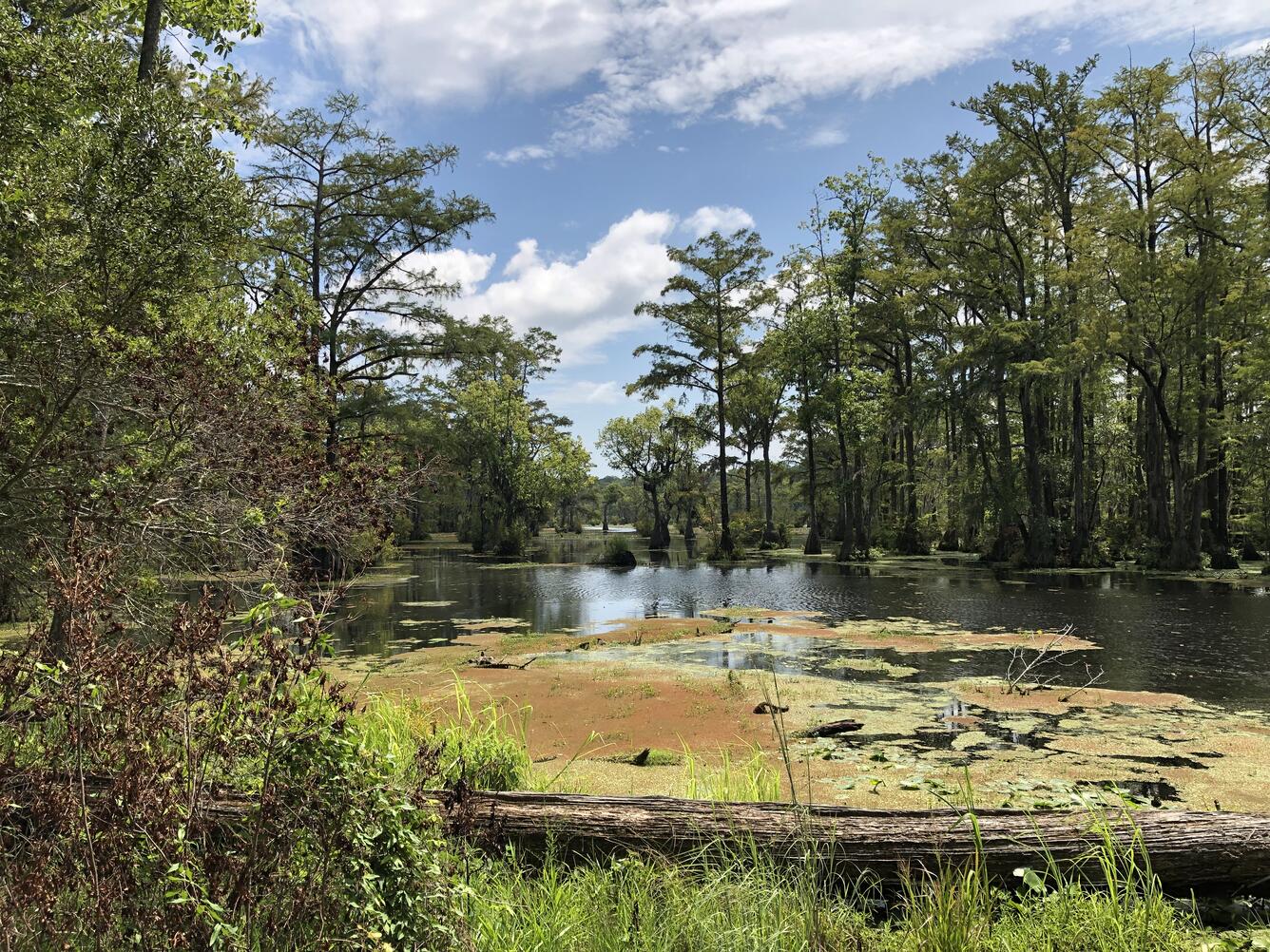
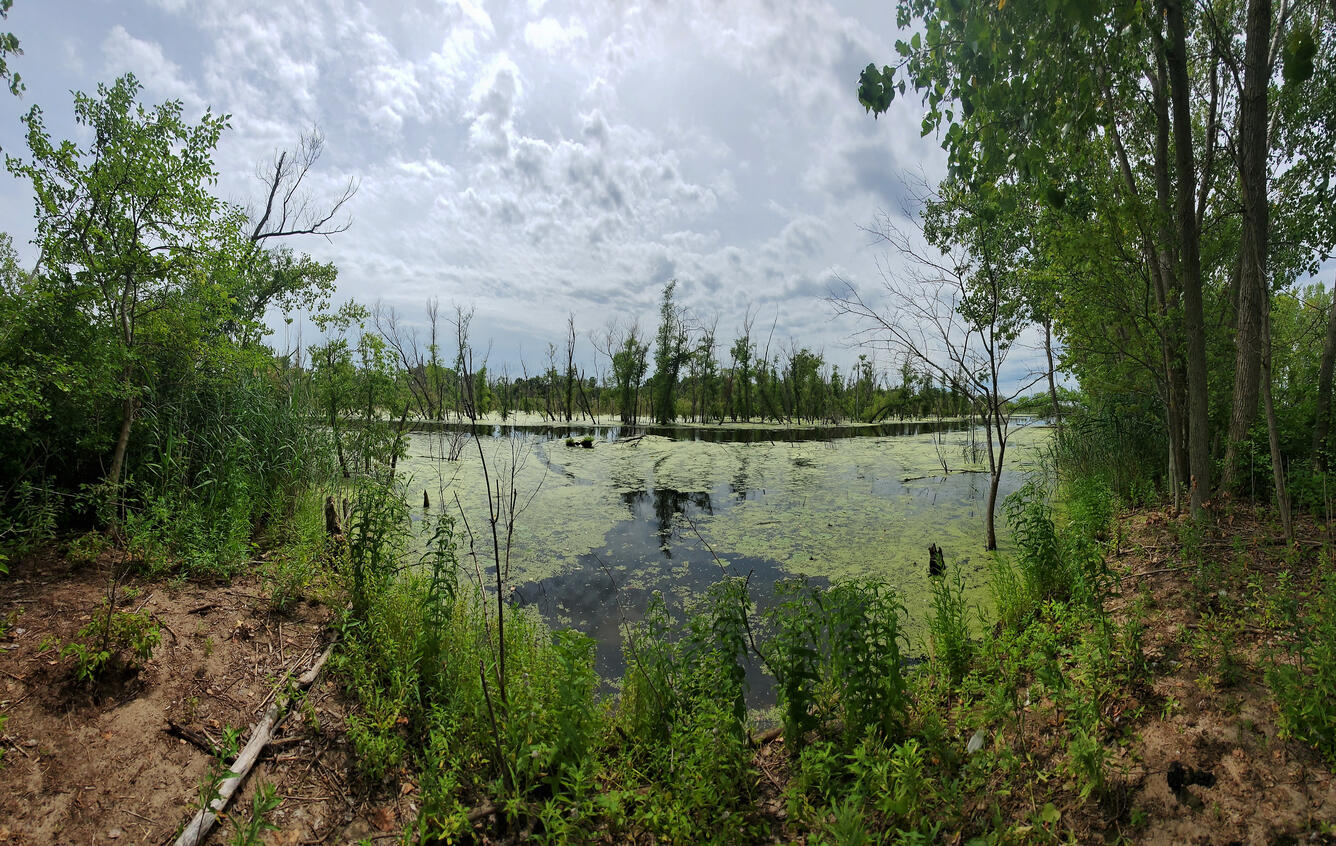
Coastal wetlands are transitional areas between dry land and open water that are either permanently or seasonally inundated with fresh, brackish, or salt water. They contain a range of plant and animal species that are uniquely adapted to the wet soil conditions, the type of water present, and the degree of inundation.
Types of coastal wetlands include salt marshes, freshwater marshes, seagrass meadows, mangrove swamps, and forested swamps.
Coastal wetlands are among the most productive and valuable ecosystems in the world—comparable to even rainforests and coral reefs. They are often referred to as natural sponges or nature’s kidneys because they slow the flow of water across the watershed, filter out pollutants and excess nutrients, and even absorb and store large quantities of the greenhouse gas carbon dioxide. These capabilities help protect coastal communities from storms and flooding, prevent erosion, improve water quality, and decrease the effects of climate change. Listen to the audio-described version.
What is an estuary?
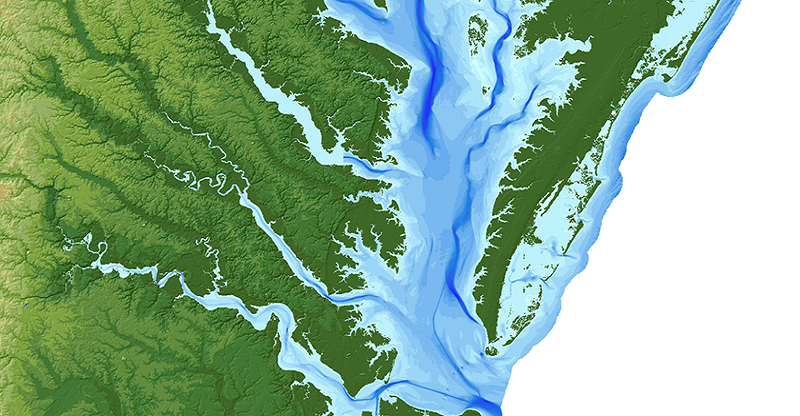
Estuaries are created where watersheds meet the ocean, bringing land-based waters and salt water from the ocean together. A dynamic ecosystem is created where river flows meet ocean tides. These regions offer food sources and shelter for many different species, including humans.
Estuaries also face a variety of issues that alter their productivity as an ecosystem—many related to the watershed that supplies water from the mainland, including:
USGS studies coastal wetlands and estuaries around the Nation. Here are just a few examples.
Why are coastal wetlands and estuaries important?
Some of America’s largest cities and communities are located along wetlands and estuaries, such as New York-New Jersey Harbor, Chesapeake Bay, San Francisco Bay, Biscayne Bay, Puget Sound, Tampa Bay, and many others. Coastal wetlands and estuaries provide numerous critical benefits and services to society—these are known as ecosystem services. Specifically, they:
Protect coastal communities from storms and flooding
Help prevent erosion
Provide essential food, refuge, and nursery habitat for commercially and recreationally important species
Improve water quality by filtering runoff and absorbing excess nutrients
Decrease the effects of climate change by storing large quantities of the greenhouse gas carbon dioxide from the atmosphere
Provide recreational opportunities like boating, hiking, hunting, fishing, kayaking, and wildlife/bird watching
Serve as important areas of commerce, shipping activity, and ocean/port access
USGS Research
Estuaries are the mixing point between land and coasts. The water that flows into them is critical to their high biological productivity. Changes to the quality, quantity, and type of water, sediment, and river flow affect everything from the types of plants and animals that live there, the landscapes that develop, and the ecosystem services provided to coastal communities.
USGS scientists work in and bring expertise in hydrology, water chemistry, ecology, and sediment transport science, to integrate various information that can help forecast, predict, and identify threats or effects of changes. This helps decision-makers and resources managers develop science-based policies that balance sustainable use of these rich coastal ecosystems while maintaining their productivity for the benefit of all.
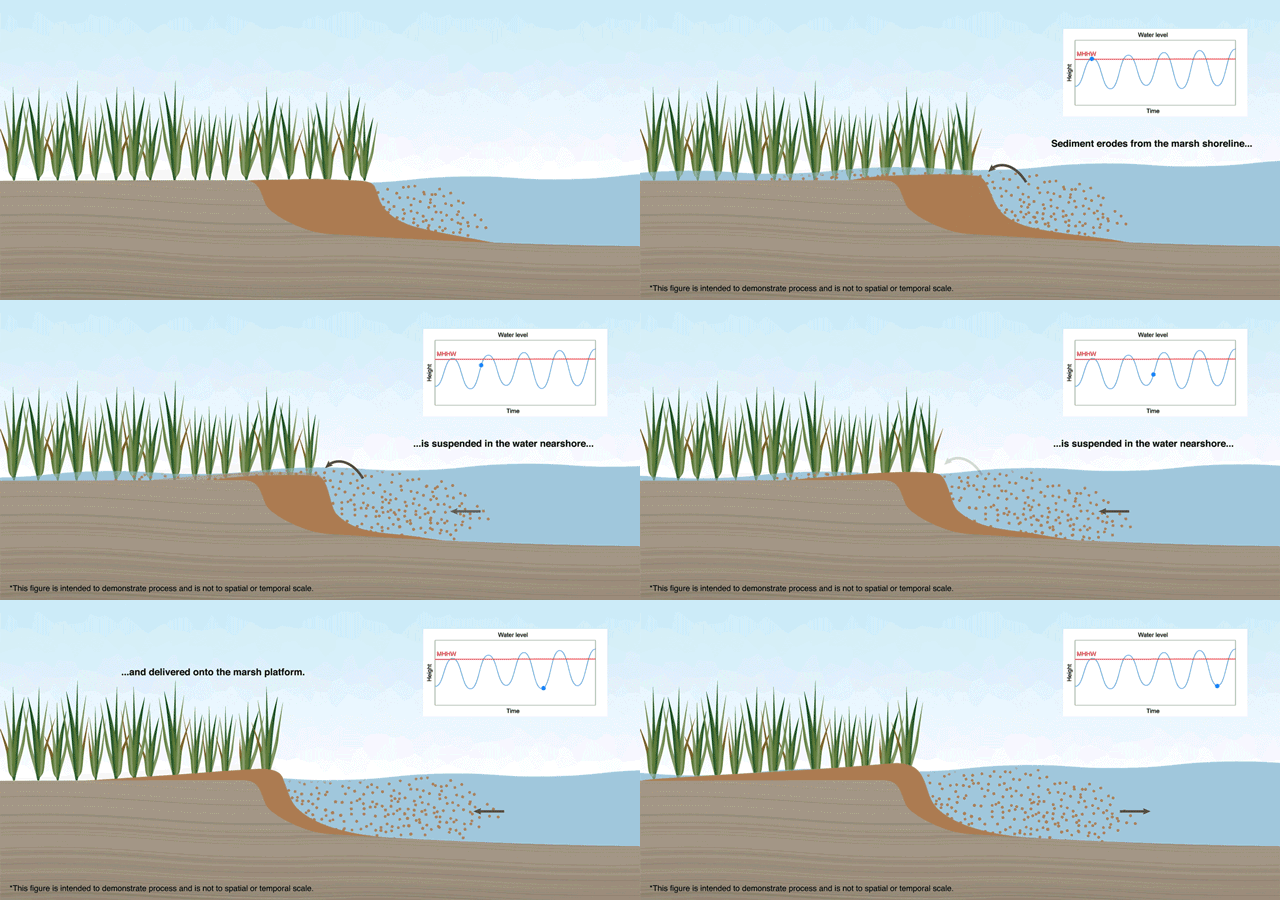
Salt marshes provide important economic and ecologic services but are vulnerable to habitat loss, particularly due to shoreline erosion from storms and sea level rise. Sediments eroded at the marsh edge are either delivered onto the marsh platform or into the estuary, the latter resulting in a net loss to the marsh sediment budget and released soil carbon. Knowledge on the timing, distance, and quantity of sediment deposition versus shoreline erosion along the marsh-estuary interface is critical for evaluating the overall health and vulnerability of coastal marshes to future scenarios of sea level rise and storms. This image is a depiction of what happens to sediments as they are eroded at the marsh edge, delivered into the estuary and onto the marsh platform, leading to a higher marsh platform elevation at the marsh shoreline, but loss of wetland habitat area at the eroding shoreline edge.
Storms, sea-level rise, and other elements of climate and coastal change often involve coastal engineering in order to accommodate human needs. These natural systems are highly adaptable. Many plant and animal species can move and grow in response to changing conditions, but some management actions like building coastal defense structures (e.g., seawalls and dikes) and maintaining roads restrict the ability of these coastal ecosystems to adapt or migrate. When estuaries and coastal wetlands are constrained by seawalls or unable to move, they can be inundated, dried out or exposed to too much salt or fresh water. When they are depleted or destroyed, the benefits and services they provide to people and the environment could be diminished or lost. The loss of estuary and wetland health can have far-reaching effects such as reduced fish catch, diminished water quality, algal blooms, and lost habitat and food sources for many migratory species.
Graphic showing how drought can impact coastal estuarine ecosystems in the U.S. Caribbean.
The USGS conducts a variety of research on coastal wetlands and estuaries that support management decisions of federal, state, regional, and local partners and help in evaluating the effectiveness of restoring these valuable habitats so that will continue to provide the most benefits to society and ecosystems.
The USGS creates topobathymetric digital elevation models (DEMs) to assist with identifying flood, hurricane, and sea-level rise inundation hazard zones. These maps also assist with other earth science applications such as the development of sediment transport and storm surge models. The DEM data are important for a range of applications needed for climate change analysis in sensitive coastal regions. Access the Coastal National Elevation Database (CoNED) viewer.
Past, Present, and Future Conditions
USGS scientists collect basic observational data on physical processes (e.g., storms and sea-level rise) and human activities (e.g., nutrient loading), develop numerical models of these data, and apply models to understand the past, present, and future states of these ecosystems. Through this work, USGS scientists can assess vulnerability (e.g., UnVegetated-Vegetated marsh Ratio or UVVR), water-quality conditions, and resilience and identify human activities that are preventing wetland migration and causing tidal restriction, impoundments, and other issues causing degradation.
Map showing blue carbon study locations in the United States: Nisqually National Wildlife Refuge, San Francisco Bay National Estuarine Research Reserve, Barataria-Terrebonne National Estuary Program, Shark River, Ding Darling National Wildlife Refuge, LCMAP mangrove change detection pilot study, Great Dismal Swamp and Pocosin Lake National Wildlife Refuge, Chesapeake Bay Smithsonian Environmental Research Center, Waquoit Bay National Estuarine Research Reserve.
Blue Carbon
Additionally, USGS scientists are working to better understand blue carbon—carbon that is stored in coastal and marine ecosystems. Terrestrial and aquatic ecosystems can capture and store carbon dioxide from the atmosphere, a process known as carbon sequestration. Though coastal ecosystems, such as wetlands, may be smaller in size when compared to say, a forest, they can sequester more carbon per unit area, making them an incredible climate change mitigation tool.
USGS scientists are researching how environmental changes and human activities (e.g., land use management) can impact the ability of coastal wetlands and estuaries to sequester carbon and store it in soil and plant materials. These ecosystems are powerful carbon sinks and store carbon that has accumulated over hundreds to thousands of years. However, when coastal ecosystems are degraded or destroyed, their capacity to store carbon is diminished, and the carbon stored there can be released back into the atmosphere. Improved management of coastal wetlands and estuaries, leading to enhanced conservation and restoration, is therefore a crucial climate change mitigation strategy. Ultimately, USGS blue carbon research and science-based tools will help guide decision-making regarding climate change mitigation and adaptation, wetland restoration, coastal resilience, and carbon sequestration and storage.
Measuring ecosystem-atmosphere carbon exchange at the leaf-level (left) using a porometer and at the ecosystem-level (right) using eddy covariance. Learn more.
Salt marsh systems require a net import of inorganic sediment to maintain their structure in response to sea‐level rise. Marshes are affected by physical processes including tides, waves, sediment transport, and the influence of vegetation, and these processes interact in complex ways leading to sediment accretion or erosion. We implement a 3‐D hydrodynamic sediment transport model in an...
Authors
Rachel M. Allen, Neil K. Ganju, Tarandeep Kalra, Alfredo Aretxabaleta, Jessica R. Lacy
Unoccupied aerial systems (UASs) are increasingly being deployed in coastal environments to rapidly map and monitor changes to geomorphology, vegetation, and infrastructure, particularly in difficult to access areas. UAS data, relative to airplane or satellite data, typically have higher spatial resolution, sensor customization, and increased flexibility in temporal resolution, which...
Authors
Alexandra Danielle Evans, Jennifer Marie Cramer, Victoria Mary Scholl, Erika E. Lentz
Karst subterranean estuaries within globally ubiquitous carbonate aquifers are coastal groundwater ecosystems that provide an essential water resource for human populations. To understand the drivers of salinization within a coastal aquifer in the Yucatan Peninsula (Mexico), we employed hydroacoustics in flooded caves to observe how oceanic and atmospheric events facilitate mixing...
Authors
Neil K. Ganju, John W. Pohlman, Steven E. Suttles, David Brankovits
Coastal salt marshes are crucial ecosystems that provide habitat for a variety of species, improve water quality, and play a major role in the global carbon cycle. However, many salt marshes have been severely damaged by human activities such as diking and draining for urban development. Recently, there has been a noticeable shift toward the prioritization of coastal marsh restoration to...
Authors
Kasra Naseri, Michelle A. Hummel, Kevin M. Befus, Timothy P. Smith, Meagan J. Eagle, Kevin D. Kroeger
The U.S. Geological Survey collected water velocity and water quality data from salt marshes in Great Channel, southwest of Stone Harbor, New Jersey, and near Thompsons Beach, New Jersey, to evaluate restoration effectiveness after Hurricane Sandy and monitor postrestoration marsh health. Time series data of turbidity and water velocity were collected from 2018 to 2019 and 2022 to 2023...
Authors
Olivia A. De Meo, Robert D. Bales, Neil K. Ganju, Eric D. Marsjanik, Steven E. Suttles
WARC first implemented geographic information systems (GIS) in 1980 to help monitor the nature and extent of wetland habitat changes. The center continues to use GIS, remote sensing, and other computer based technologies to address a wide range of natural resource related issues.
Spatial Analysis Support for Coastal Wetlands Planning, Protection and Restoration Act (Breaux Bill) Planning Activities
WARC first implemented geographic information systems (GIS) in 1980 to help monitor the nature and extent of wetland habitat changes. The center continues to use GIS, remote sensing, and other computer based technologies to address a wide range of natural resource related issues.
The scientists at the Wetland and Aquatic Science Center (WARC) have provided coastal restoration project managers and decision makers with GIS planning, database and custom application capacity since 1992. The scope and complexity of this support has increased over the years and has resulted in the development of a comprehensive geospatial and advanced application teams that provide decision...
GIS and Custom Application Support for the Gulf Coast Ecosystem Restoration Council
The scientists at the Wetland and Aquatic Science Center (WARC) have provided coastal restoration project managers and decision makers with GIS planning, database and custom application capacity since 1992. The scope and complexity of this support has increased over the years and has resulted in the development of a comprehensive geospatial and advanced application teams that provide decision...
The San Francisco Bay-Delta PES is one way that USGS continues to provide science for the restoration and conservation of the SF Bay and its watershed. USGS research topics range from wetland restoration in the Bay to restoring habitat for anadromous fish (e.g., salmon) in the uplands. USGS has made several important discoveries critical to the fundamental understanding of this system and...
The San Francisco Bay-Delta PES is one way that USGS continues to provide science for the restoration and conservation of the SF Bay and its watershed. USGS research topics range from wetland restoration in the Bay to restoring habitat for anadromous fish (e.g., salmon) in the uplands. USGS has made several important discoveries critical to the fundamental understanding of this system and...
Our research goals are to provide the scientific information, knowledge, and tools required to ensure that decisions about land and resource use, management practices, and future development in the coastal zone and adjacent watersheds can be evaluated with a complete understanding of the probable effects on coastal ecosystems and communities, and a full assessment of their vulnerability to natural...
Our research goals are to provide the scientific information, knowledge, and tools required to ensure that decisions about land and resource use, management practices, and future development in the coastal zone and adjacent watersheds can be evaluated with a complete understanding of the probable effects on coastal ecosystems and communities, and a full assessment of their vulnerability to natural...
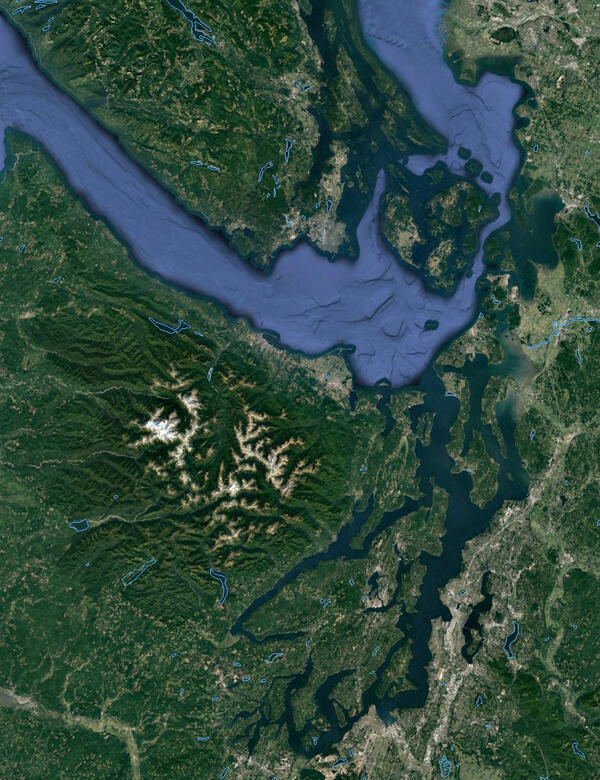
A Pacific Northwest icon, Puget Sound is the second-largest estuary in the United States. Its unique geology, climate, and nutrient-rich waters produce and sustain biologically productive coastal habitats. These same natural characteristics also contribute to a high quality of life that has led to growth in human population and urbanization. This growth has played a role in degrading the Sound...
A Pacific Northwest icon, Puget Sound is the second-largest estuary in the United States. Its unique geology, climate, and nutrient-rich waters produce and sustain biologically productive coastal habitats. These same natural characteristics also contribute to a high quality of life that has led to growth in human population and urbanization. This growth has played a role in degrading the Sound...
Marsh lateral shoreline erosion and shore-proximal sediment deposition
Salt marshes provide important economic and ecologic services but are vulnerable to habitat loss, particularly due to shoreline erosion from storms and sea level rise. Sediments eroded at the marsh edge are either delivered onto the marsh platform or into the estuary, the latter resulting in a net loss to the marsh sediment budget and released soil carbon.
Salt marshes provide important economic and ecologic services but are vulnerable to habitat loss, particularly due to shoreline erosion from storms and sea level rise. Sediments eroded at the marsh edge are either delivered onto the marsh platform or into the estuary, the latter resulting in a net loss to the marsh sediment budget and released soil carbon.
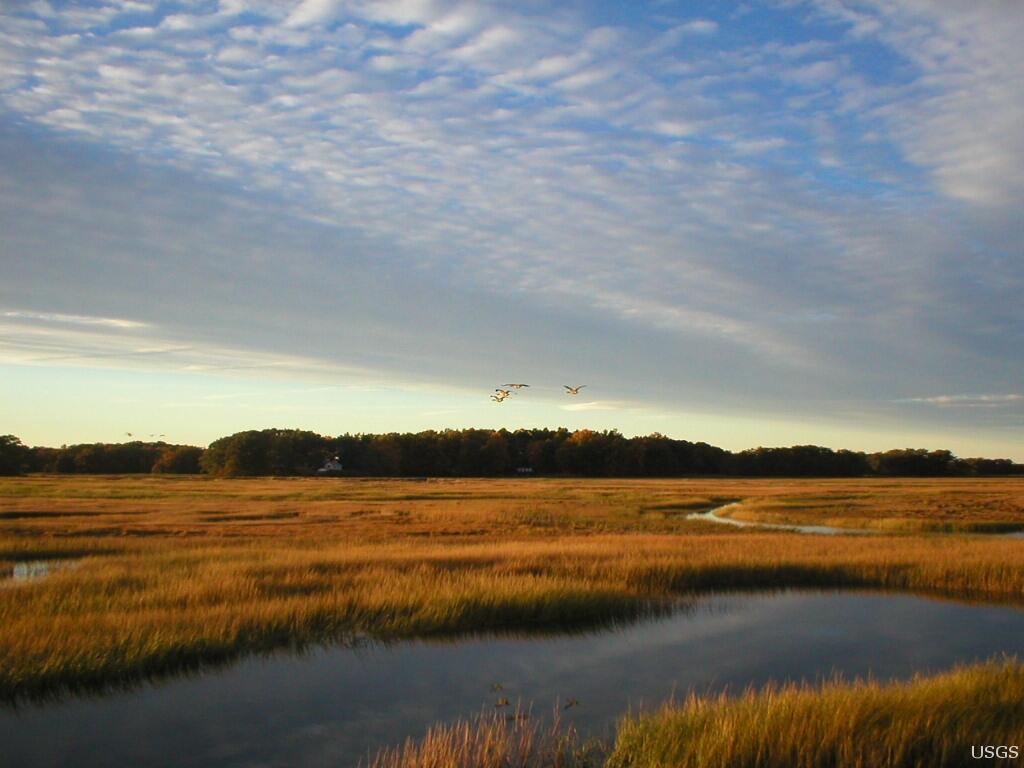
Tidal Marshland in the Plum Island Estuary, Massachusetts
The marshes of Plum Island Estuary are among those predicted by scientists to submerge during the next century under conservative projections of sea-level rise.
The marshes of Plum Island Estuary are among those predicted by scientists to submerge during the next century under conservative projections of sea-level rise.
Scientists at the U.S. Geological Survey Wetland and Aquatic Research Center (www.usgs.gov/warc) study important aspects of wetlands, such as the flow and quality of water, the chemistry of soil, and the plants and animals which call this ecosystem home.
Scientists at the U.S. Geological Survey Wetland and Aquatic Research Center (www.usgs.gov/warc) study important aspects of wetlands, such as the flow and quality of water, the chemistry of soil, and the plants and animals which call this ecosystem home.
Scientists at the U.S. Geological Survey Wetland and Aquatic Research Center study important aspects of wetlands, such as the flow and quality of water, the chemistry of soil, and the plants and animals which call this ecosystem home.
Scientists at the U.S. Geological Survey Wetland and Aquatic Research Center study important aspects of wetlands, such as the flow and quality of water, the chemistry of soil, and the plants and animals which call this ecosystem home.
The Greater Everglades Ecosystem covers much of south Florida, and the highest areas are only a few meters above sea level. Predictions of sea level rise and changes in storm intensity for the 21st century are particularly concerning to the urban population of Miami and the east coast, but also represent a challenge to Everglades National Park and Biscayne National Park resource managers. The...
Sea Level Rise and Climate: Impacts on the Greater Everglades Ecosystem and Restoration
The Greater Everglades Ecosystem covers much of south Florida, and the highest areas are only a few meters above sea level. Predictions of sea level rise and changes in storm intensity for the 21st century are particularly concerning to the urban population of Miami and the east coast, but also represent a challenge to Everglades National Park and Biscayne National Park resource managers. The...
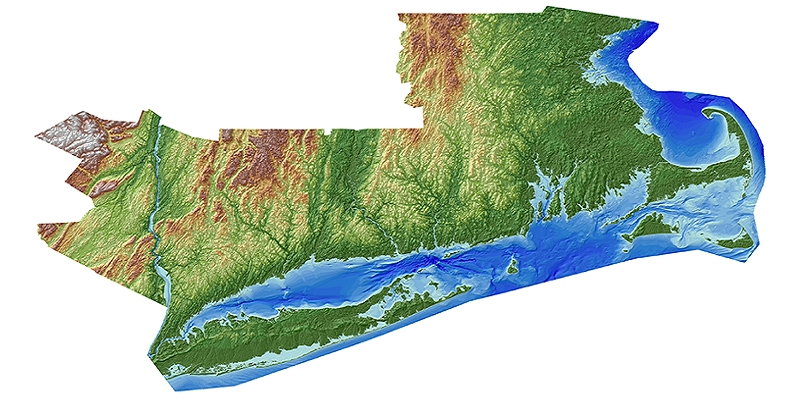
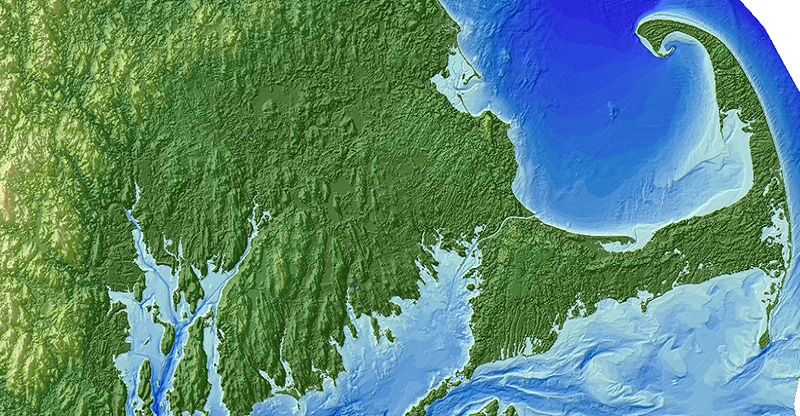
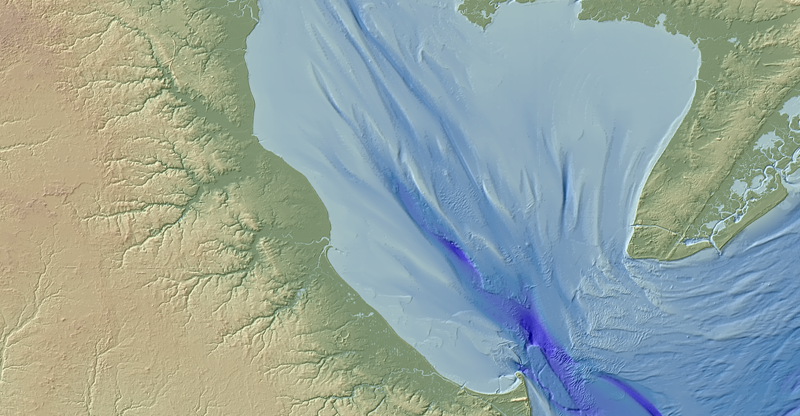
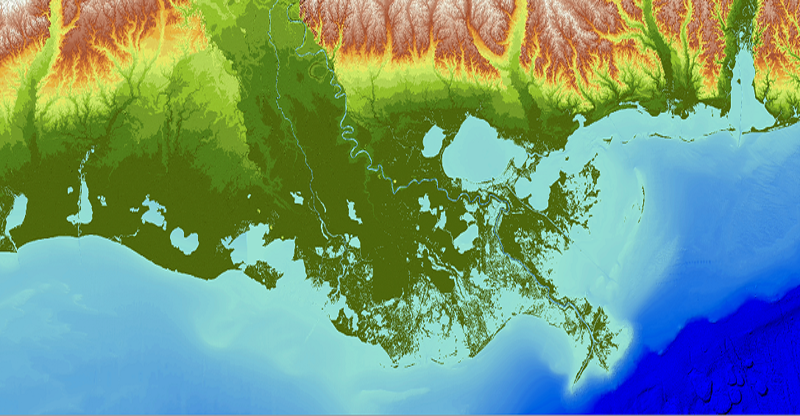
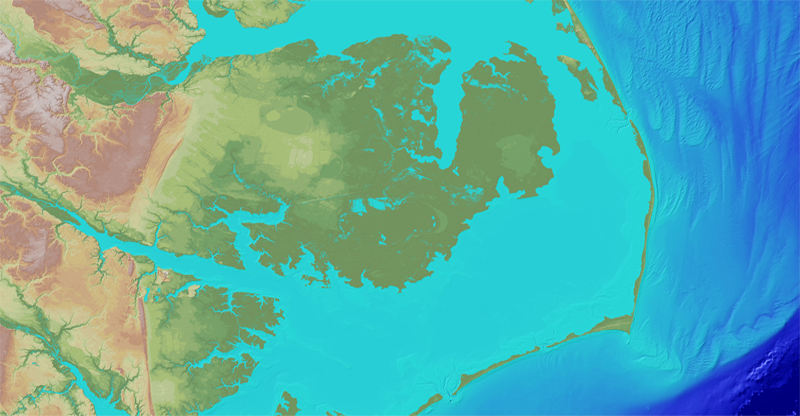
The Coastal National Elevation Database (CoNED) Project - topobathymetric digital elevation models (TBDEMs) are merged renderings of both topography (land elevation) and bathymetry (water depth) to provide seamless elevation products for select coastal regions in the United States (2011-present).
USGS EROS Archive - Digital Elevation - Coastal National Elevation Database (CoNED) Project - Topobathymetric Digital Elevation Model (TBDEM)
The Coastal National Elevation Database (CoNED) Project - topobathymetric digital elevation models (TBDEMs) are merged renderings of both topography (land elevation) and bathymetry (water depth) to provide seamless elevation products for select coastal regions in the United States (2011-present).
The Coastal National Elevation Database (CoNED) and Applications project at EROS offers information used for a range of applications analysis needed for climate change analysis.
Coastal National Elevation Database (CoNED) Applications
The Coastal National Elevation Database (CoNED) and Applications project at EROS offers information used for a range of applications analysis needed for climate change analysis.
This study analyzes changes in the extent of land in coastal Louisiana by using an average of 81 datasets (multiple dates of satellite data from 1973 to 2014) for summarizing land and water areas.
Hyper-Temporal Land Area Change Rates in Coastal Louisiana from 1973 to 2015
This study analyzes changes in the extent of land in coastal Louisiana by using an average of 81 datasets (multiple dates of satellite data from 1973 to 2014) for summarizing land and water areas.
More than half of contiguous U.S. coastal wetlands are located along the Gulf Coast. These highly-productive wetlands support many ecosystem goods and services and fish and wildlife habitat. Historically, coastal wetlands have adapted to sea-level changes via lateral and vertical movement on the landscape. As sea levels rise in the future, coastal wetlands will adapt and migrate landward into...
Incorporating Future Change into Current Conservation Planning: Evaluating Wetland Migration along the Gulf Coast under Alternative Sea-Level Rise and Urbanization Scenarios
More than half of contiguous U.S. coastal wetlands are located along the Gulf Coast. These highly-productive wetlands support many ecosystem goods and services and fish and wildlife habitat. Historically, coastal wetlands have adapted to sea-level changes via lateral and vertical movement on the landscape. As sea levels rise in the future, coastal wetlands will adapt and migrate landward into...
More than half of contiguous U.S. coastal wetlands are located along the Gulf Coast. These highly-productive wetlands support many ecosystem goods and services and fish and wildlife habitat. Historically, coastal wetlands have adapted to sea-level changes via lateral and vertical movement on the landscape. As sea levels rise in the future, coastal wetlands will adapt and migrate landward into...
Incorporating Future Change into Current Conservation Planning: Evaluating Wetland Migration along the Gulf Coast under Alternative Sea-Level Rise and Urbanization Scenarios
More than half of contiguous U.S. coastal wetlands are located along the Gulf Coast. These highly-productive wetlands support many ecosystem goods and services and fish and wildlife habitat. Historically, coastal wetlands have adapted to sea-level changes via lateral and vertical movement on the landscape. As sea levels rise in the future, coastal wetlands will adapt and migrate landward into...
More than half of contiguous U.S. coastal wetlands are located along the Gulf Coast. These highly-productive wetlands support many ecosystem goods and services and fish and wildlife habitat. Historically, coastal wetlands have adapted to sea-level changes via lateral and vertical movement on the landscape. As sea levels rise in the future, coastal wetlands will adapt and migrate landward into...
Incorporating Future Change into Current Conservation Planning: Evaluating Wetland Migration along the Gulf Coast under Alternative Sea-Level Rise and Urbanization Scenarios
More than half of contiguous U.S. coastal wetlands are located along the Gulf Coast. These highly-productive wetlands support many ecosystem goods and services and fish and wildlife habitat. Historically, coastal wetlands have adapted to sea-level changes via lateral and vertical movement on the landscape. As sea levels rise in the future, coastal wetlands will adapt and migrate landward into...
Water is a key ecosystem service that provides life to vegetation, animals, and human communities. The distribution and flow of water on a landscape influences many ecological functions, such as the distribution and health of vegetation and soil development and function. However, the future of many important water resources remains uncertain. Reduced snowfall and snowpack, earlier spring...
Projecting the Future Distribution and Flow of Water in Alaskan Coastal Forest Watersheds
Water is a key ecosystem service that provides life to vegetation, animals, and human communities. The distribution and flow of water on a landscape influences many ecological functions, such as the distribution and health of vegetation and soil development and function. However, the future of many important water resources remains uncertain. Reduced snowfall and snowpack, earlier spring runoff
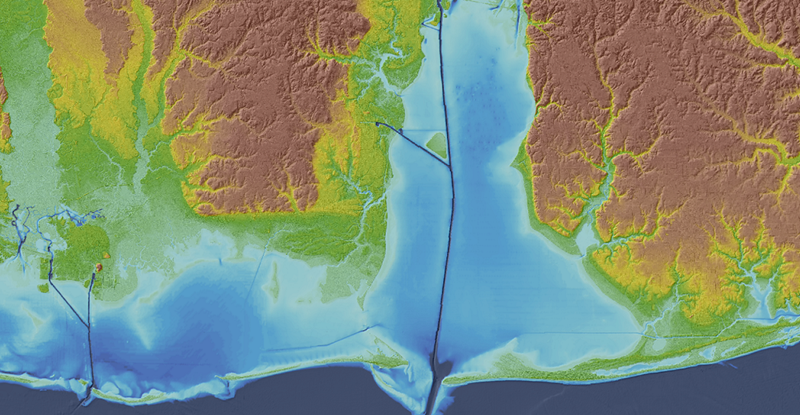
The Grand Bay National Estuarine Research Reserve (NERR) in southern Mississippi was established to provide recreational and educational opportunities along with facilitating science-based coastal management; therefore, Grand Bay is the subject of numerous short and long-term environmental studies. The reserve is an important location for research and conservation.
The Herring River in Wellfleet, MA is a tidally-restricted estuary system. Management options including potential restoration of unrestricted tidal flows require an understanding of pre-restoration sediment conditions. Altering future tidal flows may cause changes in net sediment flux and direction, which could affect marsh restoration and aquaculture in Wellfleet Harbor. This research...
There are two idealized domains developed in this work to test the marsh dynamics in the COAWST modeling framework. 1. First idealized domain is to test and verify the lateral thrust calculations. 2. Second idealized domain is to test the implementation of lateral retreat formulations.
This map shows the unvegetated and vegetated area of coastal wetlands and adjacent land (inland and shorelines) for the Conterminous United States computed from 2014-2018 Landsat imagery at ~30 meter horizontal resolution.
The Coastal National Elevation Database (CoNED) Project Viewer is a portal to the topobathymetric models created with the expertise of the expertise of the U.S. Geological Survey Earth Resources Observation and Science (EROS) Center near Sioux Falls, SD.
Coastal wetlands and estuaries connect lands and watersheds to the ocean. They are biologically and physically dynamic and are among the most productive and valuable ecosystems in the world. Many different types of USGS scientists work together to increase our understanding of these ecosystems under past, present and future conditions, and how human activities influence them.
What is a coastal wetland?
Coastal wetlands are transitional areas between dry land and open water that are either permanently or seasonally inundated with fresh, brackish, or salt water. They contain a range of plant and animal species that are uniquely adapted to the wet soil conditions, the type of water present, and the degree of inundation.
Types of coastal wetlands include salt marshes, freshwater marshes, seagrass meadows, mangrove swamps, and forested swamps.
Coastal wetlands are among the most productive and valuable ecosystems in the world—comparable to even rainforests and coral reefs. They are often referred to as natural sponges or nature’s kidneys because they slow the flow of water across the watershed, filter out pollutants and excess nutrients, and even absorb and store large quantities of the greenhouse gas carbon dioxide. These capabilities help protect coastal communities from storms and flooding, prevent erosion, improve water quality, and decrease the effects of climate change. Listen to the audio-described version.
What is an estuary?
Estuaries are created where watersheds meet the ocean, bringing land-based waters and salt water from the ocean together. A dynamic ecosystem is created where river flows meet ocean tides. These regions offer food sources and shelter for many different species, including humans.
Estuaries also face a variety of issues that alter their productivity as an ecosystem—many related to the watershed that supplies water from the mainland, including:
USGS studies coastal wetlands and estuaries around the Nation. Here are just a few examples.
Why are coastal wetlands and estuaries important?
Some of America’s largest cities and communities are located along wetlands and estuaries, such as New York-New Jersey Harbor, Chesapeake Bay, San Francisco Bay, Biscayne Bay, Puget Sound, Tampa Bay, and many others. Coastal wetlands and estuaries provide numerous critical benefits and services to society—these are known as ecosystem services. Specifically, they:
Protect coastal communities from storms and flooding
Help prevent erosion
Provide essential food, refuge, and nursery habitat for commercially and recreationally important species
Improve water quality by filtering runoff and absorbing excess nutrients
Decrease the effects of climate change by storing large quantities of the greenhouse gas carbon dioxide from the atmosphere
Provide recreational opportunities like boating, hiking, hunting, fishing, kayaking, and wildlife/bird watching
Serve as important areas of commerce, shipping activity, and ocean/port access
USGS Research
Estuaries are the mixing point between land and coasts. The water that flows into them is critical to their high biological productivity. Changes to the quality, quantity, and type of water, sediment, and river flow affect everything from the types of plants and animals that live there, the landscapes that develop, and the ecosystem services provided to coastal communities.
USGS scientists work in and bring expertise in hydrology, water chemistry, ecology, and sediment transport science, to integrate various information that can help forecast, predict, and identify threats or effects of changes. This helps decision-makers and resources managers develop science-based policies that balance sustainable use of these rich coastal ecosystems while maintaining their productivity for the benefit of all.
Salt marshes provide important economic and ecologic services but are vulnerable to habitat loss, particularly due to shoreline erosion from storms and sea level rise. Sediments eroded at the marsh edge are either delivered onto the marsh platform or into the estuary, the latter resulting in a net loss to the marsh sediment budget and released soil carbon. Knowledge on the timing, distance, and quantity of sediment deposition versus shoreline erosion along the marsh-estuary interface is critical for evaluating the overall health and vulnerability of coastal marshes to future scenarios of sea level rise and storms. This image is a depiction of what happens to sediments as they are eroded at the marsh edge, delivered into the estuary and onto the marsh platform, leading to a higher marsh platform elevation at the marsh shoreline, but loss of wetland habitat area at the eroding shoreline edge.
Storms, sea-level rise, and other elements of climate and coastal change often involve coastal engineering in order to accommodate human needs. These natural systems are highly adaptable. Many plant and animal species can move and grow in response to changing conditions, but some management actions like building coastal defense structures (e.g., seawalls and dikes) and maintaining roads restrict the ability of these coastal ecosystems to adapt or migrate. When estuaries and coastal wetlands are constrained by seawalls or unable to move, they can be inundated, dried out or exposed to too much salt or fresh water. When they are depleted or destroyed, the benefits and services they provide to people and the environment could be diminished or lost. The loss of estuary and wetland health can have far-reaching effects such as reduced fish catch, diminished water quality, algal blooms, and lost habitat and food sources for many migratory species.
Graphic showing how drought can impact coastal estuarine ecosystems in the U.S. Caribbean.
The USGS conducts a variety of research on coastal wetlands and estuaries that support management decisions of federal, state, regional, and local partners and help in evaluating the effectiveness of restoring these valuable habitats so that will continue to provide the most benefits to society and ecosystems.
The USGS creates topobathymetric digital elevation models (DEMs) to assist with identifying flood, hurricane, and sea-level rise inundation hazard zones. These maps also assist with other earth science applications such as the development of sediment transport and storm surge models. The DEM data are important for a range of applications needed for climate change analysis in sensitive coastal regions. Access the Coastal National Elevation Database (CoNED) viewer.
Past, Present, and Future Conditions
USGS scientists collect basic observational data on physical processes (e.g., storms and sea-level rise) and human activities (e.g., nutrient loading), develop numerical models of these data, and apply models to understand the past, present, and future states of these ecosystems. Through this work, USGS scientists can assess vulnerability (e.g., UnVegetated-Vegetated marsh Ratio or UVVR), water-quality conditions, and resilience and identify human activities that are preventing wetland migration and causing tidal restriction, impoundments, and other issues causing degradation.
Map showing blue carbon study locations in the United States: Nisqually National Wildlife Refuge, San Francisco Bay National Estuarine Research Reserve, Barataria-Terrebonne National Estuary Program, Shark River, Ding Darling National Wildlife Refuge, LCMAP mangrove change detection pilot study, Great Dismal Swamp and Pocosin Lake National Wildlife Refuge, Chesapeake Bay Smithsonian Environmental Research Center, Waquoit Bay National Estuarine Research Reserve.
Blue Carbon
Additionally, USGS scientists are working to better understand blue carbon—carbon that is stored in coastal and marine ecosystems. Terrestrial and aquatic ecosystems can capture and store carbon dioxide from the atmosphere, a process known as carbon sequestration. Though coastal ecosystems, such as wetlands, may be smaller in size when compared to say, a forest, they can sequester more carbon per unit area, making them an incredible climate change mitigation tool.
USGS scientists are researching how environmental changes and human activities (e.g., land use management) can impact the ability of coastal wetlands and estuaries to sequester carbon and store it in soil and plant materials. These ecosystems are powerful carbon sinks and store carbon that has accumulated over hundreds to thousands of years. However, when coastal ecosystems are degraded or destroyed, their capacity to store carbon is diminished, and the carbon stored there can be released back into the atmosphere. Improved management of coastal wetlands and estuaries, leading to enhanced conservation and restoration, is therefore a crucial climate change mitigation strategy. Ultimately, USGS blue carbon research and science-based tools will help guide decision-making regarding climate change mitigation and adaptation, wetland restoration, coastal resilience, and carbon sequestration and storage.
Measuring ecosystem-atmosphere carbon exchange at the leaf-level (left) using a porometer and at the ecosystem-level (right) using eddy covariance. Learn more.
Salt marsh systems require a net import of inorganic sediment to maintain their structure in response to sea‐level rise. Marshes are affected by physical processes including tides, waves, sediment transport, and the influence of vegetation, and these processes interact in complex ways leading to sediment accretion or erosion. We implement a 3‐D hydrodynamic sediment transport model in an...
Authors
Rachel M. Allen, Neil K. Ganju, Tarandeep Kalra, Alfredo Aretxabaleta, Jessica R. Lacy
Unoccupied aerial systems (UASs) are increasingly being deployed in coastal environments to rapidly map and monitor changes to geomorphology, vegetation, and infrastructure, particularly in difficult to access areas. UAS data, relative to airplane or satellite data, typically have higher spatial resolution, sensor customization, and increased flexibility in temporal resolution, which...
Authors
Alexandra Danielle Evans, Jennifer Marie Cramer, Victoria Mary Scholl, Erika E. Lentz
Karst subterranean estuaries within globally ubiquitous carbonate aquifers are coastal groundwater ecosystems that provide an essential water resource for human populations. To understand the drivers of salinization within a coastal aquifer in the Yucatan Peninsula (Mexico), we employed hydroacoustics in flooded caves to observe how oceanic and atmospheric events facilitate mixing...
Authors
Neil K. Ganju, John W. Pohlman, Steven E. Suttles, David Brankovits
Coastal salt marshes are crucial ecosystems that provide habitat for a variety of species, improve water quality, and play a major role in the global carbon cycle. However, many salt marshes have been severely damaged by human activities such as diking and draining for urban development. Recently, there has been a noticeable shift toward the prioritization of coastal marsh restoration to...
Authors
Kasra Naseri, Michelle A. Hummel, Kevin M. Befus, Timothy P. Smith, Meagan J. Eagle, Kevin D. Kroeger
The U.S. Geological Survey collected water velocity and water quality data from salt marshes in Great Channel, southwest of Stone Harbor, New Jersey, and near Thompsons Beach, New Jersey, to evaluate restoration effectiveness after Hurricane Sandy and monitor postrestoration marsh health. Time series data of turbidity and water velocity were collected from 2018 to 2019 and 2022 to 2023...
Authors
Olivia A. De Meo, Robert D. Bales, Neil K. Ganju, Eric D. Marsjanik, Steven E. Suttles
WARC first implemented geographic information systems (GIS) in 1980 to help monitor the nature and extent of wetland habitat changes. The center continues to use GIS, remote sensing, and other computer based technologies to address a wide range of natural resource related issues.
Spatial Analysis Support for Coastal Wetlands Planning, Protection and Restoration Act (Breaux Bill) Planning Activities
WARC first implemented geographic information systems (GIS) in 1980 to help monitor the nature and extent of wetland habitat changes. The center continues to use GIS, remote sensing, and other computer based technologies to address a wide range of natural resource related issues.
The scientists at the Wetland and Aquatic Science Center (WARC) have provided coastal restoration project managers and decision makers with GIS planning, database and custom application capacity since 1992. The scope and complexity of this support has increased over the years and has resulted in the development of a comprehensive geospatial and advanced application teams that provide decision...
GIS and Custom Application Support for the Gulf Coast Ecosystem Restoration Council
The scientists at the Wetland and Aquatic Science Center (WARC) have provided coastal restoration project managers and decision makers with GIS planning, database and custom application capacity since 1992. The scope and complexity of this support has increased over the years and has resulted in the development of a comprehensive geospatial and advanced application teams that provide decision...
The San Francisco Bay-Delta PES is one way that USGS continues to provide science for the restoration and conservation of the SF Bay and its watershed. USGS research topics range from wetland restoration in the Bay to restoring habitat for anadromous fish (e.g., salmon) in the uplands. USGS has made several important discoveries critical to the fundamental understanding of this system and...
The San Francisco Bay-Delta PES is one way that USGS continues to provide science for the restoration and conservation of the SF Bay and its watershed. USGS research topics range from wetland restoration in the Bay to restoring habitat for anadromous fish (e.g., salmon) in the uplands. USGS has made several important discoveries critical to the fundamental understanding of this system and...
Our research goals are to provide the scientific information, knowledge, and tools required to ensure that decisions about land and resource use, management practices, and future development in the coastal zone and adjacent watersheds can be evaluated with a complete understanding of the probable effects on coastal ecosystems and communities, and a full assessment of their vulnerability to natural...
Our research goals are to provide the scientific information, knowledge, and tools required to ensure that decisions about land and resource use, management practices, and future development in the coastal zone and adjacent watersheds can be evaluated with a complete understanding of the probable effects on coastal ecosystems and communities, and a full assessment of their vulnerability to natural...
A Pacific Northwest icon, Puget Sound is the second-largest estuary in the United States. Its unique geology, climate, and nutrient-rich waters produce and sustain biologically productive coastal habitats. These same natural characteristics also contribute to a high quality of life that has led to growth in human population and urbanization. This growth has played a role in degrading the Sound...
A Pacific Northwest icon, Puget Sound is the second-largest estuary in the United States. Its unique geology, climate, and nutrient-rich waters produce and sustain biologically productive coastal habitats. These same natural characteristics also contribute to a high quality of life that has led to growth in human population and urbanization. This growth has played a role in degrading the Sound...
Marsh lateral shoreline erosion and shore-proximal sediment deposition
Salt marshes provide important economic and ecologic services but are vulnerable to habitat loss, particularly due to shoreline erosion from storms and sea level rise. Sediments eroded at the marsh edge are either delivered onto the marsh platform or into the estuary, the latter resulting in a net loss to the marsh sediment budget and released soil carbon.
Salt marshes provide important economic and ecologic services but are vulnerable to habitat loss, particularly due to shoreline erosion from storms and sea level rise. Sediments eroded at the marsh edge are either delivered onto the marsh platform or into the estuary, the latter resulting in a net loss to the marsh sediment budget and released soil carbon.
Tidal Marshland in the Plum Island Estuary, Massachusetts
The marshes of Plum Island Estuary are among those predicted by scientists to submerge during the next century under conservative projections of sea-level rise.
The marshes of Plum Island Estuary are among those predicted by scientists to submerge during the next century under conservative projections of sea-level rise.
Scientists at the U.S. Geological Survey Wetland and Aquatic Research Center (www.usgs.gov/warc) study important aspects of wetlands, such as the flow and quality of water, the chemistry of soil, and the plants and animals which call this ecosystem home.
Scientists at the U.S. Geological Survey Wetland and Aquatic Research Center (www.usgs.gov/warc) study important aspects of wetlands, such as the flow and quality of water, the chemistry of soil, and the plants and animals which call this ecosystem home.
Scientists at the U.S. Geological Survey Wetland and Aquatic Research Center study important aspects of wetlands, such as the flow and quality of water, the chemistry of soil, and the plants and animals which call this ecosystem home.
Scientists at the U.S. Geological Survey Wetland and Aquatic Research Center study important aspects of wetlands, such as the flow and quality of water, the chemistry of soil, and the plants and animals which call this ecosystem home.
The Greater Everglades Ecosystem covers much of south Florida, and the highest areas are only a few meters above sea level. Predictions of sea level rise and changes in storm intensity for the 21st century are particularly concerning to the urban population of Miami and the east coast, but also represent a challenge to Everglades National Park and Biscayne National Park resource managers. The...
Sea Level Rise and Climate: Impacts on the Greater Everglades Ecosystem and Restoration
The Greater Everglades Ecosystem covers much of south Florida, and the highest areas are only a few meters above sea level. Predictions of sea level rise and changes in storm intensity for the 21st century are particularly concerning to the urban population of Miami and the east coast, but also represent a challenge to Everglades National Park and Biscayne National Park resource managers. The...
The Coastal National Elevation Database (CoNED) Project - topobathymetric digital elevation models (TBDEMs) are merged renderings of both topography (land elevation) and bathymetry (water depth) to provide seamless elevation products for select coastal regions in the United States (2011-present).
USGS EROS Archive - Digital Elevation - Coastal National Elevation Database (CoNED) Project - Topobathymetric Digital Elevation Model (TBDEM)
The Coastal National Elevation Database (CoNED) Project - topobathymetric digital elevation models (TBDEMs) are merged renderings of both topography (land elevation) and bathymetry (water depth) to provide seamless elevation products for select coastal regions in the United States (2011-present).
The Coastal National Elevation Database (CoNED) and Applications project at EROS offers information used for a range of applications analysis needed for climate change analysis.
Coastal National Elevation Database (CoNED) Applications
The Coastal National Elevation Database (CoNED) and Applications project at EROS offers information used for a range of applications analysis needed for climate change analysis.
This study analyzes changes in the extent of land in coastal Louisiana by using an average of 81 datasets (multiple dates of satellite data from 1973 to 2014) for summarizing land and water areas.
Hyper-Temporal Land Area Change Rates in Coastal Louisiana from 1973 to 2015
This study analyzes changes in the extent of land in coastal Louisiana by using an average of 81 datasets (multiple dates of satellite data from 1973 to 2014) for summarizing land and water areas.
More than half of contiguous U.S. coastal wetlands are located along the Gulf Coast. These highly-productive wetlands support many ecosystem goods and services and fish and wildlife habitat. Historically, coastal wetlands have adapted to sea-level changes via lateral and vertical movement on the landscape. As sea levels rise in the future, coastal wetlands will adapt and migrate landward into...
Incorporating Future Change into Current Conservation Planning: Evaluating Wetland Migration along the Gulf Coast under Alternative Sea-Level Rise and Urbanization Scenarios
More than half of contiguous U.S. coastal wetlands are located along the Gulf Coast. These highly-productive wetlands support many ecosystem goods and services and fish and wildlife habitat. Historically, coastal wetlands have adapted to sea-level changes via lateral and vertical movement on the landscape. As sea levels rise in the future, coastal wetlands will adapt and migrate landward into...
More than half of contiguous U.S. coastal wetlands are located along the Gulf Coast. These highly-productive wetlands support many ecosystem goods and services and fish and wildlife habitat. Historically, coastal wetlands have adapted to sea-level changes via lateral and vertical movement on the landscape. As sea levels rise in the future, coastal wetlands will adapt and migrate landward into...
Incorporating Future Change into Current Conservation Planning: Evaluating Wetland Migration along the Gulf Coast under Alternative Sea-Level Rise and Urbanization Scenarios
More than half of contiguous U.S. coastal wetlands are located along the Gulf Coast. These highly-productive wetlands support many ecosystem goods and services and fish and wildlife habitat. Historically, coastal wetlands have adapted to sea-level changes via lateral and vertical movement on the landscape. As sea levels rise in the future, coastal wetlands will adapt and migrate landward into...
More than half of contiguous U.S. coastal wetlands are located along the Gulf Coast. These highly-productive wetlands support many ecosystem goods and services and fish and wildlife habitat. Historically, coastal wetlands have adapted to sea-level changes via lateral and vertical movement on the landscape. As sea levels rise in the future, coastal wetlands will adapt and migrate landward into...
Incorporating Future Change into Current Conservation Planning: Evaluating Wetland Migration along the Gulf Coast under Alternative Sea-Level Rise and Urbanization Scenarios
More than half of contiguous U.S. coastal wetlands are located along the Gulf Coast. These highly-productive wetlands support many ecosystem goods and services and fish and wildlife habitat. Historically, coastal wetlands have adapted to sea-level changes via lateral and vertical movement on the landscape. As sea levels rise in the future, coastal wetlands will adapt and migrate landward into...
Water is a key ecosystem service that provides life to vegetation, animals, and human communities. The distribution and flow of water on a landscape influences many ecological functions, such as the distribution and health of vegetation and soil development and function. However, the future of many important water resources remains uncertain. Reduced snowfall and snowpack, earlier spring...
Projecting the Future Distribution and Flow of Water in Alaskan Coastal Forest Watersheds
Water is a key ecosystem service that provides life to vegetation, animals, and human communities. The distribution and flow of water on a landscape influences many ecological functions, such as the distribution and health of vegetation and soil development and function. However, the future of many important water resources remains uncertain. Reduced snowfall and snowpack, earlier spring runoff
The Grand Bay National Estuarine Research Reserve (NERR) in southern Mississippi was established to provide recreational and educational opportunities along with facilitating science-based coastal management; therefore, Grand Bay is the subject of numerous short and long-term environmental studies. The reserve is an important location for research and conservation.
The Herring River in Wellfleet, MA is a tidally-restricted estuary system. Management options including potential restoration of unrestricted tidal flows require an understanding of pre-restoration sediment conditions. Altering future tidal flows may cause changes in net sediment flux and direction, which could affect marsh restoration and aquaculture in Wellfleet Harbor. This research...
There are two idealized domains developed in this work to test the marsh dynamics in the COAWST modeling framework. 1. First idealized domain is to test and verify the lateral thrust calculations. 2. Second idealized domain is to test the implementation of lateral retreat formulations.
This map shows the unvegetated and vegetated area of coastal wetlands and adjacent land (inland and shorelines) for the Conterminous United States computed from 2014-2018 Landsat imagery at ~30 meter horizontal resolution.
The Coastal National Elevation Database (CoNED) Project Viewer is a portal to the topobathymetric models created with the expertise of the expertise of the U.S. Geological Survey Earth Resources Observation and Science (EROS) Center near Sioux Falls, SD.