



Andrea Tokranov (USGS New England Water Science Center) collecting soil samples for PFAS analysis for study “PFAS Partitioning to Soils and Biosolids in New Hampshire” in cooperation with the New Hampshire Department of Environmental Services.
Andrea Tokranov
Andrea Tokranov is a Research Hydrologist in the New England Water Science Center and a Researcher in the Environmental Health Program of the Ecosystems Mission Area.
Andrea studies the fate, transport, and ecosystem exposure and effects of per- and polyfluoroalkyl substances (PFAS). She also manages the PFAS laboratory for biological matrices, which uses high resolution mass spectrometry for targeted and non-targeted analysis of PFAS.
Science and Products
Not All PFAS Are Alike: Fish Responses Reveal The Importance Of Real-World Mixtures
A USGS study demonstrates the importance of monitoring not just the amount of PFAS in groundwater, but the PFAS mixture present. Building on two decades of experience conducting mobile laboratory experiments, USGS researchers applied this approach at a contaminated fire training area to evaluate how fish respond to complex PFAS mixtures, providing important scientific evidence that can improve how...
Statewide Studies of PFAS in Connecticut
The U.S. Geological Survey (USGS) New England Water Science Center, in cooperation with the Connecticut Department of Economic and Community Development (CT DECD) and the Connecticut Department of Energy and Environmental Protection (CT DEEP), is investigating the occurrence of per- and polyfluoroalkyl substances (PFAS) in soils and shallow groundwater across the state of Connecticut. The studies...

Effective Communication in PFAS Research: Moving Beyond "Ubiquitous"
In recent years, per- and polyfluoroalkyl substances (PFAS), have gained attention for their environmental presence; however, the term "ubiquitous" used to describe them can be misleading. USGS scientists push to use more precise language such as "widespread" and “commonly detected” to avoid confusion and misinformation. This distinction is crucial for understanding the actual occurrence of PFAS...

Understanding the Dynamics of Per- and Polyfluoroalkyl Substances (PFAS): Insights from USGS Research
The USGS Environmental Health (EH) Program research where per- and polyfluoroalkyl substances PFAS are found, how they move and change in the environment, how they might affect both ecosystems and human health, and ways to reduce their impact. The three teams focusing on these issues within the EH Program include: 1) the PFAS Integrated Science Team, 2) the PFAS Core Technology Team, and 3) the...
A National Predictive Model for PFAS Occurrence in Groundwater
In October of 2024, USGS Scientist’s published a study where they created a model to predict PFAS occurrence in groundwater at the depths of drinking water supplies. This model can help guide our partners to sample areas where PFAS in drinking water could be an issue for the public.
By
Ecosystems Mission Area, Water Resources Mission Area, Contaminant Biology, Environmental Health Program, Toxic Substances Hydrology, California Water Science Center, Eastern Ecological Science Center, Lower Mississippi-Gulf Water Science Center, New England Water Science Center, New Jersey Water Science Center, New Mexico Water Science Center, New York Water Science Center, Pennsylvania Water Science Center, South Atlantic Water Science Center (SAWSC), Western Ecological Research Center (WERC)
Per- and Polyfluoroalkyl Substance (PFAS) Core Technology Team
The Per- and Polyfluoroalkyl Substance (PFAS) Core Technology Team (CTT) within the Environmental Health Program partners with external and internal stakeholders to develop and apply analytical methods for measuring PFAS in complex matrices, addressing environmental health issues related to transport, distribution, fate, effects, and exposure.

Research on Per- and Polyfluoroalkyl Substances (PFAS) in the New England Water Science Center
Per- and polyfluoroalkyl substances (PFAS) are a diverse group of over 4,000 different compounds. Since the 1940s, PFAS have been manufactured and used around the globe, including in the United States. PFAS are resistant to chemical and thermal breakdown and impart stain and water-resistance properties, making them useful for a variety of commercial applications, but also persistent in the...

Large Fraction of Unidentified Organofluorine in a Coastal Watershed has Implications for River to Marine Ecosystems
A group of scientists investigated per- and polyfluoroalkyl substances (PFAS) in watersheds on Cape Cod and identified a unique signature for aqueous film forming foams (AFFF) from legacy firefighting and fire training. A combination of statistical modeling and laboratory measurements indicates that unidentified organofluorine constitutes a large fraction of PFAS in the river systems that...

Advanced PFAS Measurement Methods
Environmental Health Program scientists, in collaboration with other USGS scientists, are developing complementary field and laboratory methods and capabilities to detect and quantify a range of target and nontarget per- and polyfluoroalkyl substances (PFAS) and indicator compounds at low levels (parts per trillion) in a variety of environmental matrices. The PFAS Integrated Science Team is...
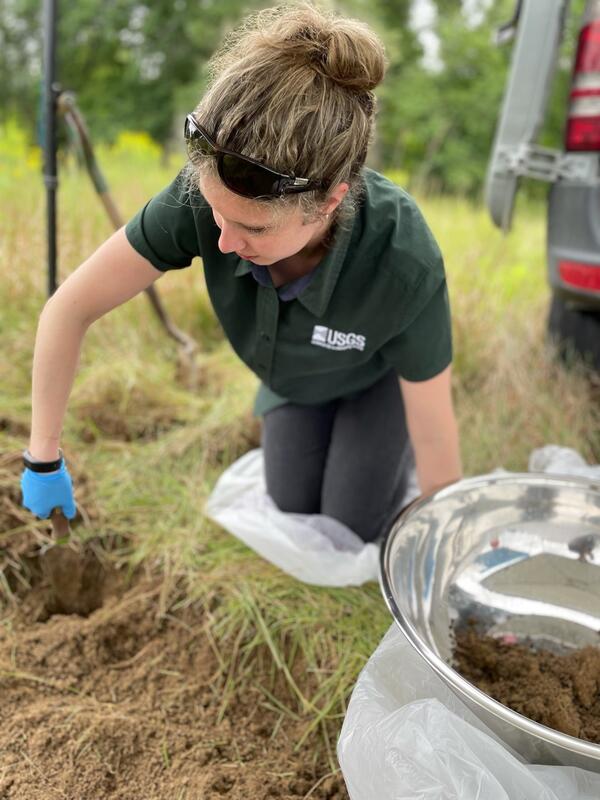
Soil Sampling for PFAS
Andrea Tokranov (USGS New England Water Science Center) collecting soil samples for PFAS analysis for study “PFAS Partitioning to Soils and Biosolids in New Hampshire” in cooperation with the New Hampshire Department of Environmental Services.

USGS Laboratory for the Analysis of Per- and Polyfluoroalkyl Substances (PFAS)
USGS Laboratory for the Analysis of Per- and Polyfluoroalkyl Substances (PFAS)The U.S. Geological Survey laboratory for the analysis of per- and polyfluoroalkyl substances (PFAS) uses cutting-edge techniques to analyze environmental samples including tissues, plasma, water, and soils to undertake and support research projects across the country.

Groundwater sampling for PFAS
USGS scientists sampling groundwater near the top of the water table in a corn field in Concord, New Hampshire.
USGS scientists sampling groundwater near the top of the water table in a corn field in Concord, New Hampshire.

Collecting a sample of soil affected by Per- and Polyfluoroalkyl Substances (PFAS)
Collecting a sample of soil affected by Per- and Polyfluoroalkyl Substances (PFAS)U.S. Geological Survey hydrologic technician collects a sample of soil affected by Per- and Polyfluoroalkyl Substances (PFAS).
Collecting a sample of soil affected by Per- and Polyfluoroalkyl Substances (PFAS)
Collecting a sample of soil affected by Per- and Polyfluoroalkyl Substances (PFAS)U.S. Geological Survey hydrologic technician collects a sample of soil affected by Per- and Polyfluoroalkyl Substances (PFAS).

Scientist standing near a high resolution mass spectrometer
Scientist standing near a high resolution mass spectrometerUSGS scientist standing near the high-resolution mass spectrometer at the U.S. Geological Survey Eastern Ecological Science Center. The instrument will be used for analyses of PFAS in plasma and tissue samples. Any display of trade, firm, or product names is for descriptive purposes only and does not imply endorsement by the U.S. Government.
Science and Products
Not All PFAS Are Alike: Fish Responses Reveal The Importance Of Real-World Mixtures
A USGS study demonstrates the importance of monitoring not just the amount of PFAS in groundwater, but the PFAS mixture present. Building on two decades of experience conducting mobile laboratory experiments, USGS researchers applied this approach at a contaminated fire training area to evaluate how fish respond to complex PFAS mixtures, providing important scientific evidence that can improve how...
Statewide Studies of PFAS in Connecticut
The U.S. Geological Survey (USGS) New England Water Science Center, in cooperation with the Connecticut Department of Economic and Community Development (CT DECD) and the Connecticut Department of Energy and Environmental Protection (CT DEEP), is investigating the occurrence of per- and polyfluoroalkyl substances (PFAS) in soils and shallow groundwater across the state of Connecticut. The studies...
Effective Communication in PFAS Research: Moving Beyond "Ubiquitous"
In recent years, per- and polyfluoroalkyl substances (PFAS), have gained attention for their environmental presence; however, the term "ubiquitous" used to describe them can be misleading. USGS scientists push to use more precise language such as "widespread" and “commonly detected” to avoid confusion and misinformation. This distinction is crucial for understanding the actual occurrence of PFAS...
Understanding the Dynamics of Per- and Polyfluoroalkyl Substances (PFAS): Insights from USGS Research
The USGS Environmental Health (EH) Program research where per- and polyfluoroalkyl substances PFAS are found, how they move and change in the environment, how they might affect both ecosystems and human health, and ways to reduce their impact. The three teams focusing on these issues within the EH Program include: 1) the PFAS Integrated Science Team, 2) the PFAS Core Technology Team, and 3) the...
A National Predictive Model for PFAS Occurrence in Groundwater
In October of 2024, USGS Scientist’s published a study where they created a model to predict PFAS occurrence in groundwater at the depths of drinking water supplies. This model can help guide our partners to sample areas where PFAS in drinking water could be an issue for the public.
By
Ecosystems Mission Area, Water Resources Mission Area, Contaminant Biology, Environmental Health Program, Toxic Substances Hydrology, California Water Science Center, Eastern Ecological Science Center, Lower Mississippi-Gulf Water Science Center, New England Water Science Center, New Jersey Water Science Center, New Mexico Water Science Center, New York Water Science Center, Pennsylvania Water Science Center, South Atlantic Water Science Center (SAWSC), Western Ecological Research Center (WERC)
Per- and Polyfluoroalkyl Substance (PFAS) Core Technology Team
The Per- and Polyfluoroalkyl Substance (PFAS) Core Technology Team (CTT) within the Environmental Health Program partners with external and internal stakeholders to develop and apply analytical methods for measuring PFAS in complex matrices, addressing environmental health issues related to transport, distribution, fate, effects, and exposure.
Research on Per- and Polyfluoroalkyl Substances (PFAS) in the New England Water Science Center
Per- and polyfluoroalkyl substances (PFAS) are a diverse group of over 4,000 different compounds. Since the 1940s, PFAS have been manufactured and used around the globe, including in the United States. PFAS are resistant to chemical and thermal breakdown and impart stain and water-resistance properties, making them useful for a variety of commercial applications, but also persistent in the...
Large Fraction of Unidentified Organofluorine in a Coastal Watershed has Implications for River to Marine Ecosystems
A group of scientists investigated per- and polyfluoroalkyl substances (PFAS) in watersheds on Cape Cod and identified a unique signature for aqueous film forming foams (AFFF) from legacy firefighting and fire training. A combination of statistical modeling and laboratory measurements indicates that unidentified organofluorine constitutes a large fraction of PFAS in the river systems that...
Advanced PFAS Measurement Methods
Environmental Health Program scientists, in collaboration with other USGS scientists, are developing complementary field and laboratory methods and capabilities to detect and quantify a range of target and nontarget per- and polyfluoroalkyl substances (PFAS) and indicator compounds at low levels (parts per trillion) in a variety of environmental matrices. The PFAS Integrated Science Team is...
Soil Sampling for PFAS
Andrea Tokranov (USGS New England Water Science Center) collecting soil samples for PFAS analysis for study “PFAS Partitioning to Soils and Biosolids in New Hampshire” in cooperation with the New Hampshire Department of Environmental Services.
Andrea Tokranov (USGS New England Water Science Center) collecting soil samples for PFAS analysis for study “PFAS Partitioning to Soils and Biosolids in New Hampshire” in cooperation with the New Hampshire Department of Environmental Services.
USGS Laboratory for the Analysis of Per- and Polyfluoroalkyl Substances (PFAS)
USGS Laboratory for the Analysis of Per- and Polyfluoroalkyl Substances (PFAS)The U.S. Geological Survey laboratory for the analysis of per- and polyfluoroalkyl substances (PFAS) uses cutting-edge techniques to analyze environmental samples including tissues, plasma, water, and soils to undertake and support research projects across the country.
Groundwater sampling for PFAS
USGS scientists sampling groundwater near the top of the water table in a corn field in Concord, New Hampshire.
USGS scientists sampling groundwater near the top of the water table in a corn field in Concord, New Hampshire.
Collecting a sample of soil affected by Per- and Polyfluoroalkyl Substances (PFAS)
Collecting a sample of soil affected by Per- and Polyfluoroalkyl Substances (PFAS)U.S. Geological Survey hydrologic technician collects a sample of soil affected by Per- and Polyfluoroalkyl Substances (PFAS).
Collecting a sample of soil affected by Per- and Polyfluoroalkyl Substances (PFAS)
Collecting a sample of soil affected by Per- and Polyfluoroalkyl Substances (PFAS)U.S. Geological Survey hydrologic technician collects a sample of soil affected by Per- and Polyfluoroalkyl Substances (PFAS).
Scientist standing near a high resolution mass spectrometer
Scientist standing near a high resolution mass spectrometerUSGS scientist standing near the high-resolution mass spectrometer at the U.S. Geological Survey Eastern Ecological Science Center. The instrument will be used for analyses of PFAS in plasma and tissue samples. Any display of trade, firm, or product names is for descriptive purposes only and does not imply endorsement by the U.S. Government.