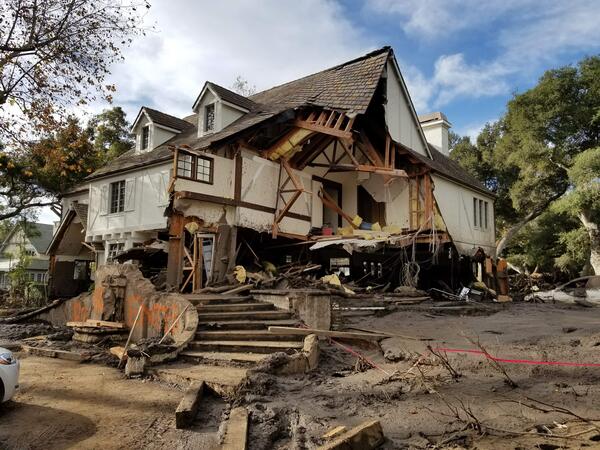
Geologists assess boulders displaced during the Montecito debris flow event on Jan. 9, 2018.
Images
Images
Geologists assess boulders displaced during the Montecito debris flow event on Jan. 9, 2018.
Swimming pool sign spray-painted to warn first responders and others to be careful around the potentially dangerous area.
USGS scientist Margaret Lamont measures a Kemp’s ridley sea turtle recovered from the cold waters of St. Joseph Bay. Rescued sea turtles are weighed, measured andmarked with an identifier, and are examined to determine if they need medical attention. Photo by USGS.
USGS scientist Margaret Lamont, who has studied sea turtles in Florida since 1995, carries a cold-stunned green sea turtle from the mud flats of St. Joseph Bay. Photo by USGS.
Field water-level monitoring gage EDEN 13. Photograph by Michael Oliver, U.S. Geological Survey.
U.S. Geological Survey Fact Sheet 2017–3069
Version 1.1, January 2018
Field water-level monitoring gage EDEN 13. Photograph by Michael Oliver, U.S. Geological Survey.
U.S. Geological Survey Fact Sheet 2017–3069
Version 1.1, January 2018
Scientists and volunteers use nets to scoop the immobile sea turtles out of St. Joseph Bay before transporting them to safety. Photo by USGS.
Eglin Air Force Base biologist Kathy Gault (left) and Dave Seay (right), a contract biologist working with the USGS, hauled cold-stunned sea turtles to safety along the icy shore of Cape San Blas. Scientists and licensed volunteers walked the beaches and marshes, loading cold-stunned sea turtles into kayaks.
When water temperatures drop below 50 degrees Fahrenheit (10 degrees Celsius), cold-blooded sea turtles, like this Kemp’s ridley, can become cold-stunned. They are unable to swim or even raise their heads out of the water to breathe, which can lead to drowning. Photo by Margaret Lamont, USGS
David Seay, a contract biologist working with the USGS, holds a green sea turtle that is recovering from the effects of cold-stunning in St. Joseph Bay. Photo by Margaret Lamont, USGS.
USGS scientists Daniel Catizone (left) and David Seay (center) joined federal and state workers and volunteers in rescuing an estimated 1,000 cold-stunned sea turtles, making this the second largest sea turtle rescue of the 21st century. Photo by Margaret Lamont, USGS
As floodwaters recede, USGS scientists document high water marks, which include debris carried by flood water. The USGS Flood Inundation Mapper incorporates data about past flooding on Lake Ontario’s New York shoreline, including high water marks. Photo by Jared Marion, USGS.
Technicians prepare to board a boat to measure water flow.
Technicians prepare to board a boat to measure water flow.USGS technicians prepare to board a boat to go out to the center of the channel in the San Joaquin River below Friant Dam to get an accurate measurement of water flow during releases from the Dam for flood control.
Technicians prepare to board a boat to measure water flow.
Technicians prepare to board a boat to measure water flow.USGS technicians prepare to board a boat to go out to the center of the channel in the San Joaquin River below Friant Dam to get an accurate measurement of water flow during releases from the Dam for flood control.
This image shows a sea lamprey in its larvae phase.
Green sea turtles are listed as threatened or endangered throughout their range. (Credit: Thierry Work, USGS)
Gila monsters are one of only two venomous lizard species in the world. They live in the southwestern U.S. and in Mexico. This animated GIF comes from a video that short features USGS Emeritus Research Ecologist, Cecil Schwalbe describing details of Gila monster biology and ecology and how he survived a very painful Gila monster bite.
This photomicrograph shows a liver of a frog with a severe Perkinsea infection.
Documenting landslides in Puerto Rico caused by Hurricane Maria.
Documenting landslides in Puerto Rico caused by Hurricane Maria.Bill Schulz, USGS Research Geologist, takes photographs of Puerto Rican hillsides from a U.S. Army helicopter to document landslides caused by Hurricane Maria.
Documenting landslides in Puerto Rico caused by Hurricane Maria.
Documenting landslides in Puerto Rico caused by Hurricane Maria.Bill Schulz, USGS Research Geologist, takes photographs of Puerto Rican hillsides from a U.S. Army helicopter to document landslides caused by Hurricane Maria.
Coral reefs are prone to phase shifts where they quickly transition from coral-dominated to a uniformity of other organisms, typically algae. The Palmyra Atoll National Wildlife Refuge in the Central Pacific is a unique case where a transition from corals to corallimorphs occurred.
Photograph from page 19 of
A USGS intern preparing to examine a black carp captured from the wild. This fish and others were examined for various aspects of their life history, including age, the environments in which they have lived and whether they were naturally reproduced. Credit: USGS.
Lowering an acoustic Doppler current profiler from a cable way.
Lowering an acoustic Doppler current profiler from a cable way.USGS technicians preparing for a streamflow measurement by lowering an acoustic Doppler current profiler from a cable way on the American River near Fair Oaks, California.
Lowering an acoustic Doppler current profiler from a cable way.
Lowering an acoustic Doppler current profiler from a cable way.USGS technicians preparing for a streamflow measurement by lowering an acoustic Doppler current profiler from a cable way on the American River near Fair Oaks, California.