



Drivers of Ecosystem Change
Restoration Ecology and Species Recovery
Western Fisheries Research Center
Research at the WFRC focuses on the environmental factors responsible for the creation, maintenance, and regulation of fish populations including their interactions in aquatic communities and ecosystems. Within these pages you will find research information on Pacific salmon; western trout, charr, and resident riverine fishes; desert and inland fishes; aquatic ecosystems and their resources.

Peer Reviewed Publications
Peer Reviewed Publications

Dive into our research through our rich and diverse publications.
News
Exclusive: Happy Holidays from the Western Fisheries Research Center!
Exclusive: Happy Holidays from the Western Fisheries Research Center!
Congratulations to Chris Pullano for Winning this Issue's Photo Contest!
Congratulations to Chris Pullano for Winning this Issue's Photo Contest!
Director's Message: To All of Our Partners, Thank You!
Director's Message: To All of Our Partners, Thank You!
Publications
Unveiling a legacy of fish introductions to mountain lakes using historical records and eDNA surveys in a National Park Unveiling a legacy of fish introductions to mountain lakes using historical records and eDNA surveys in a National Park
Across the western United States, introductions of non-native fish into historically fishless mountain lakes have impacted native biota. Understanding the impacts of fish introductions is essential for conservation in Olympic National Park, a Biosphere Reserve. We reconstructed fish plantings using records dating back to 1930, followed by environmental DNA (eDNA) surveys to estimate the...
Roadway runoff induced acute mortality in juvenile coho salmon during spring storm events Roadway runoff induced acute mortality in juvenile coho salmon during spring storm events
Extensive mortalities of adult coho salmon (Oncorhynchus kisutch), often called “Urban Runoff Mortality Syndrome” (URMS), have been documented during the fall in creeks where water quality has been degraded by roadway runoff. The primary cause of mortality is 6PPD-quinone (6PPDQ; N-(1,3-dimethylbutyl)-N′-phenyl-p-phenylenediamine quinone)–an ozone transformation product that forms on all...
Gas bubble trauma progression and mortality in sculpin, threespine stickleback, and Northern pikeminnow Gas bubble trauma progression and mortality in sculpin, threespine stickleback, and Northern pikeminnow
We examined the progression of gas bubble trauma (GBT) and associated mortality in sculpin (Cottus spp.), threespine stickleback (Gasterosteus aculeatus), and Northern pikeminnow (Ptychocheilus oregonensis) exposed to three levels of total dissolved gas (TDG; 120, 125, and 130% saturation) in laboratory experiments. Sculpin were most sensitive to elevated TDG followed by stickleback and...
Science
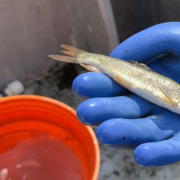
The Science of Suckers: What’s driving population declines in the Klamath River basin?
USGS and its partners are working tirelessly to monitor suckers and understand why they are disappearing from lakes and streams in the Klamath River Basin
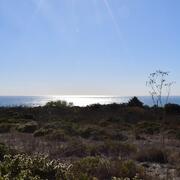
Where land meets sea: USGS science for resilient coastal habitats
USGS coastal science plays a critical role in supporting the effective, science-based management of coastal ecosystems, where the biodiversity of land and sea meet. It provides managers with the information they need to make sound decisions. Through cutting-edge research, predictive modeling, and decision-support tools, USGS empowers resource managers to make informed, science-based choices. From...
By
Core Science Systems Mission Area, Ecosystems Mission Area, Water Resources Mission Area, Cooperative Research Units, Ecosystems Land Change Science Program, Land Management Research Program, Science and Decisions Center, Species Management Research Program, California Water Science Center, Eastern Ecological Science Center, Forest and Rangeland Ecosystem Science Center, Lower Mississippi-Gulf Water Science Center, Pacific Coastal and Marine Science Center, Western Ecological Research Center (WERC), Western Fisheries Research Center, Western Geographic Science Center, Wetland and Aquatic Research Center
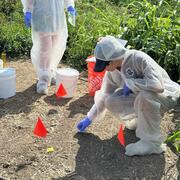
eDNA and the Efficacy of Management Actions
Environmental DNA (eDNA) is a powerful feedback tool, giving managers fast, clear, and cost-effective evidence to guide decisions and improve conservation outcomes.
By
Ecosystems Mission Area, Biological Threats and Invasive Species Research Program, Environmental Health Program, Species Management Research Program, Alaska Science Center, Columbia Environmental Research Center, Eastern Ecological Science Center, Forest and Rangeland Ecosystem Science Center, Fort Collins Science Center, Great Lakes Science Center, National Wildlife Health Center, Northern Prairie Wildlife Research Center, Northern Rocky Mountain Science Center, Pacific Island Ecosystems Research Center, Southwest Biological Science Center, Upper Midwest Environmental Sciences Center, Western Ecological Research Center (WERC), Western Fisheries Research Center, Wetland and Aquatic Research Center , Pacific Northwest Environmental DNA Laboratory