



In the winter of 2015, the public noticed thousands of dead seabirds washing ashore across the western coast of the United States and Canada. The USGS linked this massive seabird die-off to the North Pacific Marine Heatwave. A marine heatwave occurs when sea surface temperatures are above normal for an extended period of time.
Marine Biology and Ecosystems
California Sea Otter Surveys and Research
Coral Reef Project
Aerial Seabird and Marine Mammal Surveys
CASC Fish Research
The ocean is home to a wealth of biodiversity - from invisible-to-the-eye microbes to the larger-than-life megafauna - and unique marine habitat, such as deepwater coral reefs, seamounts, and submarine canyons. USGS science helps inform the management and conservation of marine biodiversity and habitats, from the coastlines down to the deepest trench.
Life in the Sea
From the microscopic plants known as phytoplankton that form the basis of the aquatic food web to the largest animal to ever live on Earth, the blue whale, our oceans are home to a wealth of biodiversity and every organism plays a critical role in the structure and function of this expansive marine environment.
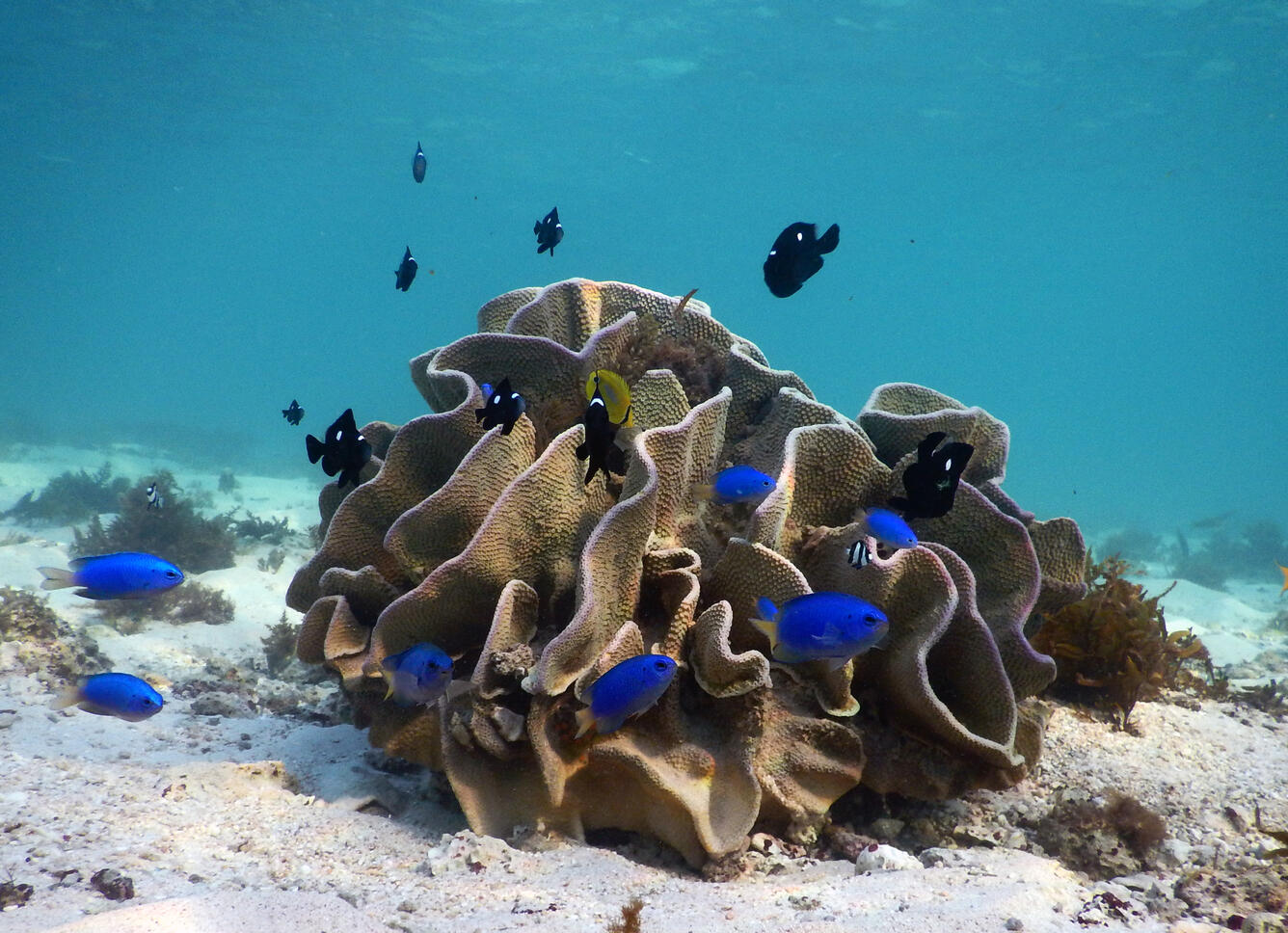


Sources/Usage: Public Domain. View Media Details
Maintaining this biodiversity is important because a healthy ocean provides us with oxygen, helps regulate climate and weather, acts as a source of protein for many people around the world, and provides jobs and opportunities for eco-tourism and recreation. USGS science informs the management and conservation of marine biodiversity and habitats, in both nearshore and deepwater ecosystems.
USGS Role in Marine Ecosystems Research
From the Atlantic to the Pacific and the Gulf Region in between, USGS scientists have implemented a multi-faceted offshore research program that weaves together expertise in a variety of disciplines to investigate nearshore and deepwater ecosystems. This interdisciplinary approach relies on a network of partners from around the Nation and the world to examine microbiology, population genetics, paleoecology, food webs, taxonomy, community ecology, physical oceanography, seafloor characteristics, and submarine hazards in the little explored, yet vital, marine ecosystems.
Media

Wildlife disease: Much like terrestrial species, animals in the ocean have to worry about the spread of disease. USGS scientists across the Nation are working together with various federal and state partners to assess and better understand a novel coral disease that first appeared in stony corals off the coast of Florida in 2014 and has now spread throughout the Caribbean. In Hawaii, USGS scientists are studying the cause and spread of fibropapillomatosis, a disease that leads to tumors growing internally and externally on sea turtles.
Sources/Usage: Public Domain. View Media Details
Media

Wildlife tracking: Understanding the short- and long-distance movements of wildlife, particularly those species that spend most of their life offshore and/or underwater, is critical for a wide variety of ecological research questions and management decisions. The USGS tags and tracks imperiled marine species, such as sea otters, sea turtles, and seabirds to learn about their behavior, migration patterns, and habitat use and areas of high use. This information can help inform the creation of marine protected areas or the development of species management strategies. Several aquatic animals, such as manatees or fishes like Chinook salmon and river herring, can move between fresh and salt water. Tracking their movement can reveal connections between marine and coastal ecosystems and provide insight into the seasonality of mass migrations.
Sources/Usage: Public Domain. View Media Details
Media

Satellite tracking: The satellite tracking map (yellow lines show satellite locations over time) of a loggerhead sea turtle tagged in Florida Keys National Marine Sanctuary. The male turtle traveled to Palm Beach County, Florida for a probable breeding foray during March of 2020.
Sources/Usage: Public Domain. View Media Details
USGS Science in Nearshore Ecosystems
Nearshore systems are the habitats in which most people interact with marine environments, which include seabirds, seagrasses, algae, benthic invertebrates and fish, and top predators that include marine mammals like sharks, sea otters, walruses, and even polar bears. USGS research addresses natural and human-induced changes to this ecosystem and all its components.
Media

Sources/Usage: Public Domain. View Media Details
Exploring Deep-sea Ecosystems
Most life in the ocean exists in surface waters above 200 meters depth where they have access to sunlight. However, even below 200 meters, where little to no sunlight reaches, temperatures drop, and pressure increases, abundant life exists. A diversity of organisms, including fishes, crustaceans, cephalopods, anemones, sea stars, microbes, and even corals make their home in the deep sea. These organisms reside on topographically complex terrain mirroring our terrestrial landscape, dotted with features like trenches, seamounts, canyons, and volcanoes. They also leave behind fossils that help geoscientists construct models of ancient ocean conditions and Earth’s geologic history, as shown in the schematic below.
Media

Sources/Usage: Public Domain. View Media Details
Life at the Bottom of the Ocean
The mention of the seafloor may evoke thoughts of a deep, dark expanse of nothing, but the often-assumed void of life in the deep sea couldn’t be further from the truth. Even with the lack of sunlight, an average temperature of 4 degrees Celsius, and extreme pressures that an unprotected human could not survive, the deep sea is brimming with biodiversity, including deep-sea corals. The DISCOVRE (DIversity, Systematics and COnnectivity of Vulnerable Reef Ecosystems) program investigates unique and fragile deep-sea coral environments from the microscopic level to the ecosystem level. The multi-disciplinary approach has enhanced our understanding of the structure and function of significant biological communities surrounding deep coral reefs off the United States’ coasts.
Media

Sources/Usage: Public Domain. View Media Details
Science

Seabirds and Forage Fish Ecology
Alaska's coastal and offshore waters provide foraging habitat for an estimated 100 million birds comprising more than 90 different species; from loons and seaducks that nest inland, to petrels and puffins that breed on islands off shore. All these birds depend on the sea to provide a wide variety of food types— from clams, crabs and urchins nearshore— to krill, forage fish, and squid offshore. The...

Polar Bear Research
Polar bears ( Ursus maritimus) are one of 4 marine mammal species managed by the U.S. Department of Interior. The USGS Alaska Science Center leads long–term research on polar bears to inform local, state, national and international policy makers regarding conservation of the species and its habitat. Our studies, ongoing since 1985, are focused on population dynamics, health and energetics...

Tracking Data for Tufted Puffins (Fratercula cirrhata)
Available here are tracking data for the tufted puffin, a seabird species that is found only in coastal and offshore areas of the North Pacific Ocean. These data were collected to better understand the migratory patterns of tufted puffins that breed in the Aleutian Islands.

Tracking Data for Pelagic Cormorants (Phalacrocorax pelagicus)
Available here are tracking data for the pelagic cormorant, a seabird species that breeds throughout the northern Pacific Ocean and spends the winter in East Asia and throughout costal portions of western North America. These data were collected to better understand the migratory patterns of Pelagic cormorants that breed in southeast Alaska.

Nearshore Marine Ecosystem Research
Nearshore ecosystems include many resources that are of high ecological, recreational, subsistence, and economic value. They also are subject to influences from a wide variety of natural and human-caused perturbations, which can originate in terrestrial or oceanic environments. Our research is designed to evaluate sources of variation in the nearshore and how they influence resources of high...
Multimedia

North Pacific Marine Heatwave
In the winter of 2015, the public noticed thousands of dead seabirds washing ashore across the western coast of the United States and Canada. The USGS linked this massive seabird die-off to the North Pacific Marine Heatwave. A marine heatwave occurs when sea surface temperatures are above normal for an extended period of time.

Argos Wildlife Tracking Common Eiders - animation
Illustrates where Common Eiders were tracked using Argos Wildlife Tracking.
Illustrates where Common Eiders were tracked using Argos Wildlife Tracking.

Seabirds and Marine Mammals Photographed During Aerial Surveys

Tufted Puffins on the water, Alaska
Four Tufted Puffins on the water, near their breeding colony at Gull Island in Kachemak Bay, Alaska
Four Tufted Puffins on the water, near their breeding colony at Gull Island in Kachemak Bay, Alaska

Fin Whale (Balaenoptera physalus) breaking the surface
Fin Whale (Balaenoptera physalus) breaking the surfaceZoomed image of a Fin Whale (Balaenoptera physalus) breaking the surface.
Fin Whale (Balaenoptera physalus) breaking the surface
Fin Whale (Balaenoptera physalus) breaking the surfaceZoomed image of a Fin Whale (Balaenoptera physalus) breaking the surface.
Fin Whale (Balaenoptera physalus) breaking the surface
Fin Whale (Balaenoptera physalus) breaking the surfaceZoomed image of a Fin Whale (Balaenoptera physalus) breaking the surface.
Fin Whale (Balaenoptera physalus) breaking the surface
Fin Whale (Balaenoptera physalus) breaking the surfaceZoomed image of a Fin Whale (Balaenoptera physalus) breaking the surface.

Argos Wildlife Tracking Pelagic Cormorants - animation
Argos Wildlife Tracking Pelagic Cormorants - animationIllustrates where Pelagic Cormorants were tracked using Argos Wildlife Tracking.
Argos Wildlife Tracking Pelagic Cormorants - animation
Argos Wildlife Tracking Pelagic Cormorants - animationIllustrates where Pelagic Cormorants were tracked using Argos Wildlife Tracking.
Argos Wildlife Tracking Pelagic Cormorants - animation
Argos Wildlife Tracking Pelagic Cormorants - animationIllustrates where Pelagic Cormorants were tracked using Argos Wildlife Tracking.
Argos Wildlife Tracking Pelagic Cormorants - animation
Argos Wildlife Tracking Pelagic Cormorants - animationIllustrates where Pelagic Cormorants were tracked using Argos Wildlife Tracking.

Argos Wildlife Tracking Tufted Puffin animation
Illustrates where Tufted Puffins were tracked using Argos Wildlife Tracking
Illustrates where Tufted Puffins were tracked using Argos Wildlife Tracking
Filter Total Items: 55

Trawling and Sea Turtle Capture Records: A Collaborative Effort between USGS and the U.S. Army Corps of Engineers
USGS is partnering with U.S. Army Corps of Engineers to digitize 20 years of historic sea turtle relocation trawling reports from over 50 sites across nine states.

Beach Compaction and the Impacts of Tilling on Nesting Sea Turtles and Foraging Shorebirds
Researchers are investigating beach compaction, the incubation environment for turtle nests, and shorebird nest abundance at beaches throughout the southeastern United States to better understand the impacts of beach compaction to nesting turtles and foraging seabirds.

Fine-Scale Dive Profiles and Activity Patterns of Sea Turtles in the Gulf
Researchers are developing acceleration data logger pop-off packages that can be affixed to sea turtles to collect behavioral patterns of diving, surfacing, and general activity levels.

Sea Turtle Movement and Habitat Use in the Northern Gulf
The Bureau of Ocean Energy Management (BOEM) uses trawling to capture and relocate live sea turtles away from dredging locations to minimize the risk of turtle entrainment. These incidental turtle captures provide a unique opportunity to fill critical data gaps for difficult to capture life-stages of marine turtles.

CASC Fish Research
The CASC Fish Research Program is a dynamic group of federal researchers and early-career scientists working together to explore the impacts of climate and other stressors on fish and aquatic systems to inform conservation and climate adaptation.

Development of Environmental DNA (eDNA) Detection Tools to Track the Obligate Coral Predator Coralliophila galea to Support Coral Outplant Site Selection
With the support of the Mote Marine Laboratory and Aquarium, USGS researchers will develop and optimize a CRISPR biosensor to detect C. galea eDNA in the field. The development of this tool could assist coral restoration managers and stakeholders to more effectively inform decisions on coral outplant site selection, based on coral predator presence.

California Sea Otter Surveys and Research
WERC collaborates with other research scientists to conduct annual population surveys of the southern sea otter -- a federally listed threatened species. In coordination with the California Department of Fish and Wildlife and other institutions, ongoing surveys and research continues to inform the southern sea otter recovery plan for the U.S. Fish and Wildlife Service, and contributes to our...

Stony Coral Tissue Loss Disease – Investigating Possible Pathogens and Transmission Mechanisms
Coral disease was first documented on Florida reefs in the 1970s. Since then, outbreaks of diseases have increased, and disease is now one major reason why coral reefs worldwide are in decline. Although what causes most coral diseases is not known, the few with known causes have been linked to microorganisms, highlighting the need for studies of microbes associated with diseased corals.

Pacific Marine Heatwave
The USGS conducts research on marine wildlife, habitats, and ecosystem processes to provide science to inform our partners as they make decisions relative to species status, resource use, and human activities. These studies examine impacts of severe heatwaves on marine ecosystems of the North Pacific.

Characterization of Benthic Habitats on the Pacific Margin: Assessing the Connectivity of Hard Substrates, Seeps and Canyon Communities
USGS researchers will characterize the ecology of benthic invertebrates associated with deep-sea environments and broader food-web dynamics within hardground features, seeps, and adjacent soft sediments. This project will provide important information regarding deepwater benthic habitats, such as chemosynthetic communities and deep-sea corals, that could be affected by offshore wind development.

Developing a USGS Digital Coral Growth Archive using Rotating X-Ray Computerized Tomography - The ACTS Project
The Archival Computed Tomography Scanning Project (ACTS) currently develops the USGS Coral Core Archive, housed at the Pacific and St. Petersburg Coastal and Marine Science Centers, that contains approximately 500 coral reef cores from U.S. jurisdictions worldwide. This archive, is one of the largest coral archives in the world and provides historical context for coral-reef science studies...

Exploring Biodiversity of the Deep Hawaiian Pacific Ocean with Seafloor Mapping and eDNA Technologies
Working in partnership with BOEM and the NOAA Ocean Exploration Cooperative Institute, scientists from the USGS will embark on a 10-day voyage to the outer limits of the U.S. Pacific waters south of Hawai’i to conduct seafloor mapping and autonomous environmental DNA sampling in order to investigate and characterize the geology and biology of the Hawaiian abyssal plain.
Filter Total Items: 29

USGS Science Aids Manatees
For nearly four decades, the U.S. Geological Survey's Sirenia Project has been committed to understanding the biology and ecology of the West Indian manatee to aid managers in actions that could best help the population. To do this, USGS manatee researchers rely on a variety of tools and techniques.
For nearly four decades, the U.S. Geological Survey's Sirenia Project has been committed to understanding the biology and ecology of the West Indian manatee to aid managers in actions that could best help the population. To do this, USGS manatee researchers rely on a variety of tools and techniques.

Coral reefs, Kwajalein Atoll, Republic of the Marshall Islands
Coral reefs, Kwajalein Atoll, Republic of the Marshall IslandsUnderwater image of a wave breaking over a coral reef on Kwajalein Atoll in the Republic of the Marshall Islands. This image shows how the high hydrodynamic roughness of live, healthy corals causes friction that induces breaking of waves over coral reefs, reducing wave energy at the shoreline that can cause flooding and island overwash.
Coral reefs, Kwajalein Atoll, Republic of the Marshall Islands
Coral reefs, Kwajalein Atoll, Republic of the Marshall IslandsUnderwater image of a wave breaking over a coral reef on Kwajalein Atoll in the Republic of the Marshall Islands. This image shows how the high hydrodynamic roughness of live, healthy corals causes friction that induces breaking of waves over coral reefs, reducing wave energy at the shoreline that can cause flooding and island overwash.

Tufted Puffin with a meal
Tufted Puffin with a meal flying over the Aleutian Islands
Tufted Puffin with a meal flying over the Aleutian Islands

Red bubblegum coral at 440 meters deep in Norfolk Canyon
Red bubblegum coral at 440 meters deep in Norfolk CanyonRed bubblegum coral (Paragorgia) and several colonies of Primnoa occupy a boulder in close proximity to an anemone and sea star, at approximately 440 meters depth in Norfolk Canyon. Image courtesy of Deepwater Canyons 2013 – Pathways to the Abyss, NOAA-OER/BOEM/USGS
Red bubblegum coral at 440 meters deep in Norfolk Canyon
Red bubblegum coral at 440 meters deep in Norfolk CanyonRed bubblegum coral (Paragorgia) and several colonies of Primnoa occupy a boulder in close proximity to an anemone and sea star, at approximately 440 meters depth in Norfolk Canyon. Image courtesy of Deepwater Canyons 2013 – Pathways to the Abyss, NOAA-OER/BOEM/USGS

Healthy coral reef in the Tumon Bay Marine Preserve
Healthy coral reef in the Tumon Bay Marine PreserveA healthy coral reef in the Tumon Bay Marine Preserve off Tumon, Guam, showing a number of different species of fish swimming over a high coral cover reef composed of a number of hard and soft coral species.
Healthy coral reef in the Tumon Bay Marine Preserve
Healthy coral reef in the Tumon Bay Marine PreserveA healthy coral reef in the Tumon Bay Marine Preserve off Tumon, Guam, showing a number of different species of fish swimming over a high coral cover reef composed of a number of hard and soft coral species.

Sunflower sea star on the seafloor
Photograph of the seafloor off the California coast showing coarse sand, shells, and a sunflower sea star. It was taken during a "ground-truthing" survey off of Salt Point, California, in support of the California Seafloor Mapping Program.
Photograph of the seafloor off the California coast showing coarse sand, shells, and a sunflower sea star. It was taken during a "ground-truthing" survey off of Salt Point, California, in support of the California Seafloor Mapping Program.

Fibropapillomatosis
Hawaiian green sea turtle (Chelonia mydas) with fibropapillomatosis
Hawaiian green sea turtle (Chelonia mydas) with fibropapillomatosis

Fibropapillomatosis
Hawaiian green sea turtle (Chelonia mydas) with fibropapillomatosis
Hawaiian green sea turtle (Chelonia mydas) with fibropapillomatosis
The ocean is home to a wealth of biodiversity - from invisible-to-the-eye microbes to the larger-than-life megafauna - and unique marine habitat, such as deepwater coral reefs, seamounts, and submarine canyons. USGS science helps inform the management and conservation of marine biodiversity and habitats, from the coastlines down to the deepest trench.
Life in the Sea
From the microscopic plants known as phytoplankton that form the basis of the aquatic food web to the largest animal to ever live on Earth, the blue whale, our oceans are home to a wealth of biodiversity and every organism plays a critical role in the structure and function of this expansive marine environment.
Sources/Usage: Public Domain. View Media Details
Maintaining this biodiversity is important because a healthy ocean provides us with oxygen, helps regulate climate and weather, acts as a source of protein for many people around the world, and provides jobs and opportunities for eco-tourism and recreation. USGS science informs the management and conservation of marine biodiversity and habitats, in both nearshore and deepwater ecosystems.
USGS Role in Marine Ecosystems Research
From the Atlantic to the Pacific and the Gulf Region in between, USGS scientists have implemented a multi-faceted offshore research program that weaves together expertise in a variety of disciplines to investigate nearshore and deepwater ecosystems. This interdisciplinary approach relies on a network of partners from around the Nation and the world to examine microbiology, population genetics, paleoecology, food webs, taxonomy, community ecology, physical oceanography, seafloor characteristics, and submarine hazards in the little explored, yet vital, marine ecosystems.
Media
Wildlife disease: Much like terrestrial species, animals in the ocean have to worry about the spread of disease. USGS scientists across the Nation are working together with various federal and state partners to assess and better understand a novel coral disease that first appeared in stony corals off the coast of Florida in 2014 and has now spread throughout the Caribbean. In Hawaii, USGS scientists are studying the cause and spread of fibropapillomatosis, a disease that leads to tumors growing internally and externally on sea turtles.
Sources/Usage: Public Domain. View Media Details
Media
Wildlife tracking: Understanding the short- and long-distance movements of wildlife, particularly those species that spend most of their life offshore and/or underwater, is critical for a wide variety of ecological research questions and management decisions. The USGS tags and tracks imperiled marine species, such as sea otters, sea turtles, and seabirds to learn about their behavior, migration patterns, and habitat use and areas of high use. This information can help inform the creation of marine protected areas or the development of species management strategies. Several aquatic animals, such as manatees or fishes like Chinook salmon and river herring, can move between fresh and salt water. Tracking their movement can reveal connections between marine and coastal ecosystems and provide insight into the seasonality of mass migrations.
Sources/Usage: Public Domain. View Media Details
Media
Satellite tracking: The satellite tracking map (yellow lines show satellite locations over time) of a loggerhead sea turtle tagged in Florida Keys National Marine Sanctuary. The male turtle traveled to Palm Beach County, Florida for a probable breeding foray during March of 2020.
Sources/Usage: Public Domain. View Media Details
USGS Science in Nearshore Ecosystems
Nearshore systems are the habitats in which most people interact with marine environments, which include seabirds, seagrasses, algae, benthic invertebrates and fish, and top predators that include marine mammals like sharks, sea otters, walruses, and even polar bears. USGS research addresses natural and human-induced changes to this ecosystem and all its components.
Media
Sources/Usage: Public Domain. View Media Details
Exploring Deep-sea Ecosystems
Most life in the ocean exists in surface waters above 200 meters depth where they have access to sunlight. However, even below 200 meters, where little to no sunlight reaches, temperatures drop, and pressure increases, abundant life exists. A diversity of organisms, including fishes, crustaceans, cephalopods, anemones, sea stars, microbes, and even corals make their home in the deep sea. These organisms reside on topographically complex terrain mirroring our terrestrial landscape, dotted with features like trenches, seamounts, canyons, and volcanoes. They also leave behind fossils that help geoscientists construct models of ancient ocean conditions and Earth’s geologic history, as shown in the schematic below.
Media
Sources/Usage: Public Domain. View Media Details
Life at the Bottom of the Ocean
The mention of the seafloor may evoke thoughts of a deep, dark expanse of nothing, but the often-assumed void of life in the deep sea couldn’t be further from the truth. Even with the lack of sunlight, an average temperature of 4 degrees Celsius, and extreme pressures that an unprotected human could not survive, the deep sea is brimming with biodiversity, including deep-sea corals. The DISCOVRE (DIversity, Systematics and COnnectivity of Vulnerable Reef Ecosystems) program investigates unique and fragile deep-sea coral environments from the microscopic level to the ecosystem level. The multi-disciplinary approach has enhanced our understanding of the structure and function of significant biological communities surrounding deep coral reefs off the United States’ coasts.
Media
Sources/Usage: Public Domain. View Media Details
Science
Seabirds and Forage Fish Ecology
Alaska's coastal and offshore waters provide foraging habitat for an estimated 100 million birds comprising more than 90 different species; from loons and seaducks that nest inland, to petrels and puffins that breed on islands off shore. All these birds depend on the sea to provide a wide variety of food types— from clams, crabs and urchins nearshore— to krill, forage fish, and squid offshore. The...
Polar Bear Research
Polar bears ( Ursus maritimus) are one of 4 marine mammal species managed by the U.S. Department of Interior. The USGS Alaska Science Center leads long–term research on polar bears to inform local, state, national and international policy makers regarding conservation of the species and its habitat. Our studies, ongoing since 1985, are focused on population dynamics, health and energetics...
Tracking Data for Tufted Puffins (Fratercula cirrhata)
Available here are tracking data for the tufted puffin, a seabird species that is found only in coastal and offshore areas of the North Pacific Ocean. These data were collected to better understand the migratory patterns of tufted puffins that breed in the Aleutian Islands.
Tracking Data for Pelagic Cormorants (Phalacrocorax pelagicus)
Available here are tracking data for the pelagic cormorant, a seabird species that breeds throughout the northern Pacific Ocean and spends the winter in East Asia and throughout costal portions of western North America. These data were collected to better understand the migratory patterns of Pelagic cormorants that breed in southeast Alaska.
Nearshore Marine Ecosystem Research
Nearshore ecosystems include many resources that are of high ecological, recreational, subsistence, and economic value. They also are subject to influences from a wide variety of natural and human-caused perturbations, which can originate in terrestrial or oceanic environments. Our research is designed to evaluate sources of variation in the nearshore and how they influence resources of high...
Multimedia
North Pacific Marine Heatwave
In the winter of 2015, the public noticed thousands of dead seabirds washing ashore across the western coast of the United States and Canada. The USGS linked this massive seabird die-off to the North Pacific Marine Heatwave. A marine heatwave occurs when sea surface temperatures are above normal for an extended period of time.
In the winter of 2015, the public noticed thousands of dead seabirds washing ashore across the western coast of the United States and Canada. The USGS linked this massive seabird die-off to the North Pacific Marine Heatwave. A marine heatwave occurs when sea surface temperatures are above normal for an extended period of time.
Argos Wildlife Tracking Common Eiders - animation
Illustrates where Common Eiders were tracked using Argos Wildlife Tracking.
Illustrates where Common Eiders were tracked using Argos Wildlife Tracking.
Seabirds and Marine Mammals Photographed During Aerial Surveys
Tufted Puffins on the water, Alaska
Four Tufted Puffins on the water, near their breeding colony at Gull Island in Kachemak Bay, Alaska
Four Tufted Puffins on the water, near their breeding colony at Gull Island in Kachemak Bay, Alaska
Fin Whale (Balaenoptera physalus) breaking the surface
Fin Whale (Balaenoptera physalus) breaking the surfaceZoomed image of a Fin Whale (Balaenoptera physalus) breaking the surface.
Fin Whale (Balaenoptera physalus) breaking the surface
Fin Whale (Balaenoptera physalus) breaking the surfaceZoomed image of a Fin Whale (Balaenoptera physalus) breaking the surface.
Fin Whale (Balaenoptera physalus) breaking the surface
Fin Whale (Balaenoptera physalus) breaking the surfaceZoomed image of a Fin Whale (Balaenoptera physalus) breaking the surface.
Fin Whale (Balaenoptera physalus) breaking the surface
Fin Whale (Balaenoptera physalus) breaking the surfaceZoomed image of a Fin Whale (Balaenoptera physalus) breaking the surface.
Argos Wildlife Tracking Pelagic Cormorants - animation
Argos Wildlife Tracking Pelagic Cormorants - animationIllustrates where Pelagic Cormorants were tracked using Argos Wildlife Tracking.
Argos Wildlife Tracking Pelagic Cormorants - animation
Argos Wildlife Tracking Pelagic Cormorants - animationIllustrates where Pelagic Cormorants were tracked using Argos Wildlife Tracking.
Argos Wildlife Tracking Pelagic Cormorants - animation
Argos Wildlife Tracking Pelagic Cormorants - animationIllustrates where Pelagic Cormorants were tracked using Argos Wildlife Tracking.
Argos Wildlife Tracking Pelagic Cormorants - animation
Argos Wildlife Tracking Pelagic Cormorants - animationIllustrates where Pelagic Cormorants were tracked using Argos Wildlife Tracking.
Argos Wildlife Tracking Tufted Puffin animation
Illustrates where Tufted Puffins were tracked using Argos Wildlife Tracking
Illustrates where Tufted Puffins were tracked using Argos Wildlife Tracking
Filter Total Items: 55
Trawling and Sea Turtle Capture Records: A Collaborative Effort between USGS and the U.S. Army Corps of Engineers
USGS is partnering with U.S. Army Corps of Engineers to digitize 20 years of historic sea turtle relocation trawling reports from over 50 sites across nine states.
Beach Compaction and the Impacts of Tilling on Nesting Sea Turtles and Foraging Shorebirds
Researchers are investigating beach compaction, the incubation environment for turtle nests, and shorebird nest abundance at beaches throughout the southeastern United States to better understand the impacts of beach compaction to nesting turtles and foraging seabirds.
Fine-Scale Dive Profiles and Activity Patterns of Sea Turtles in the Gulf
Researchers are developing acceleration data logger pop-off packages that can be affixed to sea turtles to collect behavioral patterns of diving, surfacing, and general activity levels.
Sea Turtle Movement and Habitat Use in the Northern Gulf
The Bureau of Ocean Energy Management (BOEM) uses trawling to capture and relocate live sea turtles away from dredging locations to minimize the risk of turtle entrainment. These incidental turtle captures provide a unique opportunity to fill critical data gaps for difficult to capture life-stages of marine turtles.
CASC Fish Research
The CASC Fish Research Program is a dynamic group of federal researchers and early-career scientists working together to explore the impacts of climate and other stressors on fish and aquatic systems to inform conservation and climate adaptation.
Development of Environmental DNA (eDNA) Detection Tools to Track the Obligate Coral Predator Coralliophila galea to Support Coral Outplant Site Selection
With the support of the Mote Marine Laboratory and Aquarium, USGS researchers will develop and optimize a CRISPR biosensor to detect C. galea eDNA in the field. The development of this tool could assist coral restoration managers and stakeholders to more effectively inform decisions on coral outplant site selection, based on coral predator presence.
California Sea Otter Surveys and Research
WERC collaborates with other research scientists to conduct annual population surveys of the southern sea otter -- a federally listed threatened species. In coordination with the California Department of Fish and Wildlife and other institutions, ongoing surveys and research continues to inform the southern sea otter recovery plan for the U.S. Fish and Wildlife Service, and contributes to our...
Stony Coral Tissue Loss Disease – Investigating Possible Pathogens and Transmission Mechanisms
Coral disease was first documented on Florida reefs in the 1970s. Since then, outbreaks of diseases have increased, and disease is now one major reason why coral reefs worldwide are in decline. Although what causes most coral diseases is not known, the few with known causes have been linked to microorganisms, highlighting the need for studies of microbes associated with diseased corals.
Pacific Marine Heatwave
The USGS conducts research on marine wildlife, habitats, and ecosystem processes to provide science to inform our partners as they make decisions relative to species status, resource use, and human activities. These studies examine impacts of severe heatwaves on marine ecosystems of the North Pacific.
Characterization of Benthic Habitats on the Pacific Margin: Assessing the Connectivity of Hard Substrates, Seeps and Canyon Communities
USGS researchers will characterize the ecology of benthic invertebrates associated with deep-sea environments and broader food-web dynamics within hardground features, seeps, and adjacent soft sediments. This project will provide important information regarding deepwater benthic habitats, such as chemosynthetic communities and deep-sea corals, that could be affected by offshore wind development.
Developing a USGS Digital Coral Growth Archive using Rotating X-Ray Computerized Tomography - The ACTS Project
The Archival Computed Tomography Scanning Project (ACTS) currently develops the USGS Coral Core Archive, housed at the Pacific and St. Petersburg Coastal and Marine Science Centers, that contains approximately 500 coral reef cores from U.S. jurisdictions worldwide. This archive, is one of the largest coral archives in the world and provides historical context for coral-reef science studies...
Exploring Biodiversity of the Deep Hawaiian Pacific Ocean with Seafloor Mapping and eDNA Technologies
Working in partnership with BOEM and the NOAA Ocean Exploration Cooperative Institute, scientists from the USGS will embark on a 10-day voyage to the outer limits of the U.S. Pacific waters south of Hawai’i to conduct seafloor mapping and autonomous environmental DNA sampling in order to investigate and characterize the geology and biology of the Hawaiian abyssal plain.
Filter Total Items: 29
USGS Science Aids Manatees
For nearly four decades, the U.S. Geological Survey's Sirenia Project has been committed to understanding the biology and ecology of the West Indian manatee to aid managers in actions that could best help the population. To do this, USGS manatee researchers rely on a variety of tools and techniques.
For nearly four decades, the U.S. Geological Survey's Sirenia Project has been committed to understanding the biology and ecology of the West Indian manatee to aid managers in actions that could best help the population. To do this, USGS manatee researchers rely on a variety of tools and techniques.
Coral reefs, Kwajalein Atoll, Republic of the Marshall Islands
Coral reefs, Kwajalein Atoll, Republic of the Marshall IslandsUnderwater image of a wave breaking over a coral reef on Kwajalein Atoll in the Republic of the Marshall Islands. This image shows how the high hydrodynamic roughness of live, healthy corals causes friction that induces breaking of waves over coral reefs, reducing wave energy at the shoreline that can cause flooding and island overwash.
Coral reefs, Kwajalein Atoll, Republic of the Marshall Islands
Coral reefs, Kwajalein Atoll, Republic of the Marshall IslandsUnderwater image of a wave breaking over a coral reef on Kwajalein Atoll in the Republic of the Marshall Islands. This image shows how the high hydrodynamic roughness of live, healthy corals causes friction that induces breaking of waves over coral reefs, reducing wave energy at the shoreline that can cause flooding and island overwash.
Tufted Puffin with a meal
Tufted Puffin with a meal flying over the Aleutian Islands
Tufted Puffin with a meal flying over the Aleutian Islands
Red bubblegum coral at 440 meters deep in Norfolk Canyon
Red bubblegum coral at 440 meters deep in Norfolk CanyonRed bubblegum coral (Paragorgia) and several colonies of Primnoa occupy a boulder in close proximity to an anemone and sea star, at approximately 440 meters depth in Norfolk Canyon. Image courtesy of Deepwater Canyons 2013 – Pathways to the Abyss, NOAA-OER/BOEM/USGS
Red bubblegum coral at 440 meters deep in Norfolk Canyon
Red bubblegum coral at 440 meters deep in Norfolk CanyonRed bubblegum coral (Paragorgia) and several colonies of Primnoa occupy a boulder in close proximity to an anemone and sea star, at approximately 440 meters depth in Norfolk Canyon. Image courtesy of Deepwater Canyons 2013 – Pathways to the Abyss, NOAA-OER/BOEM/USGS
Healthy coral reef in the Tumon Bay Marine Preserve
Healthy coral reef in the Tumon Bay Marine PreserveA healthy coral reef in the Tumon Bay Marine Preserve off Tumon, Guam, showing a number of different species of fish swimming over a high coral cover reef composed of a number of hard and soft coral species.
Healthy coral reef in the Tumon Bay Marine Preserve
Healthy coral reef in the Tumon Bay Marine PreserveA healthy coral reef in the Tumon Bay Marine Preserve off Tumon, Guam, showing a number of different species of fish swimming over a high coral cover reef composed of a number of hard and soft coral species.
Sunflower sea star on the seafloor
Photograph of the seafloor off the California coast showing coarse sand, shells, and a sunflower sea star. It was taken during a "ground-truthing" survey off of Salt Point, California, in support of the California Seafloor Mapping Program.
Photograph of the seafloor off the California coast showing coarse sand, shells, and a sunflower sea star. It was taken during a "ground-truthing" survey off of Salt Point, California, in support of the California Seafloor Mapping Program.
Fibropapillomatosis
Hawaiian green sea turtle (Chelonia mydas) with fibropapillomatosis
Hawaiian green sea turtle (Chelonia mydas) with fibropapillomatosis
Fibropapillomatosis
Hawaiian green sea turtle (Chelonia mydas) with fibropapillomatosis
Hawaiian green sea turtle (Chelonia mydas) with fibropapillomatosis